

Fragments of destroyed planets fall onto the dense remnants of former stars and leave a chemical trace in their atmospheres. Astronomers have learned how to read it. It turns out that distant rocky worlds are composed of almost the same materials as the planets and asteroids of the inner Solar System.
A By-product of the Survey
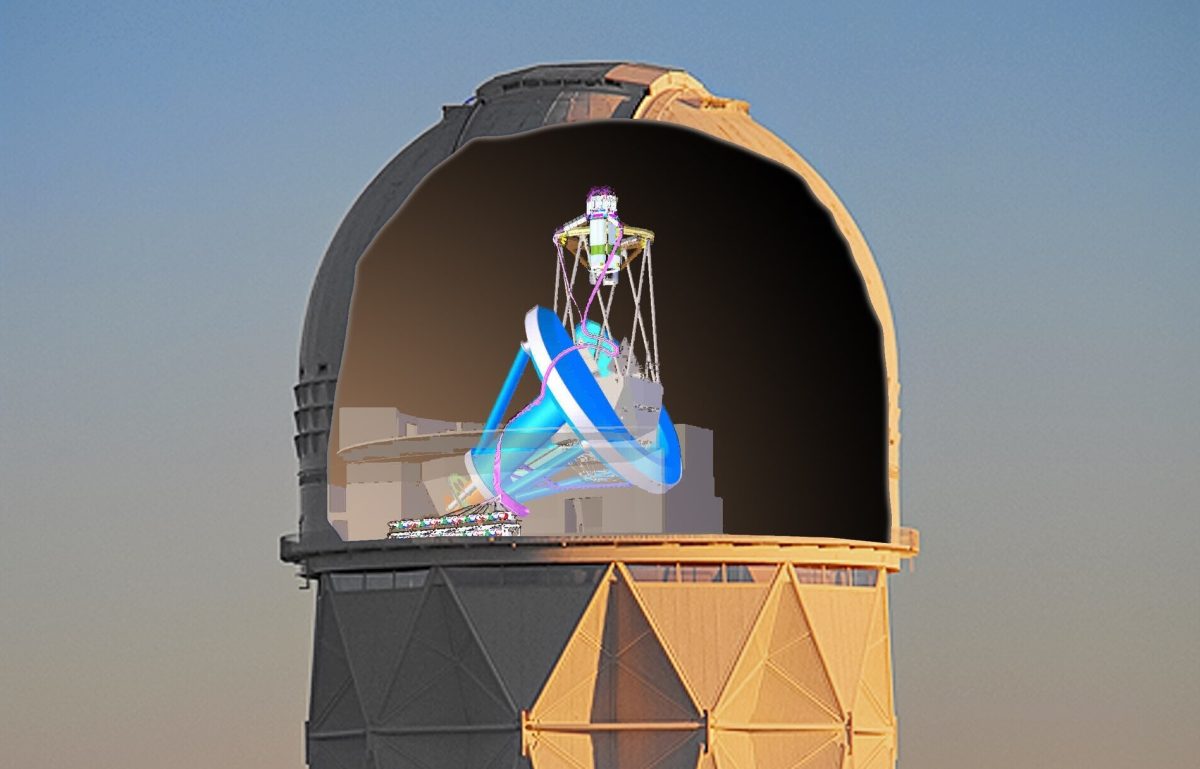
The Dark Energy Spectroscopic Instrument (DESI), located in the Arizona desert, was built to study the history of the Universe’s expansion using data from distant galaxies. However, during the five-year survey, observing conditions were not always suitable for its primary objectives.
Rather than lose valuable observing time, members of the collaboration redirected the instrument toward much closer objects. This provided them with a large sample of white-dwarf spectra, including several stars with exceptionally high concentrations of heavy elements. The findings were published in the peer-reviewed journal Monthly Notices of the Royal Astronomical Society.
Polluted Atmospheres
Stars with masses similar to that of the Sun leave behind a hot, dense core surrounded by a thin envelope of hydrogen and helium during the final stages of their evolution. Rocky bodies that once orbited at a safe distance may eventually be pushed into inner orbits by gravitational interactions, where tidal forces tear them apart.
Material from these fragments settles onto the surface of the white dwarf and mixes with its gaseous outer layer. In astrophysics, all elements heavier than helium are referred to as metals. Such elements should not be present in the pristine atmosphere of a white dwarf, so their appearance indicates that material is arriving from an external source.
Heavy elements do not remain in the atmosphere for long because the star’s powerful gravity draws them into deeper layers over periods ranging from several days to millions of years. Their very presence in the spectrum therefore means that material is still falling onto the star.
Rare Spectra
Signs of metals can be detected in between 20% and 50% of the hundreds of thousands of known white dwarfs. However, active accretion of planetary material has been recorded in only slightly more than 1,750 of them.
An even smaller proportion are suitable for precise measurements, because the spectrum must be altered strongly enough to allow researchers to calculate the relative abundances of individual elements. Only several dozen such objects are known, which makes them particularly valuable for observation.
Determining how typical the Solar System is in terms of its chemical composition requires a large sample of exoplanetary systems with measured material abundances. At present, there is no other way to obtain this information, as the study’s lead author, Paula Izquierdo of the University of Warwick, explained in comments to Phys.org.
A Familiar Chemical Composition
In the data from twelve selected objects, researchers were able to distinguish between three and ten heavy chemical elements, including oxygen, magnesium, silicon, calcium, and iron. The same elements form the basic composition of Earth and Mars.
Six of the spectra were sufficiently clear for detailed analysis. Four indicated dry rocky material, while pronounced oxygen lines in the other two pointed to oxidized compounds. These may have originated from water-rich planetesimals resembling the material from which the early Earth formed. Observations are continuing, and new white-dwarf spectra are being collected alongside data on distant galaxies.
