

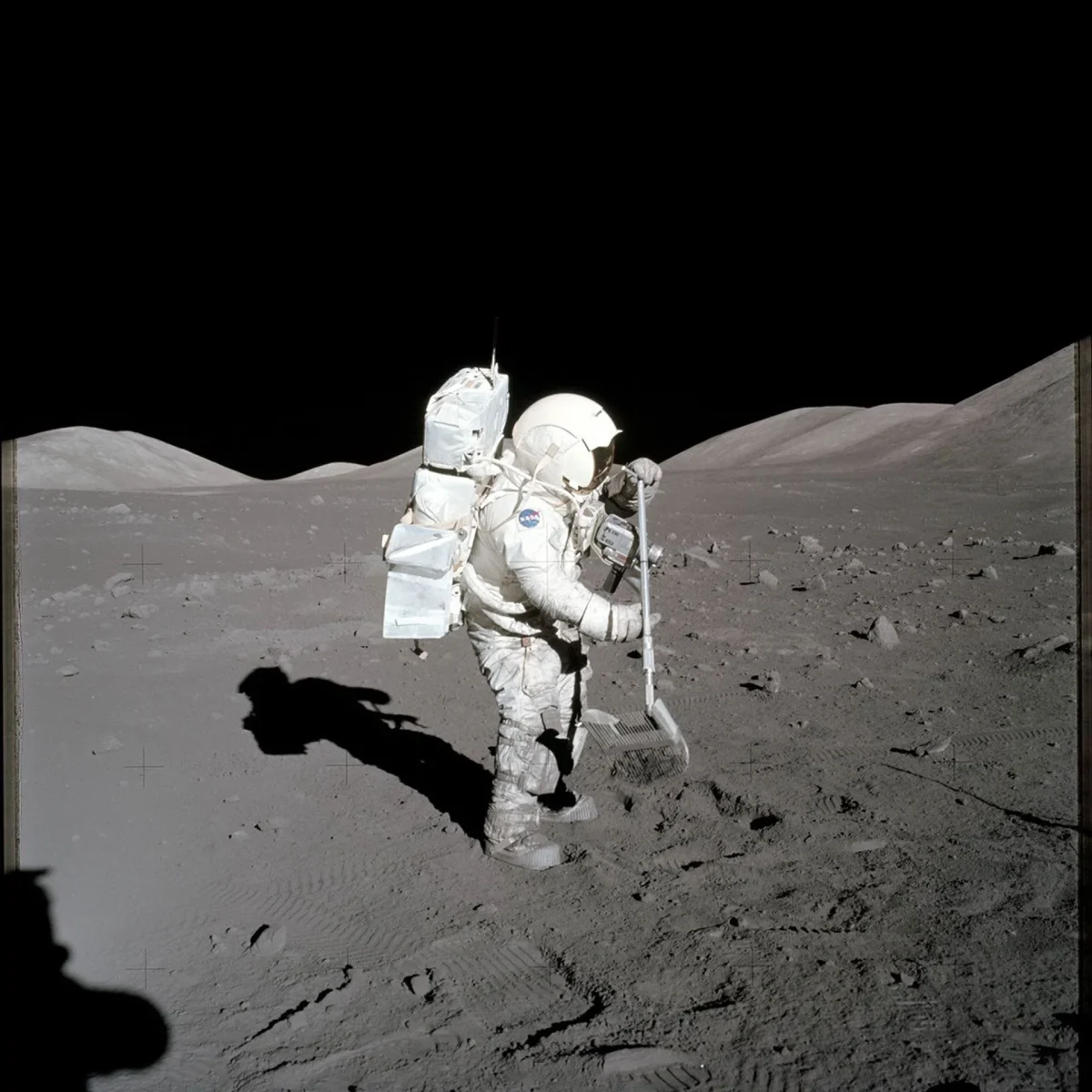
Soil samples brought back from the Moon more than half a century ago have unexpectedly become a source of information about our planet’s distant past. Earth’s surface is constantly being renewed, so no direct traces of its primordial atmosphere have survived here. Its natural satellite proved to be a more reliable archive. An analysis of the old samples showed that Earth’s gaseous envelope once had a very different chemical composition.
Traces of Earth’s Gases
Material from the upper layers of Earth’s atmosphere has been settling on the lunar surface for billions of years. It first loses electrons and becomes electrically charged, then travels with the magnetized solar wind.
Universe Today reported on a presentation by Jared Landry, an astrobiology graduate student at the Earth-Life Science Institute (ELSI) in Tokyo. The presentation was given at the Origins 2026 conference in Paris, so the findings have not yet undergone peer review.
The transfer continues today, but the researcher was interested in a period approximately 3.5 billion years ago—the Archean eon, which lasted from 4 to 2.5 billion years ago. Gases escape through a narrow outflow channel that the Moon passes through during only a small portion of its orbit.
Jared Landry had to account for this feature to estimate the actual amount of material deposited. All samples returned under the Apollo program were collected on the Moon’s near side, which was the side exposed to the stream coming from Earth. The Moon has neither plate tectonics nor weathering, so its thin layer of regolith remains an accessible archive in which material from Earth’s atmosphere may have remained unaltered for billions of years.
Sulfur in the Archean Ocean
The principal finding is that the lunar samples support the hypothesis that Earth’s Archean atmosphere contained much more sulfur than it does today. Such a composition would have created conditions for prebiotic and biological transformations in an aquatic environment.
Significant quantities of sulfur entered the ocean at that time, creating favorable conditions for the synthesis of complex organic compounds. Sulfur is difficult to retain in the atmosphere, so some mechanism that no longer exists today must have been operating. According to Jared Landry, this would have required either a weak water cycle or a cool climate, neither of which resembles conditions on modern Earth.
The Faint Young Sun Paradox
The Sun’s luminosity 3.5 billion years ago was substantially lower than it is today. Previous estimates suggested that the ocean on the young Earth could have remained unfrozen only under a strong greenhouse effect requiring carbon dioxide at a pressure equivalent to approximately one-tenth of the present atmospheric pressure.
Jared Landry’s model produces a value slightly below that threshold. According to the calculations, the Archean atmosphere contained approximately one hundred times more carbon dioxide than it does today, and together with methane, this was sufficient to keep surface water in a liquid state.
To obtain this result, the researcher had to account for the ancient solar-wind flux and the amount of fine-grained meteoritic material deposited on the regolith. The model calculates all known sources of material for each individual sample. Anything that cannot be explained by those contributions can only be attributed to material originating from Earth.
What Comes Next
The next step is to determine how warm the Archean Earth was and what its ocean looked like. Jared Landry hopes to establish which chemical compounds were available and what reactions they could have initiated.
This approach can be used for any system consisting of a solid planetary body and its natural satellite. It could therefore be applied to Mars and Phobos and, eventually, to icy bodies in the outer Solar System. Landry himself believes that prebiotic chemistry on the young Earth was not more advanced than expected—it was simply different.
