

Scientists say that water droplets in the geysers on Saturn’s moon Enceladus freeze much more slowly than previously thought. This allows the substances they contain to separate and become concentrated within individual ice particles. As a result, these substances—including potential signs of life—could be easier to detect.
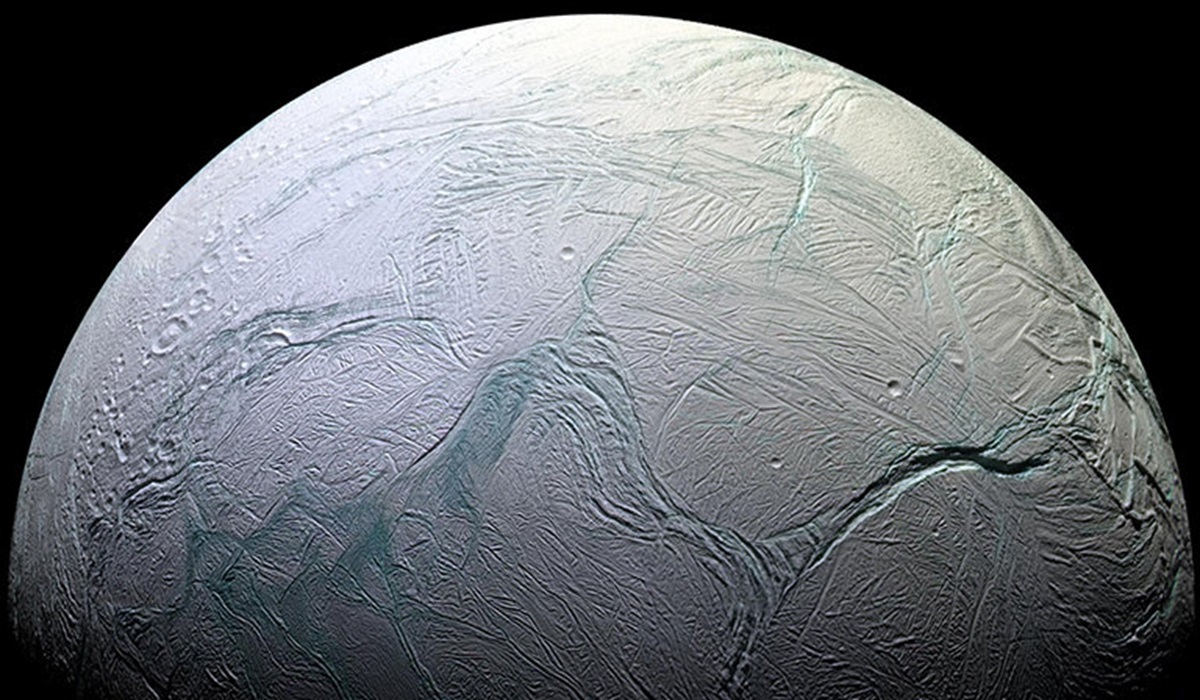
Geysers on Enceladus
The subsurface ocean on Saturn’s small moon Enceladus is the only extraterrestrial body of water from which scientists have directly analyzed samples. The findings are promising: material ejected into space contains not only dissolved salts but also organic compounds. And, as Phys.org reports, researchers believe there is much more to discover.
The findings come from a study led by researchers at Freie Universität Berlin and recently published in Science Advances. It suggests that detecting biosignatures—chemical or other measurable indications of biological activity—in Enceladus’s ocean could be easier than previously thought.
Enceladus is a small celestial body with a rocky core surrounded by an icy shell. Tidal deformation caused by Saturn’s gravitational pull generates heat inside the moon, helping maintain liquid water beneath the ice. Evidence of this hidden ocean comes from the enormous plumes that erupt through cracks in the surface. The moon’s weak gravity allows the ejected material to reach heights of several hundred kilometers.
How Water Reaches Enceladus’s Surface
Several kilometers of ice separate Enceladus’s ocean from space. Before ocean material can escape, tiny water droplets must form and travel through cracks in the ice shell, carried upward by water vapor. The researchers reconstructed this process using spacecraft observations, laboratory experiments, and theoretical models. They found that the droplets freeze much more slowly than previously assumed.
This slow freezing gives the dissolved substances time to separate. Different salts and organic compounds accumulate in different regions within each freezing droplet, creating pockets of higher concentration. As the frozen droplets travel through the cracks, collisions with the icy walls can shatter them into smaller fragments. Individual fragments may therefore contain a distinctive, highly concentrated mixture of substances.
NASA’s Cassini spacecraft provided the observations that revealed the ocean’s chemical complexity, including the presence of salts and organic compounds. Future missions will seek more specific evidence that could indicate biological activity.
Although spacecraft instruments face limitations compared with laboratories on Earth, the natural concentration of substances in individual ice grains could make their task easier. If biological material is present, it may be concentrated in only a small proportion of the particles rather than spread thinly throughout the plume. A spacecraft would need to analyze many individual grains, but encountering one enriched in such material could make potential signs of life much easier to identify.
