

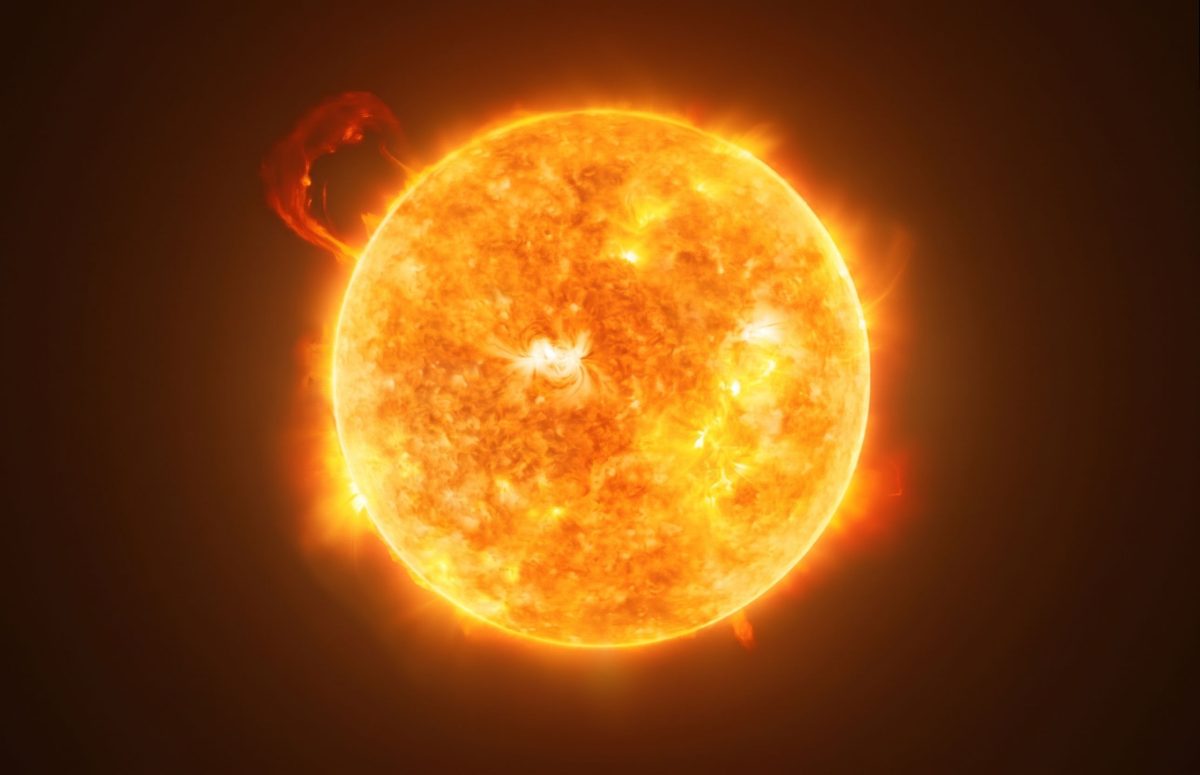
Our Sun is physically capable of producing a superflare, a type of event that until now has only been observed on other similar stars. Astrophysicists from Germany and the United States reached this conclusion by extending statistics from modern solar eruptions to the largest sunspots recorded over the past century and a half. The record-holder, observed in the mid-20th century, was large enough to make such an event possible, although it is unknown whether it actually produced a flare of that magnitude.
The Largest Sunspot Group
Astrophysicists use the term superflares for sudden bursts of energy more powerful than any event ever recorded instrumentally on the Sun. According to data from the Kepler space telescope, such events occur on stars similar to ours roughly once per century. Whether the Sun itself is capable of producing one has remained an open question, because some calculations suggested that the energy of its flares could not reach this threshold.
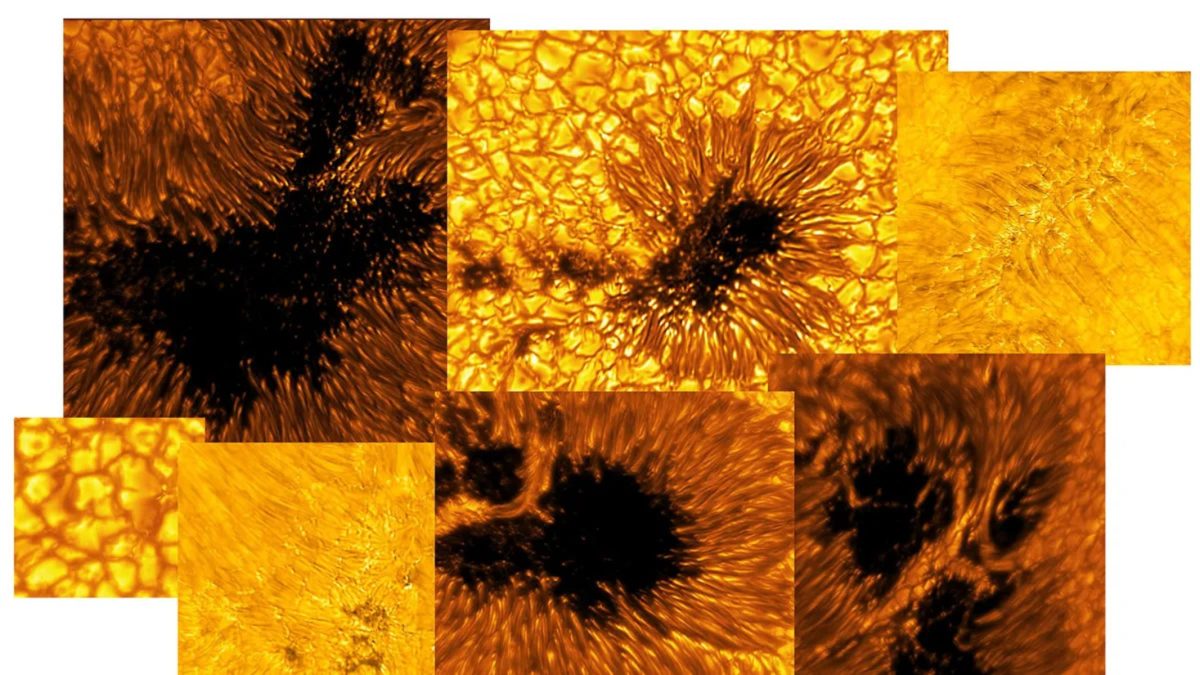
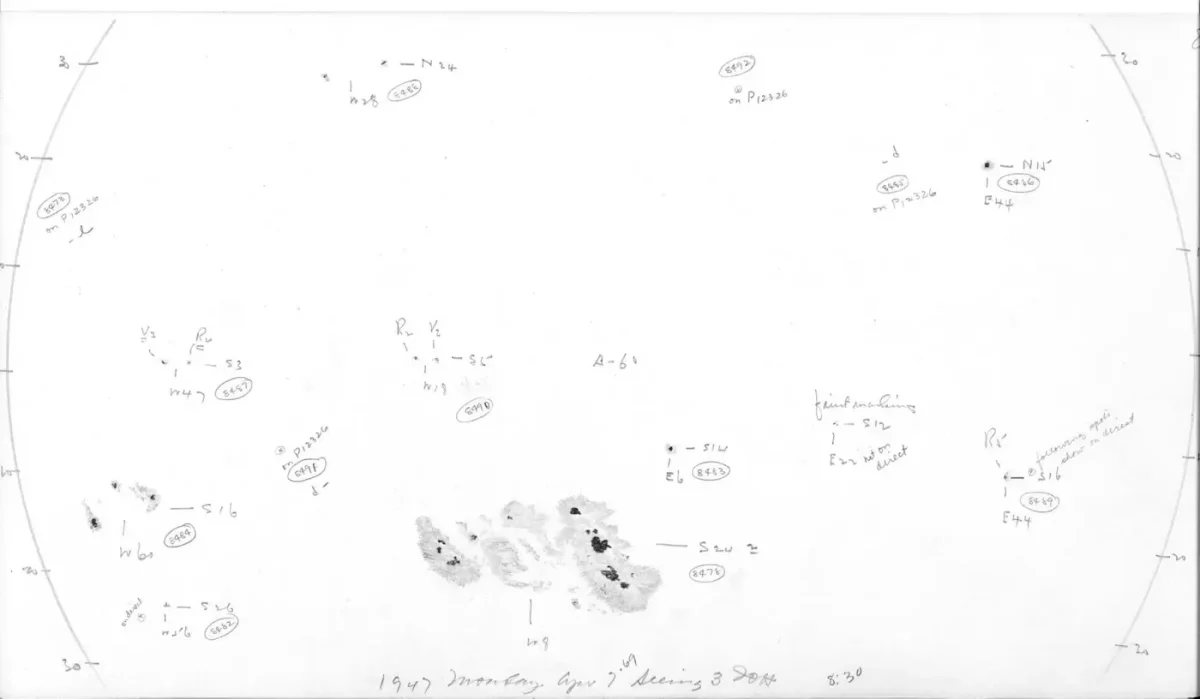
Researchers decided to test this using a sunspot group observed by astronomers in April 1947. No larger group has been recorded throughout the history of systematic observations.
Sunspots are only the dark cores of active regions, areas of strong magnetic field that store energy for flares. According to the authors’ calculations, an active region of this size, under the most favorable conditions, could release more than 10³⁴ ergs. This marks the lower end of the range in which superflares are detected. At today’s level of energy consumption, that amount of energy would be enough to power humanity for more than one and a half million years.
How the Energy Was Calculated
There are no direct measurements from 1947, so the estimate had to be based on modern data. A team led by Natalie Krivova of the Max Planck Institute for Solar System Research, together with colleagues from the University of Colorado Boulder and the U.S. National Solar Observatory, analyzed more than three thousand flares recorded by NASA’s Solar Dynamics Observatory between 2010 and 2016.
During each flare, bright ribbons appear in the solar atmosphere, marking the area where the magnetic field has reconfigured. The larger the area covered by these ribbons, the more energy is released.
The authors compared the size of these flare ribbons with the size of the entire active region and used not average values, but the most powerful known cases. This allowed them to estimate the upper limit of flare energy as a function of sunspot scale. The researchers published their results in the peer-reviewed journal Philosophical Transactions A, with the full text available on arXiv.
Testing the Method on Known Storms
The method was first tested on events whose energy had already been measured. The estimate for the flare of July 14, 2000 almost exactly matched observational data.
The estimate for the 1859 sunspot group also agreed with independent reconstructions. That group preceded the Carrington Event, considered the strongest geomagnetic storm in recorded history. As Universe Today recalls, the sky over the Caribbean glowed so brightly that people could read newspapers at night, while telegraph poles and stations caught fire on their own.
Flares Without Ejections
A large sunspot alone does not necessarily mean a threat to Earth. In October 2014, one of the largest active regions of the modern era produced eight flares of the highest class, but none was accompanied by a coronal mass ejection, meaning an eruption of plasma into interplanetary space. A strong magnetic field above the region kept the material confined near the Sun.

Active regions often appear in clusters, close to one another. When several neighboring regions merge into one, the amount of stored magnetic energy increases, as happened before the May 2024 storm. For this reason, the researchers consider their estimates for individual sunspot groups to be conservative.
The Frequency Still Needs to Be Determined
The authors emphasize that they did not investigate how often such eruptions might occur on the Sun. The figure of “once per century” applies only to other stars. It is also unknown whether the giant 1947 sunspot group actually produced even a single flare of comparable power.
A coronal mass ejection from such an event, if directed toward Earth, could disable power grids across entire regions for several months. Determining how often such events occur will now require models of the magnetic structure of active regions and reconstructions of ancient solar storms based on isotopic traces in tree rings.
