

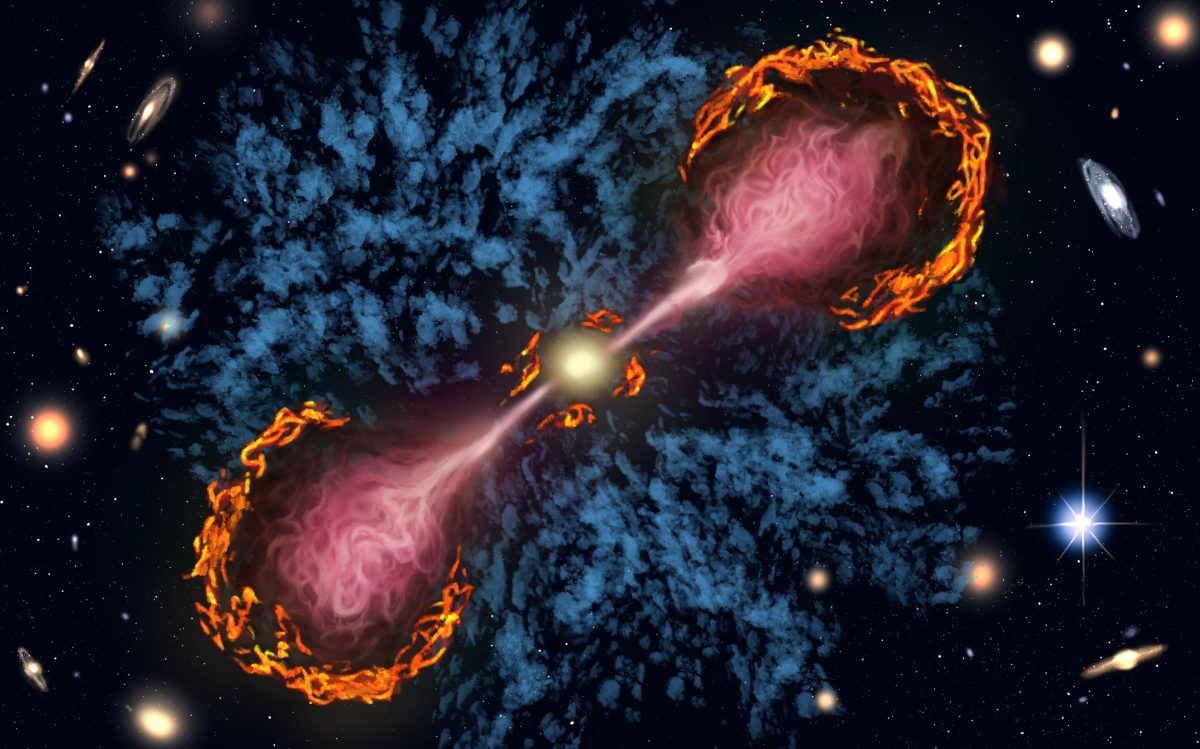
Supermassive black holes are capable of affecting gas far beyond the visible edges of their galaxies. Jets of hot plasma erupting from the vicinity of such objects heat hydrogen along their path and cause it to glow. This gas may not have enough time to cool and collapse into new stars. This may be why a significant amount of raw material for new stars remains around galaxies without ever becoming stars.
Light Along the Jet
Every large galaxy is surrounded by a vast gaseous envelope that astronomers call the circumgalactic medium. The hydrogen in it glows so faintly that detecting it requires combining data from hundreds of systems. Astronomers led by Sanchayita Borthakur of Arizona State University and Namrata Roy, who now works at the Raman Research Institute in India, did exactly that with galaxies that have active plasma jets. The optical data came from the Dark Energy Spectroscopic Instrument (DESI) survey, while the direction of the outflows was determined using the Two-metre Sky Survey (LoTSS) carried out with the Low Frequency Array (LOFAR).
Previous attempts to detect such emission had failed. The signal appears only in the direction of the jet, so if one assumes that the envelope is the same in all directions, it is easy to miss. The measurements were therefore combined specifically along the jet axes, where the researchers searched for the H-alpha line, a characteristic signature of ionized hydrogen.
The signal averaged over all directions was barely visible. Along the jets, however, the emission became clear and strong.
The maximum brightness occurs in two zones. The first is located close to the galaxy itself, where the jet first enters the gaseous envelope, while the second lies near its outer edge, where the plasma flow releases most of its energy. According to Namrata Roy, the black hole’s influence extends for hundreds of thousands of light-years.
Material for New Stars
The circumgalactic medium is 10 to 20 times larger than the visible part of a galaxy. For a system the size of the Milky Way, whose disk is about 100,000 light-years across, this means a million light-years or more. This matter gradually cools, falls inward, and gathers into dense clumps from which stars form. Astronomers have long been puzzled by why, with such large reserves of material, relatively few new stars are formed.
As Phys.org reports, citing Arizona State University, the jets may heat and disturb gas throughout the entire envelope. Material heated in this way does not have enough time to cool and fall toward the galaxy’s central regions, so star formation slows down and may eventually almost stop. The difference in scale is enormous: the black hole itself is roughly the size of the Solar System, while its galaxy could contain about 100 billion such systems.
Magnesium as a Control
The team traced cooler gas separately using the magnesium absorption line. Unlike the hydrogen emission, magnesium was distributed evenly and showed no dependence on the orientation of the jets.
The authors suggest that such a cool reservoir may surround the galaxy in all directions regardless of the jet. The jet simply heats and ionizes the material along its path, causing it to glow in the H-alpha line.
The results were published in the peer-reviewed journal The Astrophysical Journal Letters. Co-authors include Timothy Heckman of Johns Hopkins University and Tanmay Singh of Arizona State University.
A Trace in Our Galaxy
The Milky Way also has a circumgalactic medium, and its central black hole, Sagittarius A*, may once have released energy far beyond the galactic disk. This is suggested by the Fermi bubbles, two enormous structures of hot gas discovered in 2010 in gamma rays using data from the Fermi Space Telescope. They extend about 25,000 light-years above and below the plane of the Galaxy. One hypothesis links them to a burst of activity from Sagittarius A* several million years ago.
Galaxy evolution theorists now have a way to test observationally how jets distribute energy in the surrounding gas. The orientation of the jet determines where matter is heated and where it remains fuel for new stars.