

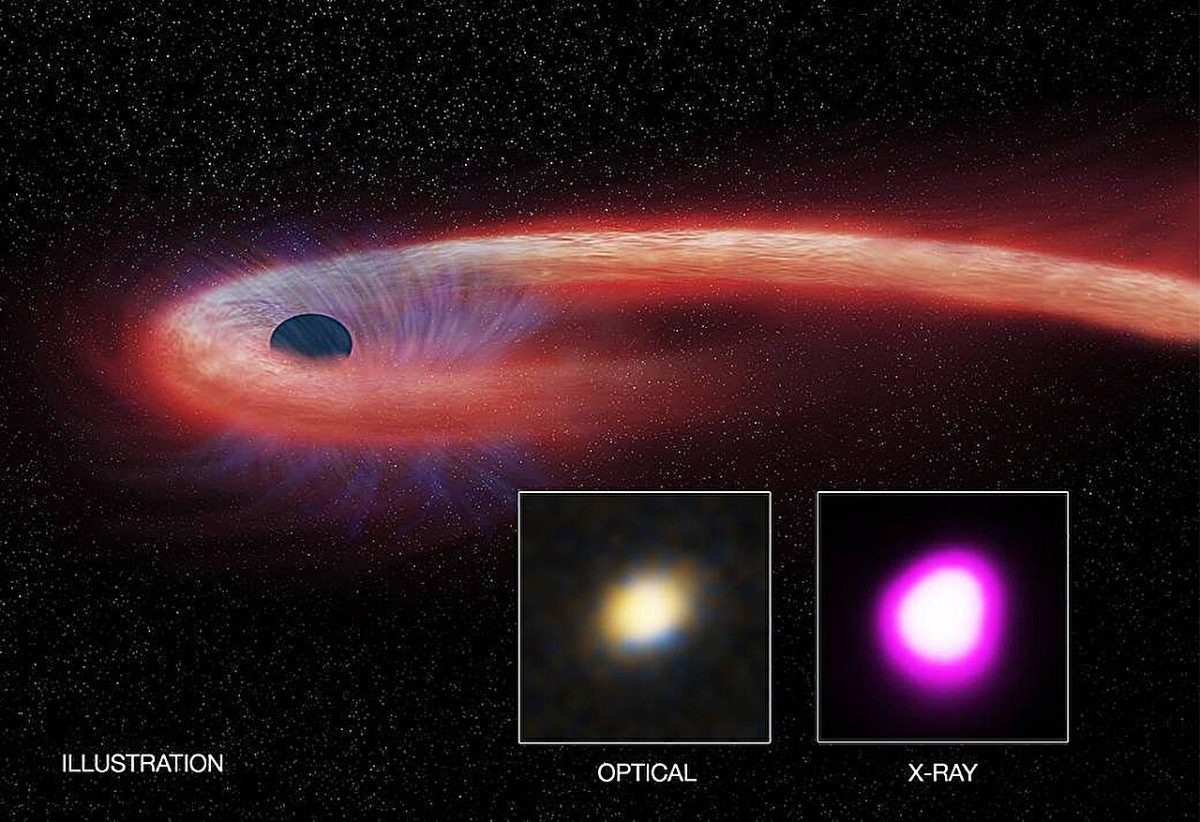
Powerful plasma jets from black holes are launched at a specific stage as matter falls onto them. This applies both to objects with masses of about ten Suns and to giants at the centers of galaxies. Astrophysicists from Australia and the United States compared two dozen cases of stellar disruption and found a common threshold. The physics of jet launching, apparently, does not depend on the mass of the object.
A Two-Percent Threshold
Radio emission after a star is disrupted appears for a second time when the rate at which matter falls onto the black hole decreases to about 2% of the Eddington limit. Jets switch on at exactly this level in stellar-mass black holes in our Galaxy, something that has been known from X-ray observations for more than two decades.
The Eddington limit is the luminosity at which outward radiation pressure balances gravity. For a black hole with a mass of one million Suns, two percent of this limit corresponds to a luminosity of about 650 million Suns, while for an object with a mass of ten Suns, the same fraction produces only about six thousand. The same proportion, but completely different absolute values.
Disrupted Stars as a Tool for Scientists
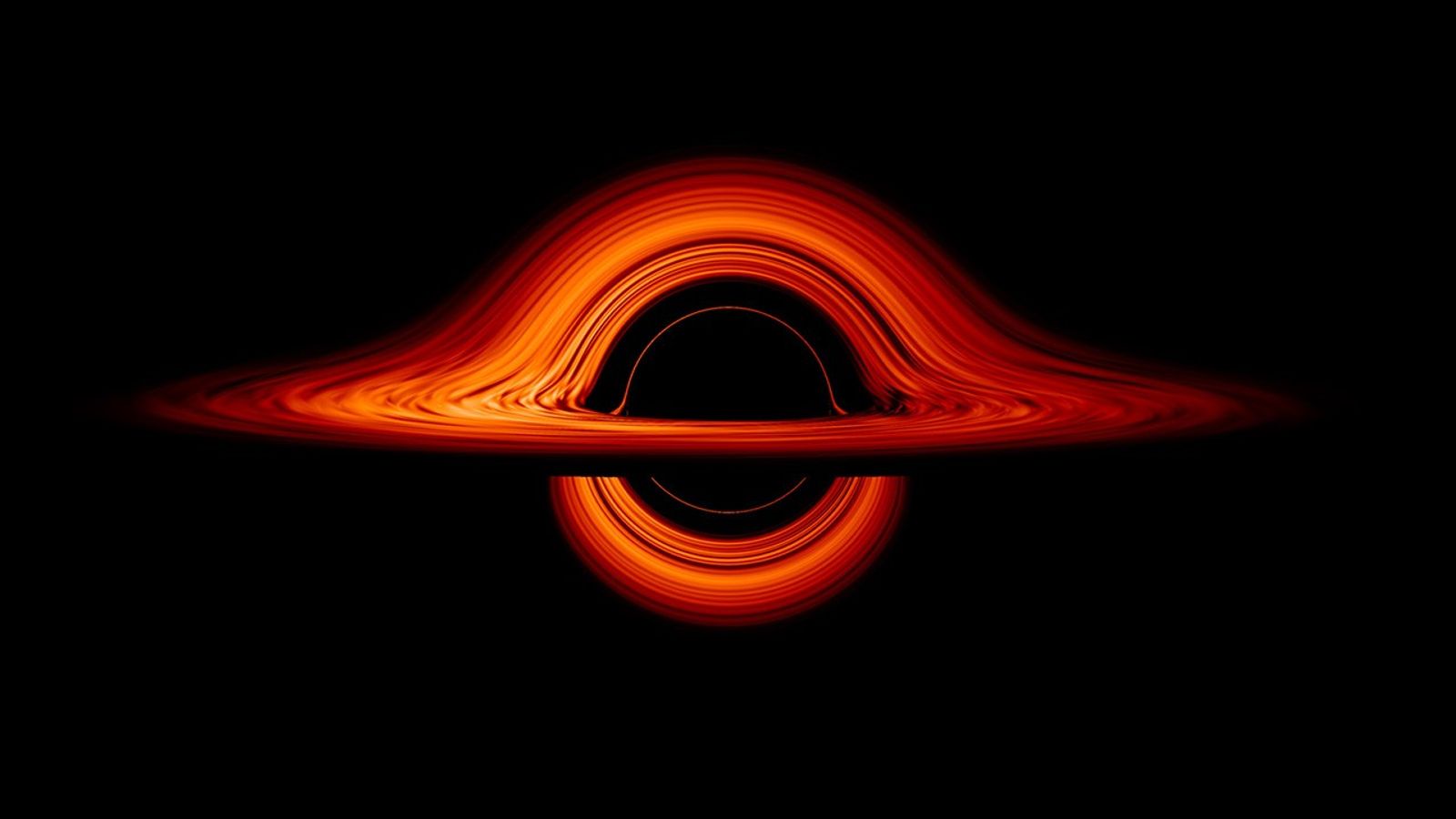
The idea that the physics of accretion is the same at all scales has existed for a long time, but it had not been possible to test it for supermassive black holes. The disks around them change over thousands of years, making it impossible to follow a complete cycle within a single system.
Tidal disruption events provided a solution. They occur when a star passes too close to a supermassive black hole and tidal forces tear it apart. Such an event compresses the evolution of the disk into just a few years. The authors of the study, published in the peer-reviewed journal Nature Astronomy, collected optical, ultraviolet, X-ray, and radio data for 20 such events, and for 10 of them they were able to model both the accretion rate and the timing of the radio outburst.
Two Waves of Ejection
The first ejection of matter occurs shortly after the star is disrupted, while the accretion rate exceeds the Eddington limit. In this phase, the jet forms under conditions of an excess supply of material.
The second wave comes much later, hundreds to thousands of days after the event. In physical terms, this is a separate process rather than a continuation of the first one.
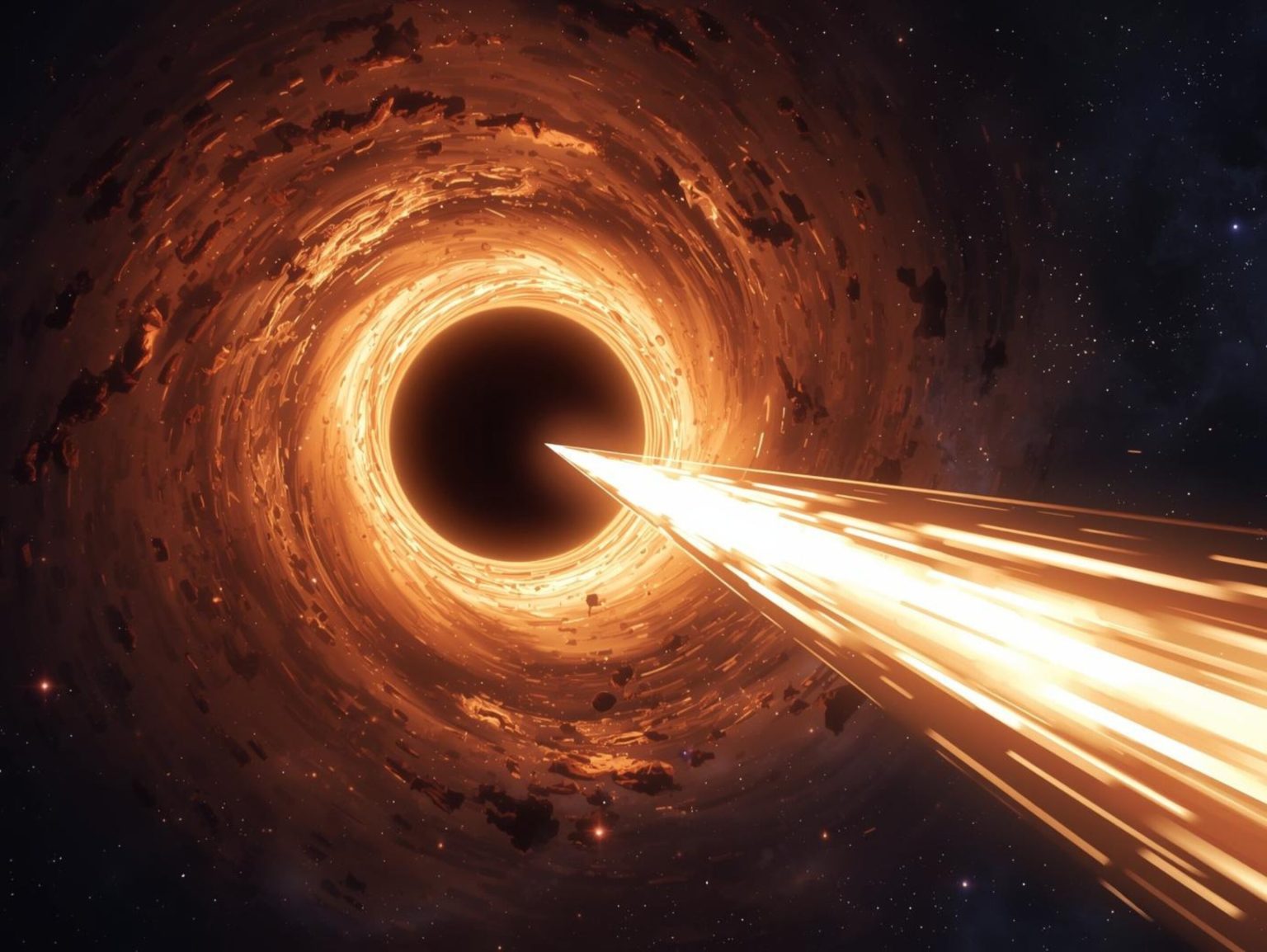
The difference in timing was precisely the mystery. In some events, the radio jet was detected almost immediately, while in others the signal appeared months or years later. According to Adelle Goodwin, whose comments are cited by phys.org, delayed jets appeared when the accretion rate dropped to the same critical threshold long known from much smaller black holes.
When to Point Radio Telescopes
Knowing the right moment provides a practical way to save observing time. Radio telescopes are among the most expensive scientific instruments, and competition for observing hours is intense, so more precisely targeted follow-up campaigns can reduce the number of wasted observations.
For Western Australia, the issue has particular importance because the low-frequency component of the Square Kilometre Array (SKA) is being built there. The Australian government has invested 387 million Australian dollars in the project, while the total cost of the observatory exceeds 2 billion.

Testing the Rule with New Surveys
The insight came not at a telescope control console, but in a bar in Madrid during a conference, where Adelle Goodwin and Andrew Mummery compared their results and noticed the same threshold in two classes of objects. Adelle Goodwin works at the International Centre for Radio Astronomy Research (ICRAR) at Curtin University in Perth, while Andrew Mummery represents the Institute for Advanced Study in Princeton.
Future sky surveys will detect far more disrupted stars than current ones. Decisions about which events should be followed with radio telescopes and exactly when observations should begin can now be based on a specific physical signature, while the final test of the rule will come from these future observing campaigns.
