

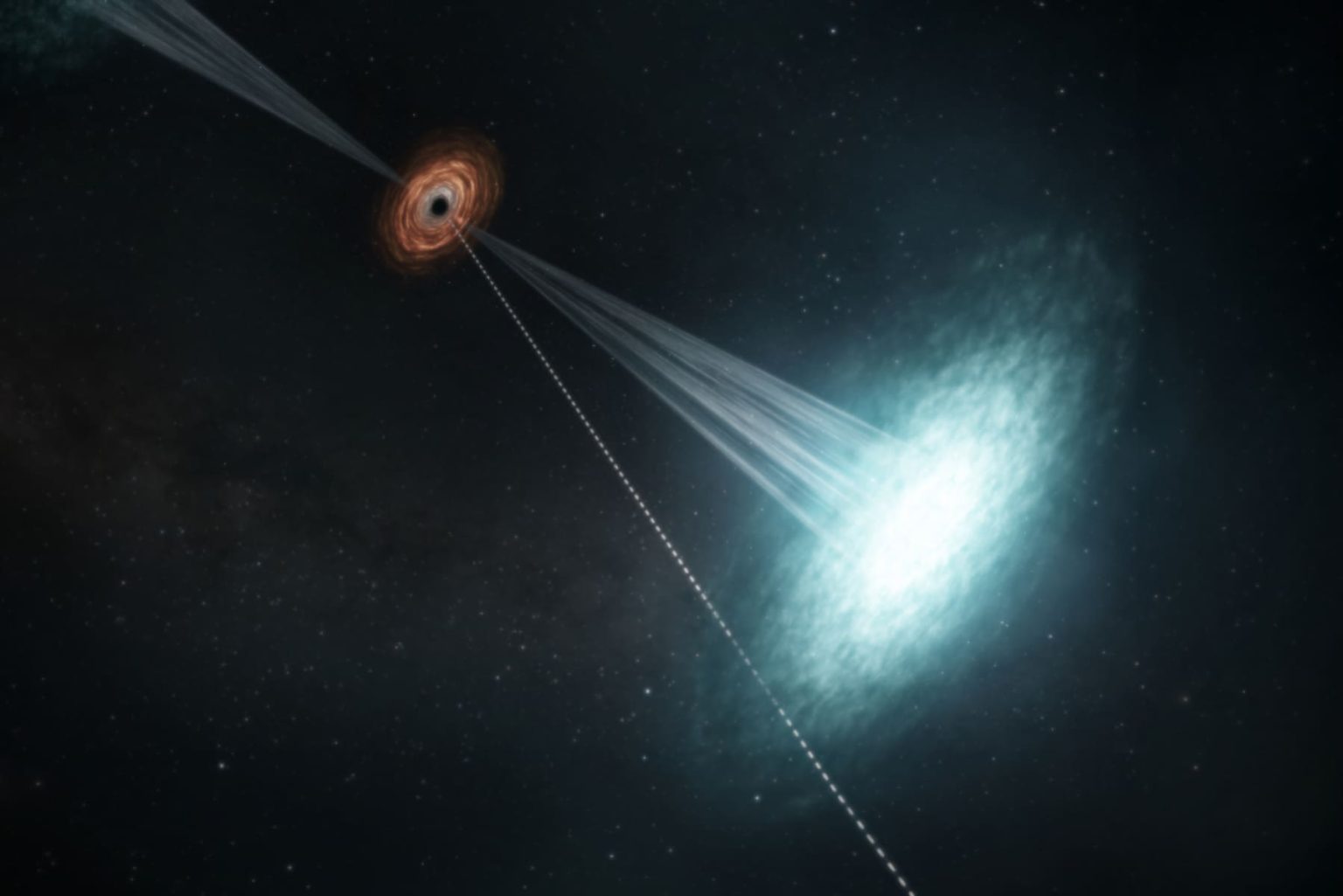
In a distant dwarf galaxy, a rare event was recorded. The gravity of an intermediate-mass black hole tore apart a star, and radio waves from the ejected matter continued to grow for years after the initial flare. Thanks to this feature, astronomers have obtained a new way to search for objects that until now have almost never appeared in observations.
A fast peak, a slow fading
The event, designated AT2019ijn, was observed at a distance of 3.4 billion light-years from Earth. In optical sky surveys, it appeared as a bright blue flash that reached its maximum in just a few days, Universe Today reports. The source then faded for much longer than similar transients usually do.
When astronomers later reviewed archival radio observations, the picture turned out to be even stranger. The intensity of the radiation increased for almost two years, until it significantly exceeded the luminosity of other stellar explosions. After that, the signal gradually weakened for at least four years.
The missing link
A team of Chinese astronomers concluded that a tidal disruption had occurred. A star came too close to an intermediate-mass black hole, and gravitational forces shredded it into streams of gas. The results were published in the peer-reviewed journal Astrophysical Journal Letters.
This category covers the range from 100 to 100,000 solar masses. It fills the gap between stellar-origin black holes, which arise after the collapse of large stars, and supermassive black holes, located at the centers of most galaxies.
Until now, the strongest evidence for the existence of intermediate-mass black holes had been the gravitational wave GW190521, detected in 2019. At that time, the merger of two lighter objects produced a body with a mass of about 142 solar masses.
Antennas on three continents
The optical data were compared with radio measurements from the Very Large Array, or VLA, in the United States, NRAO reports. In particular, scientists processed VLASS, a full-sky survey carried out with this instrument and one of the largest programs of its kind. They also used the Australian Square Kilometre Array Pathfinder, or ASKAP, and the upgraded Giant Metrewave Radio Telescope, or GMRT, in India.
Thanks to this broad coverage, scientists traced how the AT2019ijn signal changed over time and tested models of expanding ejecta. The observed picture is best explained by a scenario involving a narrow relativistic jet directed perpendicular to the line of sight. Because of this orientation, the radio flare arrived with a long delay.
A hidden population
The results fit into a group of phenomena known as fast blue optical transients, or FBOTs. Such flares brighten rapidly over about ten days, and their color near peak brightness is shifted toward the blue part of the spectrum. This is followed by fading that lasts about a month.
Some of these events may previously have been discarded, because the most powerful phase of their radio emission arrives years after the glow in visible light. Using surveys that combine both ranges, researchers expect to find many more similar cases.
A method for future searches
Intermediate-mass black holes rarely come into view, so scientists have long wanted to detect them systematically. The AT2019ijn case has become exactly such a working example. At first, such an event looks unremarkable, but later it brightens sharply in the radio range, when the jet slows down and its afterglow becomes visible.
Such observations will help determine how these objects form and evolve. They will also clarify how often stars are destroyed near such bodies and under what conditions powerful outflows arise.
