
For many years, scientists believed they had sufficiently reliable evidence that an enormous amount of invisible matter surrounds the Milky Way. It could be nothing other than dark matter. However, an analysis of stellar streams around our galaxy shows that everything may be explained much more simply.
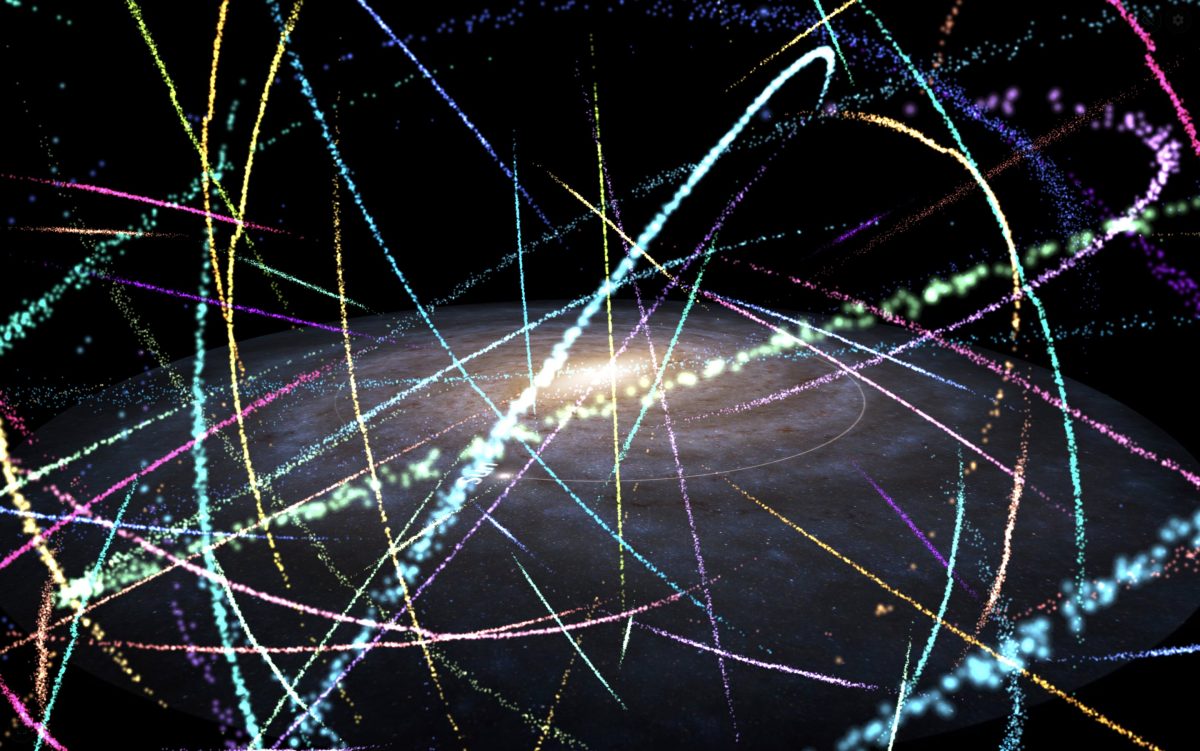
Dark Matter Around the Milky Way
Researchers from the University of Washington recently published a paper in The Astrophysical Journal that could potentially call the existence of dark matter into question. At least, as phys.org reports, the evidence for its presence near the Milky Way has been seriously challenged.
In general, dark matter is a hypothetical state in which most of the matter in the Universe is believed to exist. It does not reveal itself in any way except through its gravitational influence on very large scales, and therefore its existence still remains unconfirmed. There are several theories suggesting that the effects attributed to it can be explained in other ways. Moreover, it remains unclear what dark matter is actually made of.
Astronomers observe most evidence for the existence of dark matter in other galaxies. However, it should also exist near the Milky Way, surrounding it like a halo. Gaps and irregularities in the stellar streams around our galaxy have been cited as evidence of this.
Stellar streams themselves are ribbons of stars extending through space for hundreds of thousands of light-years. They form when a dwarf galaxy or globular cluster passes too close to the Milky Way. Its gravity then begins tearing them apart, and this process should, in principle, occur relatively evenly.
Simulation Results
It is precisely the irregularities and gaps in stellar streams that are considered evidence for the existence of dark matter around the Milky Way. In the new study, however, scientists attempted to determine whether these features might arise naturally. They turned to computer simulations: they modeled 15,000 stellar streams and allowed them to evolve under the influence of the Milky Way’s gravity alone.
In total, four galaxies the size of the Milky Way were generated, and each was allowed to evolve for 5 billion years. It turned out that stellar streams do indeed develop irregularities on their own, without any external force. This may be interpreted as meaning that dark matter is not required to explain them.
Scientists are not rushing to make any categorical claims. The problem is that far fewer stellar streams have been discovered around the Milky Way than were modeled in the simulations, which leaves room for statistical error. But it is also possible that we simply have not yet detected all of them. This is why scientists are waiting for new data from space telescopes, which should reveal more of these structures around us. Then it will become clearer just how common gaps and irregularities really are within them.
