

In 1991, geologists working for an oil company discovered a giant underground structure beneath the small town of Ames, Oklahoma. Further research revealed that it was a meteorite crater. For a long time, the scientific community regarded it as evidence of the Ordovician meteor event—a massive cosmic “bombardment” that Earth experienced approximately 467 million years ago.
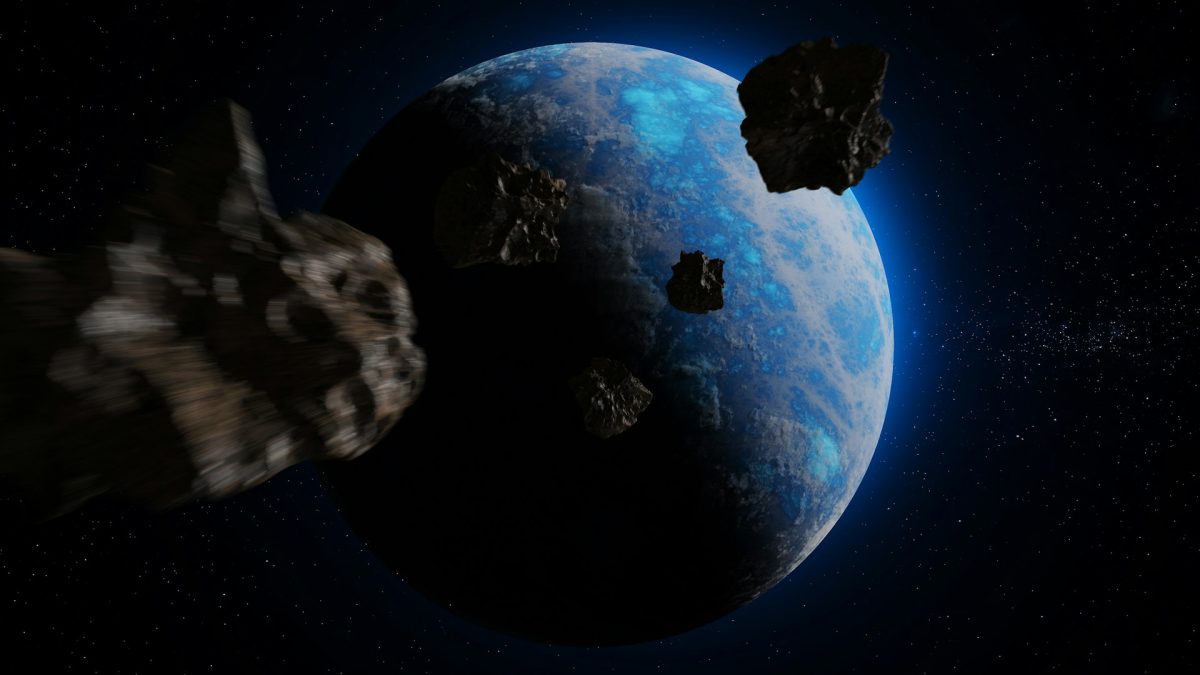
However, a new study published in Meteoritics & Planetary Science completely overturns this theory. An international team of scientists led by Elizabeth Catlos of the University of Texas at Austin has established that the crater is significantly younger than previously thought.
Zircon “Clocks”
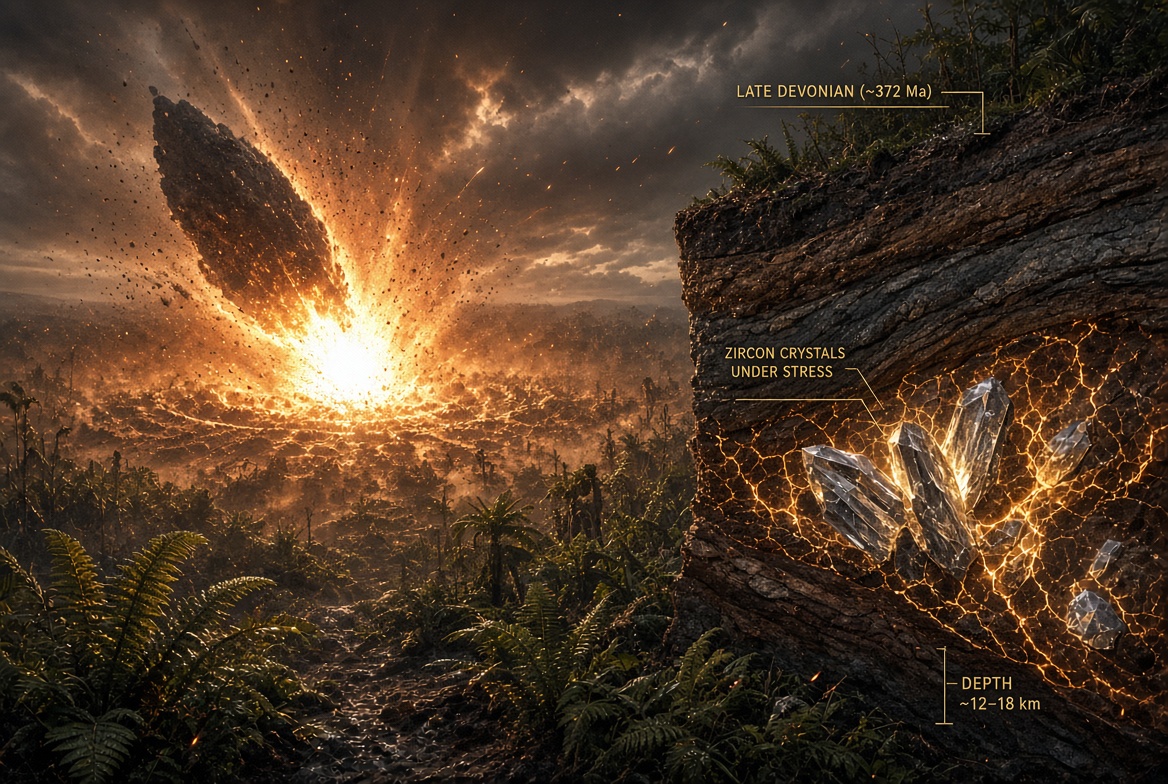
To determine the structure’s precise age, geologists collected zircon crystals directly from the impact site. Zircon is an exceptionally durable mineral that acts as a time capsule: the ratios of uranium and lead isotopes within it can be used to date geological events with great precision.
Using a series of analyses, the researchers identified clear signs of shock pressure characteristic of powerful meteorite impacts. To confirm that the crystals had been deformed specifically by a cosmic catastrophe, the geologists brought in NASA specialists.
The results were unexpected. Every method used pointed to the same date: the Ames crater formed approximately 370 million years ago, near the end of the Devonian period.
“Whichever technique we used, we kept getting the same result. Essentially, we are taking an important ‘piece’ out of the Ordovician event and moving it onto the chessboard of the Devonian extinction,” Elizabeth Catlos explains.
Crossed Out of History
The loss of the Ames crater dealt a significant blow to theories about the Ordovician meteor event. Approximately 15 kilometers in diameter, the crater had been considered one of the largest structures from that period.
The massive influx of chondrites 467 million years ago is thought to have generated so much dust that it caused global cooling and accelerated the flourishing of biodiversity on the planet. Craters like this served as key reference points for estimating the scale of the bombardment at the time. Now, the geological map of that era will have to be revised.
A New Suspect in the Catastrophe
Moving the date forward by 100 million years places the meteorite impact at another dramatic turning point—the Frasnian–Famennian, or Devonian, mass extinction. This event is considered one of the greatest catastrophes, during which an enormous number of species were wiped out.
Of course, the meteorite that left a crater 15 kilometers wide was too small to cause a global extinction on its own. Scientists still consider large-scale volcanism the primary driver of this crisis. Nevertheless, a cosmic impact of this magnitude, against a backdrop of an already unstable climate, could have added “fuel to the fire.”
Accurately reconstructing the chronology of such catastrophes helps us understand the complex workings of planetary systems and learn how the combination of internal volcanic forces and external cosmic factors can change the course of life’s evolution on Earth.
Previously, we discussed which asteroids struck Earth after the extinction of the dinosaurs.
Based on material from ScienceDaily.
