Four images were featured in NASA’s weekly selection. The James Webb Space Telescope revealed galaxies magnified and distorted by gravity. The Chandra Observatory helped explain the origin of a radio cloud shaped like a treble clef. Following the launch of the CRS-35 cargo mission, an agency photographer captured a glowing “jellyfish” over Florida, while SpaceX showcased small satellites beneath the Falcon 9 fairing. The following is a description of each image.
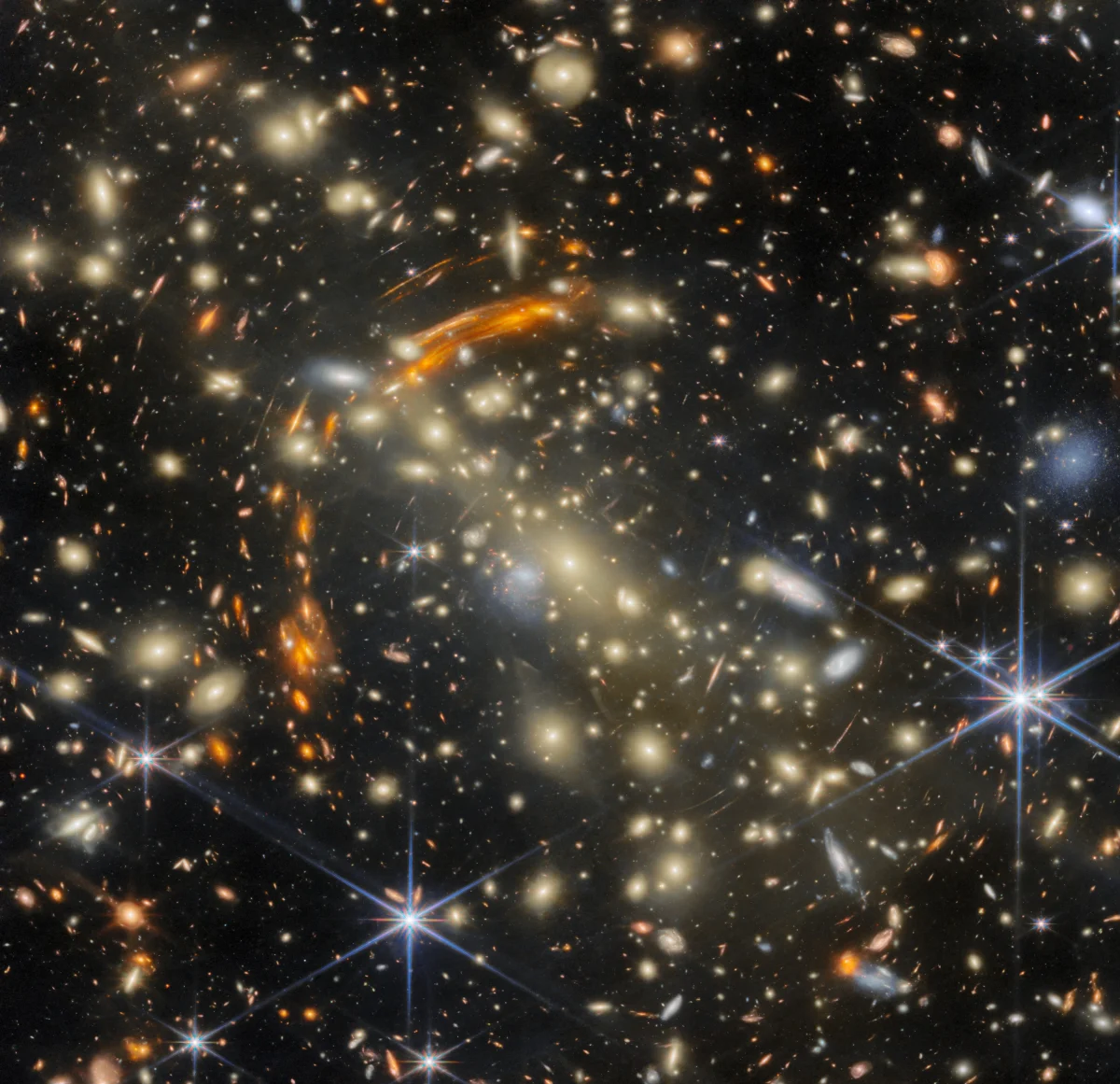
The mirror hall surrounding the MACS J0454 cluster
The James Webb Space Telescope captured an image of the MACS J0454.1-0300 galaxy cluster. Most of its members appear as golden elliptical galaxies, with the largest and brightest located at the center of the frame. Highly distorted orange galaxies are visible around it; the largest of these are arranged in a broad arc around the cluster’s center. These objects lie much farther away, and their light reaches us after passing through the cluster.
Astronomers refer to this phenomenon as gravitational lensing. The cluster’s immense mass warps spacetime, deflecting light from background galaxies. Their images are magnified, brightened, and distorted. A single distant galaxy may appear multiple times in an image as elongated copies of itself. NASA has compared such an image to a hall of mirrors. For scientists, the cluster functions as a natural telescope, enabling them to observe galaxies that are too faint to be seen directly.
ESA/Webb released the image on September 29, identifying it as an image of the Moon. On October 9, NASA added it to its “Image of the Day” collection.
The “Treble Clef” along the Milky Way
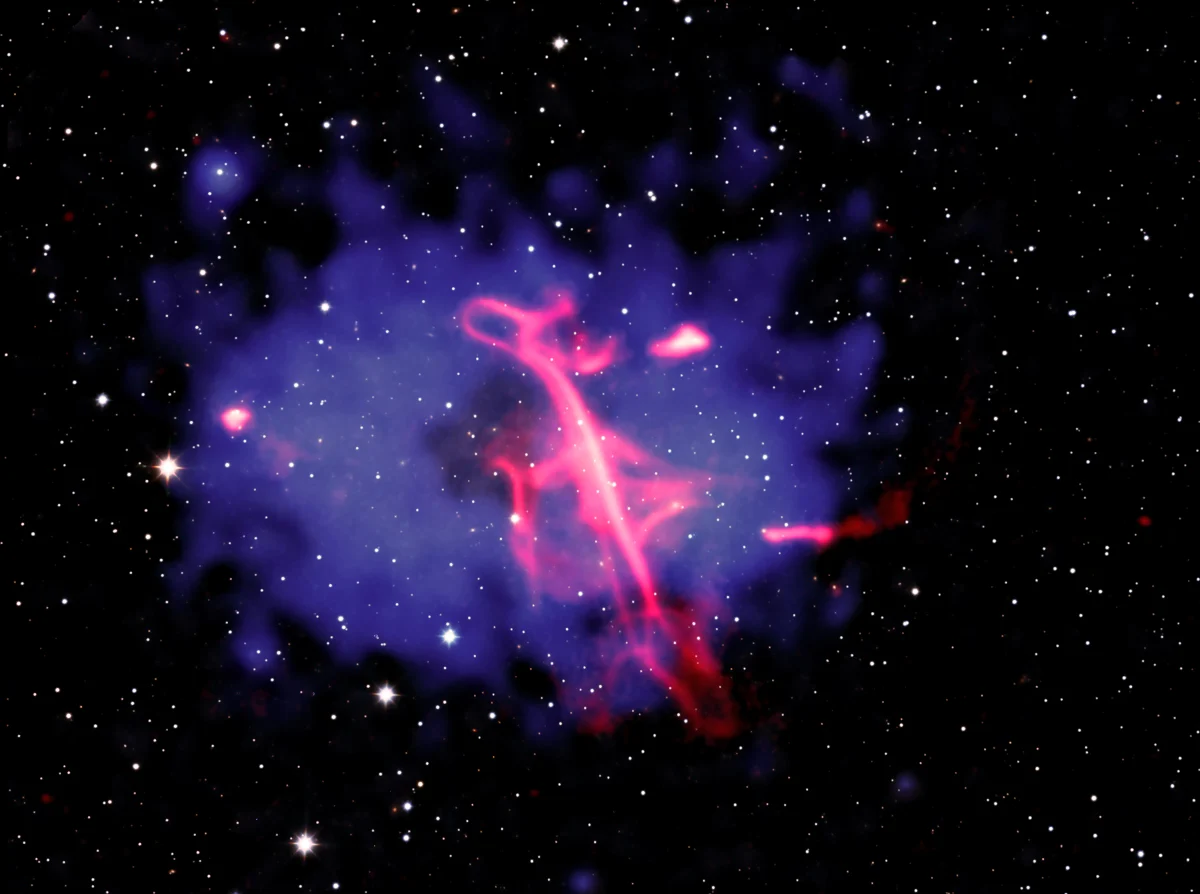
A radio source, which astronomers have nicknamed the “Treble Clef,” remained a mystery for an extended period. Located almost directly behind the plane of our galaxy, it is obscured from observers on Earth by the Milky Way’s stars, gas, and dust. Telescopes capable of penetrating this veil have helped clarify the mystery.
NASA’s Chandra X-ray Observatory and Germany’s eROSITA X-ray telescope have detected hot, diffuse gas at the “key” location. This type of gas permeates galaxy clusters, some of the largest structures in the universe, each comprising hundreds of galaxies. Further analysis revealed that two clusters are merging at this location.
In the composite image, gas with temperatures of millions of degrees is depicted in blue. Data from LOFAR, a European network of low-frequency radio telescopes, is shown in red; the musical symbol becomes visible in the radio band. Infrared data from the UK Infrared Telescope (UKIRT) appears predominantly white.
A team led by Andrea Botteon of Italy’s National Institute for Astrophysics (INAF) proposes a two-stage explanation. First, the supermassive black hole at the cluster’s center underwent an active phase, ejecting clouds of charged particles and magnetic fields at speeds approaching that of light. The cloud emitted intense radio waves and gradually faded as its particles lost energy. Several hundred million years ago, the clusters collided, compressing the aged cloud and re-energizing its particles, causing it to emit radio waves once again. Shock waves generated by the collision, analogous to the sonic boom produced by a supersonic aircraft, may also have contributed to this process.
The collision’s direction was determined using X-ray data. The researchers isolated a symmetrical oval component of hot gas in the image and analyzed the remaining data. The brightest regions were located to the left and right of the center, while the center was the dimmest. This distribution indicates that the clusters collided along the frame’s horizontal axis and are now moving away from one another.
The resemblance to a treble clef is coincidental. This phenomenon is an example of pareidolia, the brain’s tendency to perceive familiar shapes in random forms. The study was published in the journal “Astronomy & Astrophysics.”
A jellyfish located off the coast of Cape Canaveral
On October 13 at 6:33 a.m. Eastern Time (1:33 p.m. Kyiv time), a Falcon 9 rocket carrying the Dragon cargo spacecraft lifted off from Launch Complex SLC-40 at Cape Canaveral Space Force Station. This launch marked the commencement of Mission CRS-35, SpaceX’s 35th flight under a NASA contract to resupply the International Space Station. The spacecraft is carrying nearly 2.9 metric tons of cargo, including the latest set of iROSA deployable solar panels, which will increase the station’s power supply. It is also carrying equipment for manufacturing artificial retinas in microgravity and 3D models of heart tissue for drug testing.
The rocket launched before dawn, and NASA photographer John Kraus captured the so-called “jellyfish.” Although the Earth remained shrouded in darkness, the rocket’s exhaust had risen into the upper layers of the atmosphere, where it was already illuminated by sunlight. Because air pressure is very low at that altitude, the gases expand into a broad dome, beneath which luminous “tentacles” stretch out. The trail was visible in many states across the eastern United States.
The uncrewed Dragon spacecraft was scheduled to dock autonomously with the Harmony module on October 15. It will remain at the station for approximately one month before returning the experimental results and equipment to Earth.
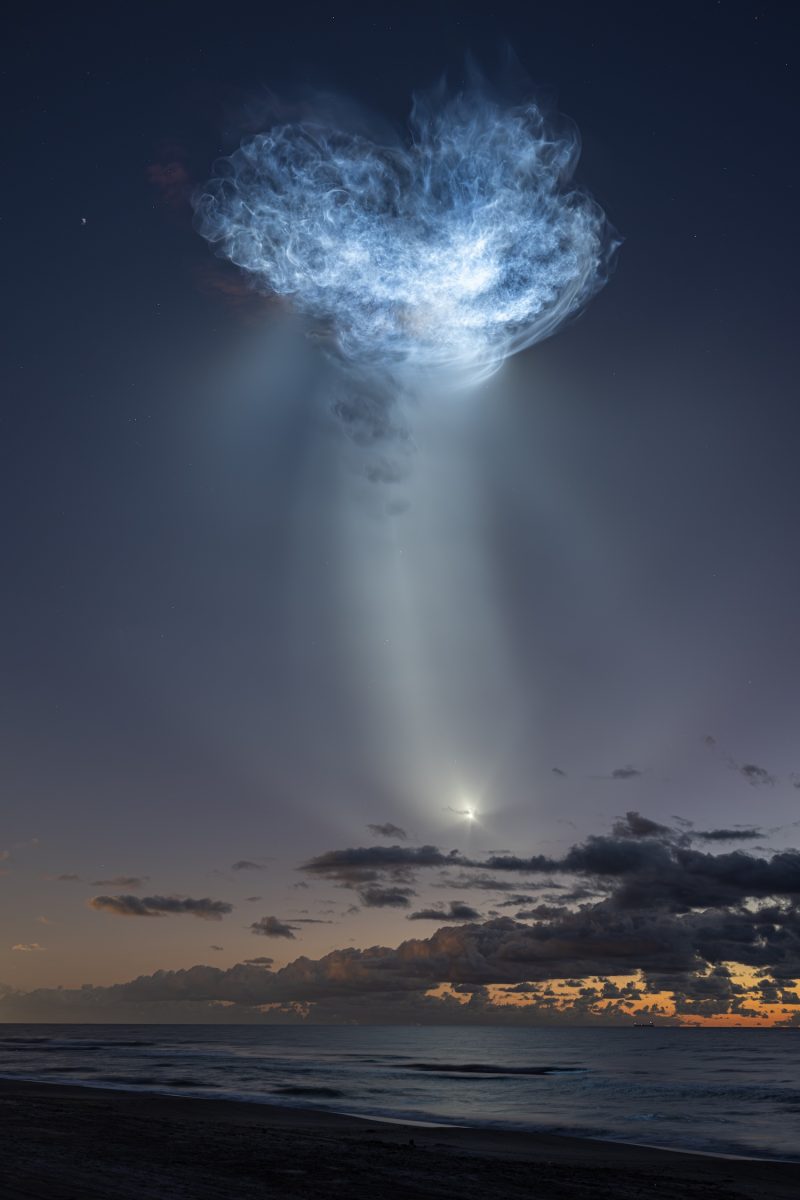
Credit: NASA/John Kraus
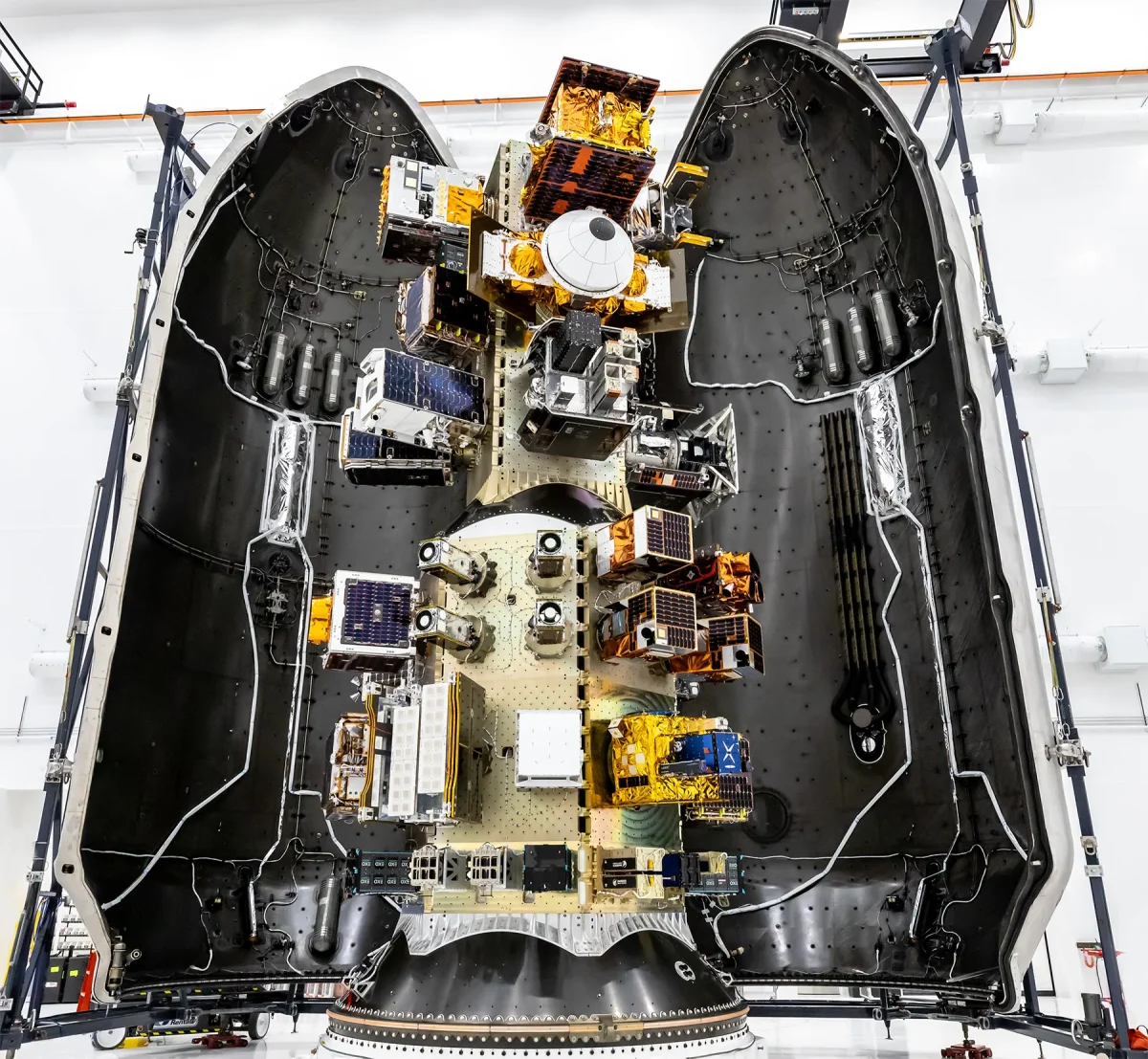
Passengers beneath the fairing
The final photograph was taken before launch. In the SpaceX image, the small satellites are secured along the central structure, while the black walls of the primary fairing curve around them. Shortly after the photograph was taken, the fairing doors closed over the payload.
On October 1 at 11:32 a.m. Pacific Time (9:32 p.m. Kyiv time), a Falcon 9 rocket launched from Vandenberg Space Force Base in California as part of the Transporter-18 mission. Under SpaceX’s Transporter shared-ride program, multiple customers share capacity aboard a single rocket. On this occasion, 130 payloads were launched into orbit. The first stage completed its 25th flight, returned to the launch site, and landed at Landing Zone 4 (LZ-4).
Among the commercial spacecraft were three supported by NASA. The ASCENT Propulsion Dual Mode CubeSat will test new propulsion system technologies. SPRITE (Supernova Remnants and Proxies for Reionization Testbed Experiment) was developed by the Laboratory for Atmospheric and Space Physics at the University of Colorado Boulder. This 12-unit CubeSat carries a far-ultraviolet spectrograph. It will map supernova remnants in the Milky Way and the Magellanic Clouds and measure the proportion of ionizing radiation emitted by relatively nearby galaxies. These data will help researchers understand the era of reionization, when the first stars and galaxies ionized hydrogen in the early universe. The SSPICY (Small Spacecraft Propulsion and Inspection Capability) spacecraft will test methods for inspecting inactive satellites, helping assess the condition of aging equipment directly in orbit.