

The TESS space telescope helped scientists study the brown dwarf HIP 61637 b. It orbits a massive and old star. By analyzing its orbit, scientists were able to learn more about how such objects form.
A Rare Cosmic Dwarf
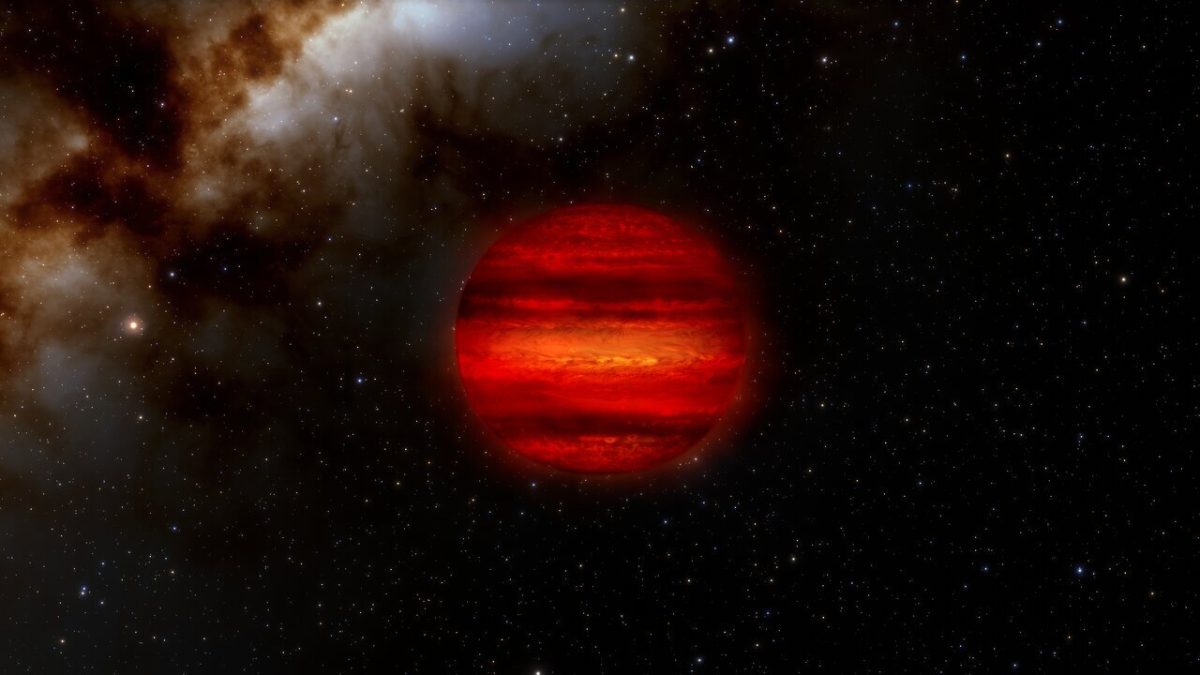
The website Phys.org reports that astronomers from Harvard University have presented an interesting study of the brown dwarf HIP 61637 b. The TESS space telescope helped them carry it out. With its help, they determined the orbital parameters of this object and used them to uncover something interesting about its past.
The star HIP 61637, around which the brown dwarf orbits, is about three times more massive than the Sun and belongs to the spectral class A. These are hot and massive stars that evolve much faster than the Sun. HIP 61637 is already approaching the end of its stay on the main sequence, after which it will begin to move to the next stage of evolution.
And this is what allowed us to establish the age of the entire system with sufficient accuracy – 396 million years, meaning that the star formed after life on Earth appeared on land. The brown dwarf that formed with the star should have the same age. This makes HIP 61637 b a particularly valuable object for studying the properties and origin of brown dwarfs.
How Brown Dwarfs Form
Brown dwarfs are objects that occupy an intermediate mass between giant planets and stars. The most massive ones can sustain deuterium fusion for a short time shortly after formation, while the less massive ones do not reach the temperatures and pressures necessary for this. However, no brown dwarf has enough mass to sustain the long-term burning of ordinary hydrogen, as stars do. Over time, all brown dwarfs gradually cool and become dimmer. In old age, their properties can resemble those of cold giant planets, although they are fundamentally different objects in origin.
Scientists are still debating how such objects form. Two main scenarios are considered. A brown dwarf could form directly from the gravitational collapse of a gas cloud, similar to a star. Another option is that it forms in a gas and dust disk around a young star, by a mechanism similar to the formation of planets.
In theory, these two scenarios could leave different traces in the properties of the system, particularly in the orbit of the brown dwarf. However, over time, gravitational interactions with other bodies and the dynamical evolution of the system can change the initial orbit. Another problem is that the age of brown dwarfs is usually very difficult to determine directly.
What the New Research Showed
New studies of HIP 61637 b play an important role in resolving this question. First, this brown dwarf is located in the so-called “brown dwarf desert” — a range of masses and orbital distances where such objects occur much less frequently than one would expect. The mass of HIP 61637 b is about 48 Jupiter masses. Objects in this range of parameters are rare, which makes HIP 61637 b interesting for studying possible mechanisms of brown dwarf formation.
Second, HIP 61637 b is only the seventh brown dwarf to have a relatively reliable age. Third, its parent star, HIP 61637, is one of the most massive stars known to have a brown dwarf in such an orbit. The young age of the system means that over the hundreds of millions of years its orbit has likely not yet undergone the long-term dynamical evolution that older systems have.
Therefore, its current parameters may partially preserve information about the conditions of formation. Its analysis suggests that the brown dwarf may have formed in a protoplanetary disk, rather than forming with the star itself.
