

The distortion of spacetime by a distant planetary system briefly amplified the light of a background star. This barely noticeable brightness spike, recorded several years ago, turned out to be the first discovery of this type in the archives of an orbital telescope.

A Super-Jupiter 40,000 Light-Years Away
The first signals were recorded back in 2023 by the European Gaia telescope, which has now completed its work. A background star briefly became brighter, which was a sign of microlensing — the gravitational bending and amplification of light by a planetary system that passed between it and Earth.
The existence of the exoplanet Gaia23bra b was confirmed thanks to data from the TESS telescope, the Transiting Exoplanet Survey Satellite, Space.com reports. In mass, this planet is approximately 1.6 times heavier than Jupiter and orbits an orange dwarf at a similar orbital distance. The parent star has about 80% of the Sun’s mass and is located 40,000 light-years from us.
Limits of the Transit Method
Usually, TESS detects exoplanets using the transit method, recording a tiny decrease in a star’s brightness when a planet passes in front of it. This approach is most effective for massive gas giants in close orbits. Additionally, the transit method used by TESS typically has a search radius of about 150 light-years.
Gaia23bra b meets none of these criteria, since it orbits far from its star and is almost 270 times farther away than the usual boundary of transit searches. Microlensing, predicted by Einstein’s general theory of relativity back in 1915, made it possible to notice this planet in already collected archival data. The results of the study were published in the peer-reviewed journal The Astrophysical Journal Letters.
According to Diana Dragomir of the University of New Mexico, when TESS was launched, no one expected it to be capable of finding such planets. It is likely that other such worlds are hidden in the mission’s archives, simply because no one had searched for them before.
A One-Time Chance
Of the roughly six thousand known exoplanets, only about 5% have been discovered through microlensing, while transits account for about 75%. At the same time, this approach can detect worlds that are inaccessible by other methods, including planets in wide orbits or in habitable zones.
However, there is a significant limitation. Microlensing occurs because of the accidental alignment of a background star, a lensing planetary system, and Earth along a single line. All three objects are moving, so such an alignment happens only once and does not repeat, unlike a transit, which can be recorded each time a planet passes in front of its star.

As the study’s lead author, Mallory Harris of the University of New Mexico, noted, the first Earth-sized planet will likely be found using this very method — and then never seen again.
A New Telescope on the Launch Pad
Gaia23bra b has become a kind of rehearsal for the large-scale microlensing campaign to be carried out by the Nancy Grace Roman Space Telescope. It will survey the central region of the Milky Way, where stars are packed densely and such events occur much more frequently.
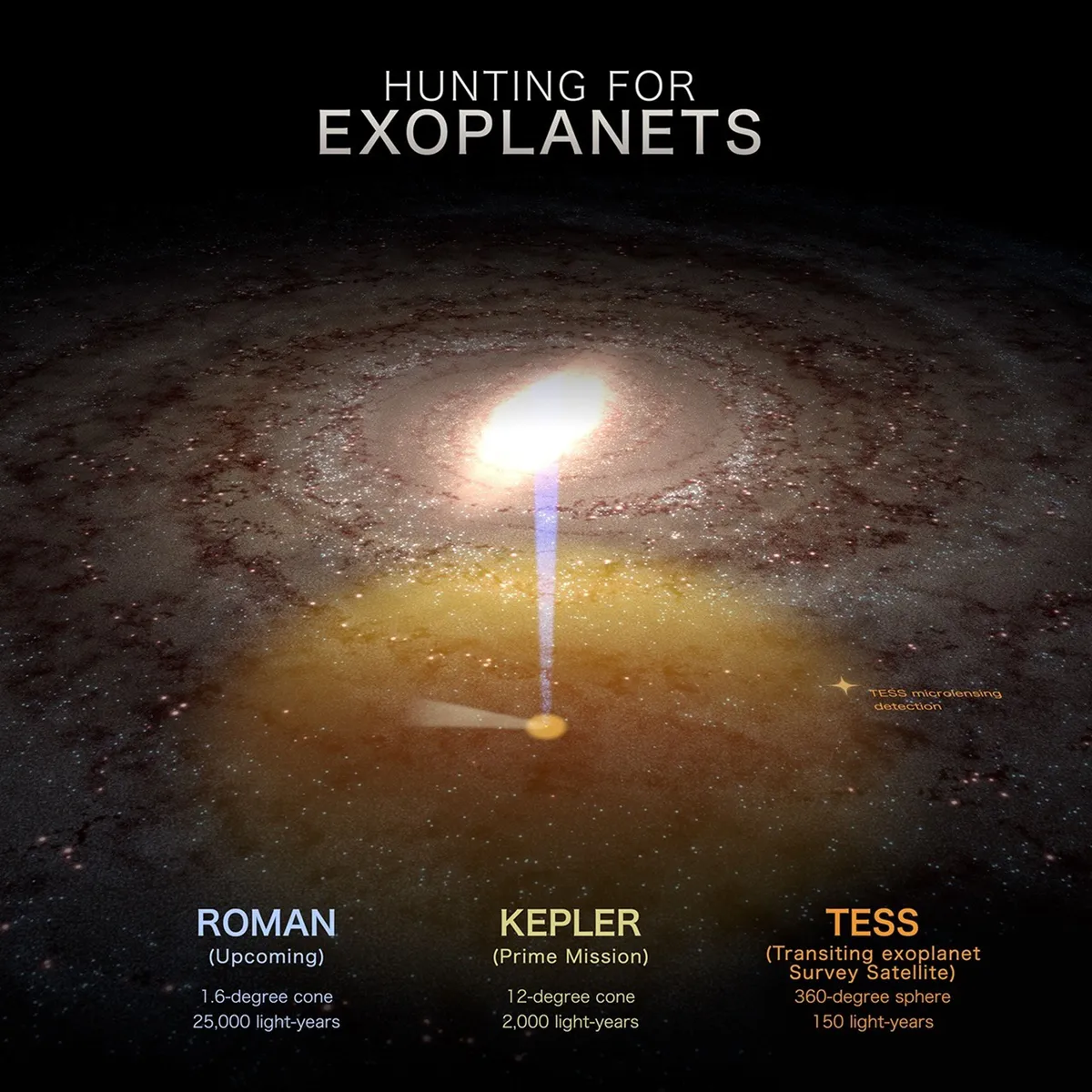
According to NASA’s forecasts, over five years of operation the new telescope will discover about a thousand such exoplanets and approximately 100,000 transiting planets. By combining data from both observatories, astronomers will be able to study the formation of planetary systems in different parts of the Galaxy.
Nancy Grace Roman was delivered to the Kennedy Space Center in Florida on June 21, and its launch is scheduled for August 30, 2026, eight months earlier than originally planned.
