The space theme has long been a staple of board games, where starships traverse the cosmos, empires wage war, and alien civilizations engage in trade. Among the hundreds of games featuring rockets on their covers are titles created by engineers, chemists, and others with a passion for real science. In some, the Solar System map is based on energy consumption; in others, a new rocket may explode during launch because it has not yet been tested. Which space-themed board games should you bring to the table for an evening of learning about orbital mechanics, terraforming, or the search for extraterrestrial life?
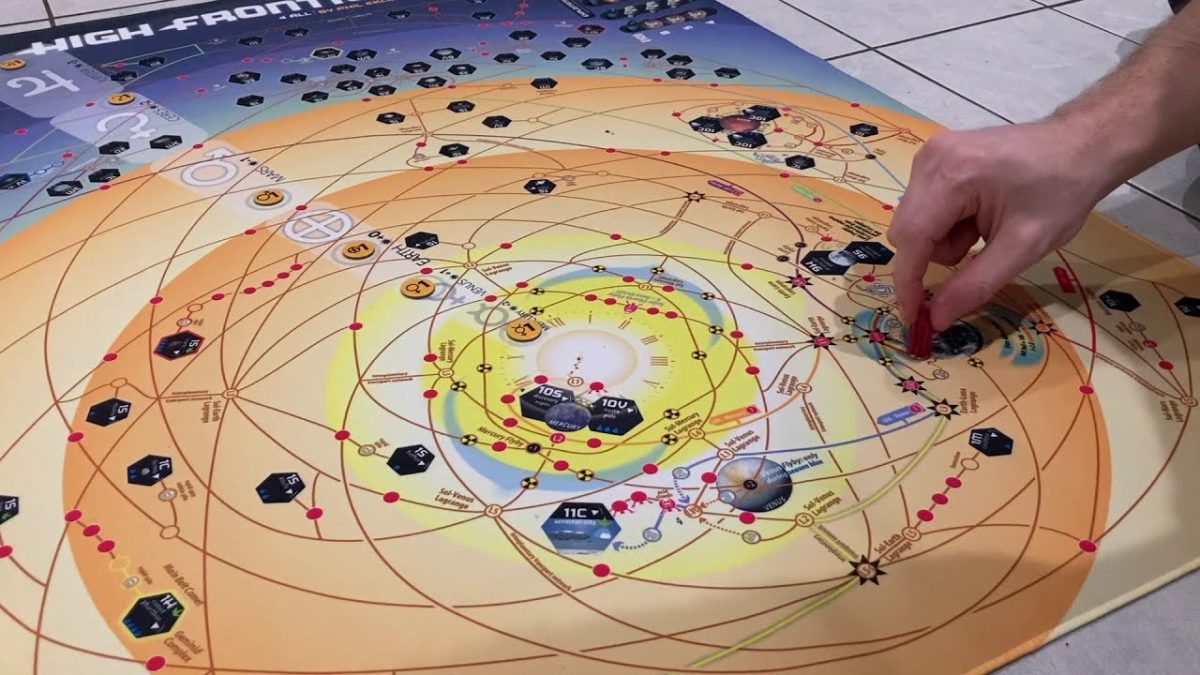
High Frontier 4 All: A map in which distance is measured in energy
Phil Eklund, an aerospace engineer and board game designer, created the first version of High Frontier in 1978. Inspired by physicist Gerard O’Neill’s book The High Frontier, which explores the concept of space colonies, Eklund produced approximately ten typewritten copies of the game’s initial version. The fourth edition, High Frontier 4 All, was published in 2020 by the Swedish publisher Ion Game Design.
The game board depicts the Solar System as a network of routes, with each segment representing the required change in velocity, or delta-v. This is broadly how ballistic engineers’ design schemes function. On such a map, Mars appears more accessible than Mercury, even though Mercury is, on average, closer to Earth. To reach the planet nearest the Sun, a spacecraft must shed the substantial velocity it acquired from Earth and its orbital motion.
Players manage agencies and corporations, assemble ships using cards that represent engines, reactors, and heat sinks, monitor their water supplies — which serve as the engines’ working fluid — and search for resources on asteroids and moons. Each engine has distinct thrust and fuel-efficiency characteristics, making it clear why a powerful chemical rocket is necessary for launching from a planet, while a weaker, more fuel-efficient ion engine is better suited to long interplanetary journeys.
The map depicts Lagrange points — locations where, in the game, players can change direction without consuming fuel (in reality, energy-efficient trajectories do indeed pass near them) — as well as aerobraking zones in planetary atmospheres and gravitational maneuvers. The technology cards were developed in collaboration with experts, and many describe real or entirely plausible developments. The rules are spread across several booklets. The game accommodates one to five players, and each session lasts for several hours. Players who take on this challenge will receive a thorough and engaging introduction to space logistics.
Leaving Earth: A space race marked by rocket explosions
Joseph Fatula’s Leaving Earth was published in 2015 by Lumenaris Group, a small American company that primarily specializes in wool-felt sewing kits. The game begins in 1956, at the dawn of the Space Age, and continues through the end of 1976. Each turn represents one year, and each player leads a national space agency operating with a limited annual budget.
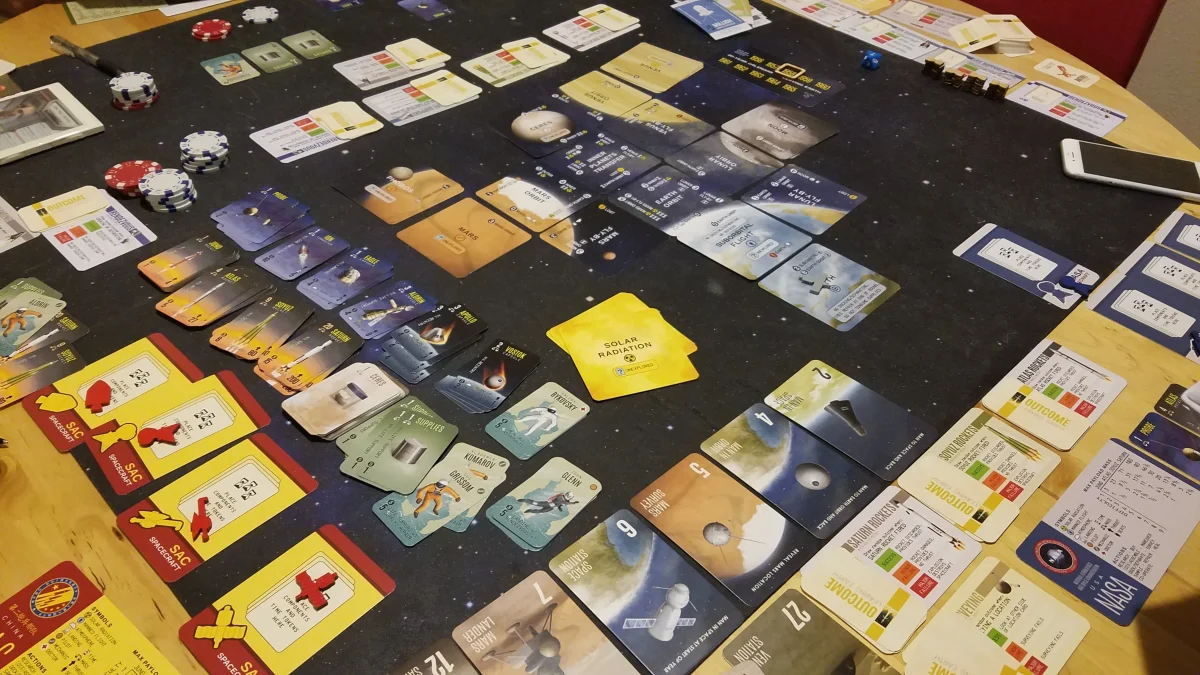
There is no standard grid; instead, the system uses location cards representing Earth orbit, lunar orbit, the surface of Mars, and Venus. Each transition between these locations has its own difficulty level. To complete a transition, the rockets’ total thrust must be at least equal to the spacecraft’s mass multiplied by that difficulty level. The calculation is straightforward and accurately reflects a central challenge of spaceflight: each additional kilogram of payload requires a larger rocket, which itself adds mass.
The most compelling gameplay mechanic centers on testing. When the agency develops a new technology, several face-down result cards are placed on it, representing successes as well as minor and major accidents. Each use of the technology reveals one of these cards, meaning the first launch of a new rocket could end in an explosion. Defects can be addressed by investing time and money, much as the engineers of the American Vanguard program did after a rocket exploded on the launch pad in December 1957. Through their own experience, players confront the same dilemma as real-world agencies: launch immediately and accept the risk, or spend another year refining the technology and relinquish the lead to competitors.
At the beginning of the game, players have limited knowledge, even about neighboring planets. The possibility of landing on Venus, the conditions on the surface of Mars, and the extent of the danger posed by solar radiation to crews are revealed only after probes have been launched. Some missions may simply disappear from the game thereafter. The Outer Planets and Stations expansions provide access to the outer planets and enable players to construct orbital stations.
Terraforming Mars: Chemistry in a box
Terraforming Mars, designed by Swedish designer Jakob Fryxelius, was released in 2016 by the family-run studio FryxGames and has since become one of the world’s most popular board games. Fryxelius holds a Ph.D. in chemistry and acknowledges his longstanding interest in science and fascination with Mars. In Ukraine, Kilogames publishes the game and its expansions.
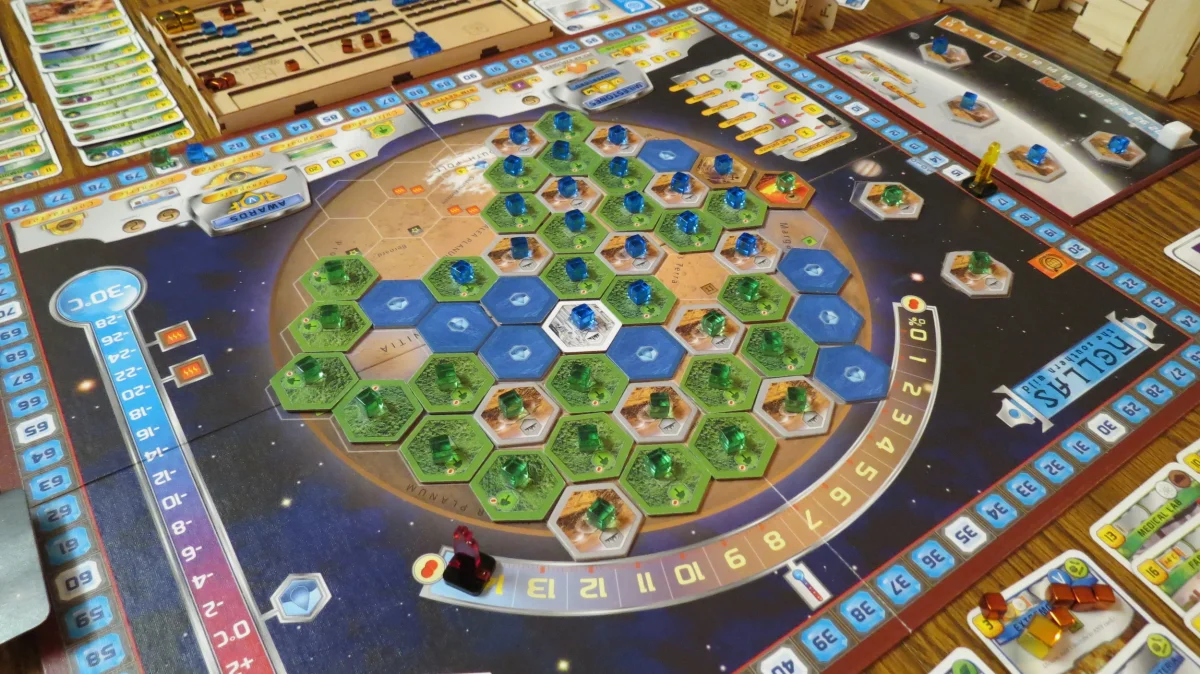
Players manage 25th-century corporations that, with funding from the World Government, are transforming Mars into a habitable planet. The game concludes when three global objectives have been achieved: the temperature has increased from −30 °C to +8 °C, the atmospheric oxygen concentration has reached 14%, and nine areas of the playing field have been converted into oceans. The game’s initial temperature is considerably milder than Mars’s actual average temperature of approximately −60 °C, and scientists continue to debate how it might be raised.
The game features more than 200 project cards, many of which describe concepts that researchers are actively discussing, including sending asteroids and comets to the planet, greenhouse gas factories, orbital mirrors, greenhouse-gas-producing bacteria, and an artificial magnetic field. Because every living organism requires specific oxygen levels or temperatures, lichens are the first to colonize Mars, while trees and animals appear much later. In his review of the game, Luca Maltalati, editor of the journal Nature Astronomy, noted that, according to scientists, this is precisely the sequence a real terraforming process would follow.
The Search for Planet X: How astronomers are searching for an invisible planet
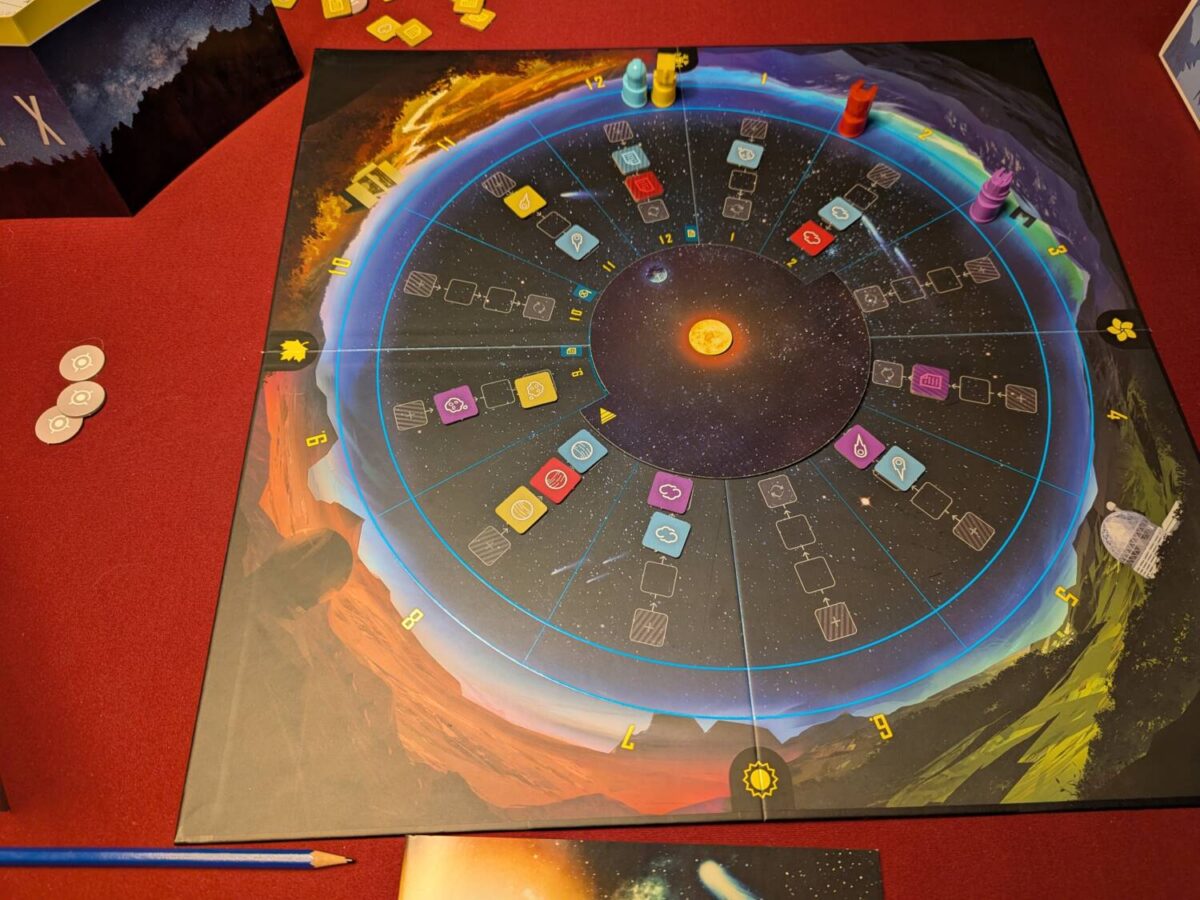
In January 2016, Konstantin Batygin and Michael Brown of the California Institute of Technology published a hypothesis concerning the Ninth Planet. Their computer simulations suggested that the unusual orbits of distant objects beyond Neptune could be explained by the gravitational influence of a massive, unidentified body on the outskirts of the Solar System. In 2020, the American studio Foxtrot Games adapted the search for this hypothetical planet into a deduction game.
Players assume the roles of astronomers and use the application to scan sectors of the sky. Each sector contains a comet, an asteroid, a dwarf planet, a gas cloud, or a void, with the locations governed by logical rules. Half of the screen is always obscured by Earth’s disk, limiting exploration to the visible portion of the sky, which gradually shifts over time. Every observation is significant, and the first person to assemble the complete picture will be the one to discover Planet X. During a routine scan, Planet X itself appears as an empty sector and can therefore be identified only through a process of elimination.
The game most accurately reflects the underlying logic of scientific research. Players publish theories about the locations of objects, which their opponents may use, while additional clues are revealed at conferences. The search for the real Ninth Planet follows the same principle: it has not been observed, and its existence is inferred solely from the behavior of other celestial bodies. In 1846, Urbain Le Verrier calculated Neptune’s position based on perturbations in Uranus’s orbit. The Ninth Planet has yet to be discovered, and astronomers place their greatest hopes in the Vera C. Rubin Observatory in Chile, which began operations in 2025 and surveys the entire southern sky every few nights. The game is designed for one to four players, lasts approximately one hour, and includes a Ukrainian-language version of the app.
SETI: A discussion of the search for extraterrestrial life
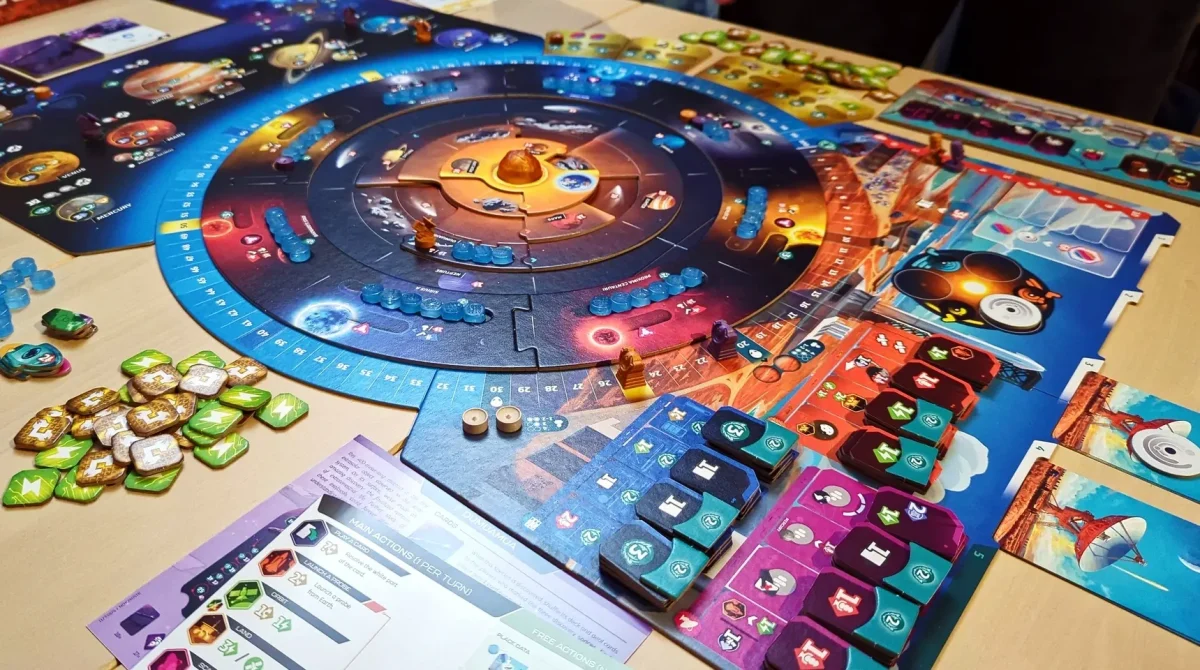
SETI: Search for Extraterrestrial Intelligence, designed by Czech designer Tomáš Holek, was released in late 2024 by Czech Games Edition, the publisher known for Galaxy Trucker and Codenames. Players lead scientific institutes in their search for signs of life beyond Earth. Polygon included the game on its list of the best board games of 2024.
At the center of the field is the Solar System, which consists of four rotating layers. The planets and asteroids gradually shift in their orbits, so probe launches must be scheduled with their relative positions in mind, much like real-world launch windows. Probes enter orbit around or land on planets and moons, while Earth-based telescopes scan deep-space sectors for signals and previously unknown exoplanets. The collected data is transmitted to the player’s computer, where it must still be analyzed.
More than 200 cards in the game are based on real technologies, projects, and discoveries. The title refers to SETI, the scientific search for extraterrestrial intelligence. This effort began in 1960 with Frank Drake’s Ozma project, when a radio telescope first scanned two neighboring stars in the hope of detecting an artificial signal. Aliens in each game are randomly selected from among five species, and the rules for detecting them vary each time. The path from raw data to discovery in the game follows the same structure as in real astronomy: observation, analysis, and confirmation.
New Dark Ages: Colony: A Ukrainian game about Mars
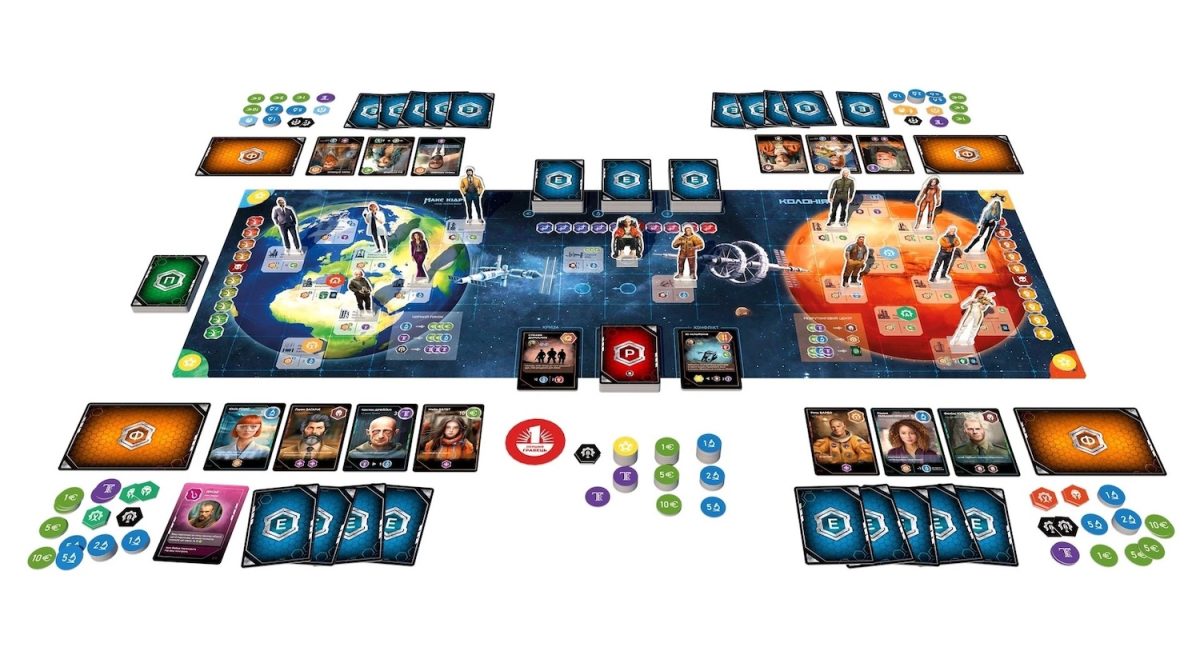
In the summer of 2025, the publishing house Bearded Tamarin released a board game based on Max Kidruk’s novel New Dark Ages: Colony. Developed by Mykhailo Voitovych and Kidruk, and illustrated by Maria Maksymiv, the game is set on Earth and Mars in 2141. Players lead one of 12 factions competing to secure humanity’s survival and shape its future.
There is less scientific simulation here than in High Frontier or Leaving Earth; in terms of genre, it is more of a story-driven strategy game. Kidruk is known for his attention to scientific detail in his novels, and the game has inherited the book’s world, along with its Martian realities. For the Ukrainian market, this is a rare example of a major Ukrainian-made board game focused on space exploration.
Board games offer an advantage that computer games lack: all calculations take place directly before the players’ eyes. In this setting, the physics cannot be concealed within program code, and whenever a rocket fails to reach Mars, the player knows precisely how much delta-v was lacking. Perhaps it is at a table like this that someone will first decide to pursue trajectory calculation professionally.