

Water on many distant planets may lie much deeper than current telescopes can detect. Instead of remaining in the upper atmosphere, it accumulates under a hydrogen-helium shell, where it becomes inaccessible to spectroscopic observations. Therefore, there may actually be much more water on such planets than can be determined from the composition of their atmospheres.
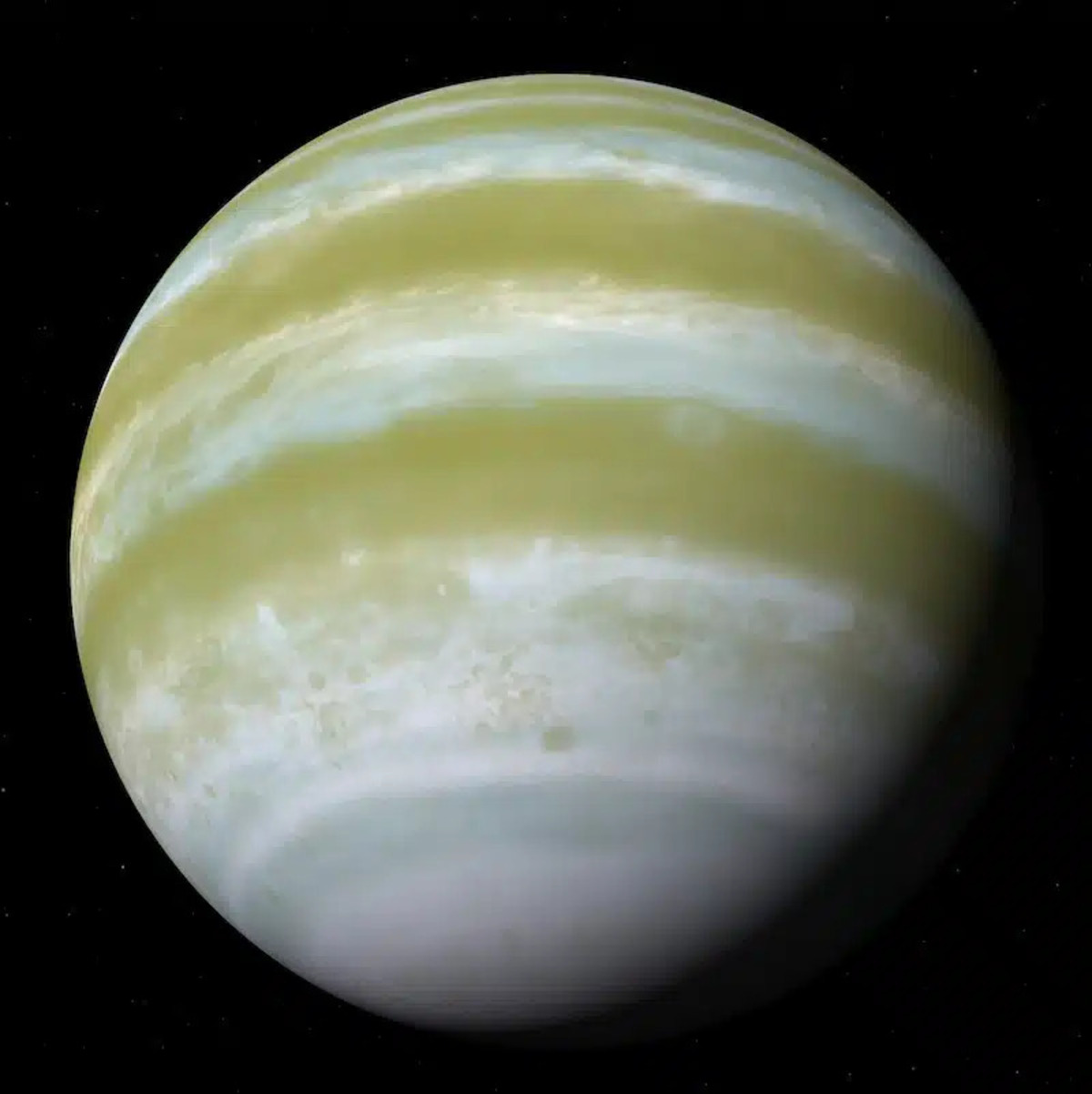
What Kind of Planets Are These?
Mini-Neptunes are among the most common celestial bodies in the Galaxy, although no similar planets exist in the Solar System. They are slightly smaller than Neptune.
Astronomers therefore have to rely on theoretical models and observational data. In terms of density, such objects occupy an intermediate position between gas giants and rocky planets such as Earth.
Where Does the Water Go?
Researchers had long assumed that the warm interiors of mini-Neptunes were thoroughly mixed. Under that scenario, the chemical composition of the outer layers would also reflect the structure of the deeper interior.
The results of simulations published in the peer-reviewed journal The Astrophysical Journal have called this assumption into question. When the atmosphere is cooler or the planet contains an especially large amount of water, the water separates from hydrogen and, because of its greater density, sinks into deeper layers.
“It is entirely possible that these planets are hiding much more water than can be seen in their atmospheres,” said lead author Caroline Piaulet-Ghorayeb of the University of Chicago. According to her, data from new powerful telescopes will need to be interpreted more cautiously, because such measurements do not reveal the true amount of water present.
The Limits of the James Webb Telescope
The James Webb Space Telescope identifies molecules in a planet’s atmosphere by analyzing starlight as the planet passes in front of its star. This method has already been used to detect hydrogen, methane, and carbon dioxide on distant worlds.
However, connecting these data with conditions deep inside the planets remains extremely difficult. Depending on temperature and pressure, water may exist as ice, liquid, gas, or a supercritical fluid. Its physical state determines whether it mixes with hydrogen or settles into regions beyond the reach of direct observation.
The Mystery of TOI-270 d
Scientists decided to test their models using the exoplanet TOI-270 d in the constellation Pictor. Earlier observations revealed precisely the combination of compounds in its atmosphere that would normally be expected to accompany a large amount of water, Daily Galaxy reports.
Simulations indicate that this object may belong to the class of planets where water has sunk beneath the outer envelope, leaving a substantial portion of it hidden. In 2024, TOI-270 d was already at the center of a scientific debate. Some research groups considered it a Hycean world with a global ocean, while others argued that its water was completely mixed with hydrogen. The new study explains why this debate has been so difficult to resolve.
The Search for New Approaches
Existing methods cannot confirm or rule out this scenario. Study co-author Eliza Kempton emphasized that the current data provide no basis for either accepting or rejecting this possibility.
“A planet rich in water could have the same average density as a planet made up of a mixture of rocks and gas,” explained Leslie Rogers, another member of the team. That’s why the team is looking for any additional data that can help narrow down the range of possible models for the planets’ internal structure.