

At first glance, the dwarf planet Pluto and Saturn’s largest moon, Titan, seem to have nothing in common. However, scientists have discovered a shared chemical characteristic between them and are now unable to explain where it came from.
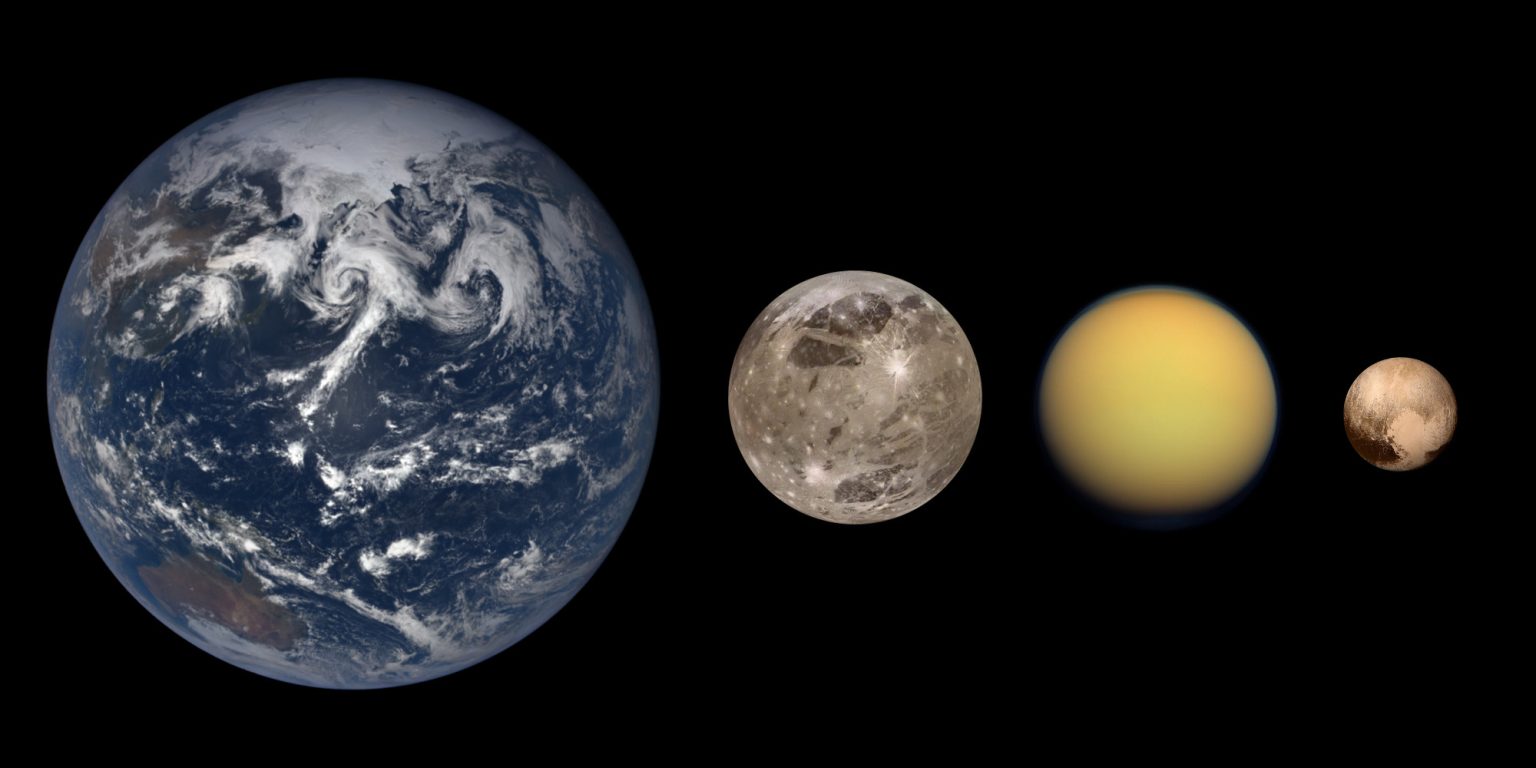
Atmospheric Similarities and Differences
A team of scientists recently detected an absorption line from Saturn’s moon Titan and Pluto that has not been seen anywhere else before. This means scientists still do not know exactly which atom or molecule produces it. Whatever its origin, however, it may point to a unique chemical process shared by these two worlds, according to a new study published on the preprint server arXiv.
The differences between Titan and Pluto may seem obvious. Titan is a large moon and one of the few bodies in the Solar System with clear evidence of stable liquid on its surface. Pluto is a frozen dwarf planet on the edge of the Solar System, much colder than Titan and roughly half its diameter. Yet the two worlds have similar atmospheres. Both possess nitrogen-rich atmospheres with significant amounts of methane. As a result, both have noticeable hazy atmospheres produced by reactions between ultraviolet light, nitrogen, and methane. However, because Pluto is much smaller, its atmosphere is far thinner.
Titan’s thicker, hazy atmosphere has made it difficult to study the chemistry of its surface using reflected light. In earlier studies, data from the Cassini-Huygens probe showed that Titan has rivers, lakes, dunes, and complex terrain, but scientists were unable to determine the exact composition of its surface, apart from suspicions that water ice may be present. Earlier observations of Titan with the James Webb Space Telescope provided insight into the chemistry of its atmosphere, but the surface composition remains largely unknown because surface features are hidden by the thicker atmosphere. Pluto’s atmosphere, on the other hand, is extremely thin, making surface signatures easier to detect.
Unknown Absorption Spectrum on Titan and Pluto
The team behind the new study recently analyzed spectra of Titan obtained by the James Webb Space Telescope: in 2022 using NIRSpec and in 2023 using MIRI, focusing on wavelengths in the 4.9–5.4 micrometer atmospheric window. In both datasets, they detected an absorption feature at 5.11 micrometers. They note that it is unlikely to be an instrumental glitch or artifact, since it was detected by two separate instruments. MIRI data from Pluto also showed an absorption feature at 5.11 micrometers, at roughly the same wavelength, although on Pluto the feature is about three times broader than on Titan.
The team reviewed previous studies and other published laboratory spectra but could not find a match for the 5.11-micrometer absorption band anywhere. They write: “We found no band in these publications that matched the position of the observed absorption on Titan and Pluto. However, the signature may shift if the compound is mixed with other substances.”
Taking into account the possibility of a shift from another wavelength, the team identified several candidates, such as C₂H₂ ice and benzene mixed with other molecules. Additional tests are needed to determine whether they could truly be responsible for this absorption band.
The researchers also say the evidence suggests that the signal comes from the surfaces of both Titan and Pluto, rather than from their atmospheres. Modeling of Titan’s atmosphere did not show absorption dips at 5.11 micrometers, while other atmospheric features were correctly reproduced by the model.
Further Research
The team suspects that the methane-nitrogen environments of Titan and Pluto, combined with exposure to ionizing radiation, likely play a major role in the chemical pathway that leads to the 5.11-micrometer feature. They write: “A more likely mechanism is related to the physical state of the molecular species, and more specifically to the diversity of their environment at the molecular level.”
Although the absorption feature has not yet been identified, the team plans to continue the search. Additional James Webb Space Telescope observations could be used to map where the 5.11-micrometer feature is strongest on Titan, helping narrow down its chemical origin.
New laboratory measurements of selected candidate molecules in realistic mixtures and matrices are also needed to find a match for the feature under conditions similar to those on Titan and Pluto. In the mid-2030s, NASA’s new Dragonfly spacecraft could help identify candidate molecules directly on Titan’s surface. However, the lack of infrared spectroscopy will prevent it from directly detecting the spectral feature on the surface.
According to phys.org
