

In the northern celestial hemisphere, within the constellation Aquila, astronomers have discovered an extremely powerful cosmic accelerator that generates fast-moving particles with the highest known energies in our galaxy. The mysterious object, named LHAASO J1912+1014u, is capable of accelerating protons to energies exceeding one quadrillion electronvolts (PeV). The discovery gives scientists an important clue to understanding the origin of high-energy particles that travel through space at nearly the speed of light. The study’s results were recently published in The Astrophysical Journal.
Astronomers first detected LHAASO J1912+1014u in 2024 near Altair, one of the brightest stars in the night sky. At first, the object was classified as an ordinary supernova remnant. Later, however, observatories detected a powerful stream of gamma radiation coming from the source.
Because gamma rays are often produced when accelerated particles collide with surrounding gas, scientists suspected that they were looking at a so-called “PeVatron” — a natural cosmic particle accelerator.
Detecting PeVatrons is extremely difficult because protons rarely maintain a straight-line trajectory from their source. In addition, lower-energy gamma rays can also be produced by fast electrons, and the initial observations did not make it possible to distinguish what exactly was responsible for the emission.
The “Three Arrows” Method
To precisely identify the nature of the object, the research team collected data from three different observatories. Each scanned a different part of the electromagnetic spectrum: the Fermi Space Telescope, Japan’s FUGIN radio telescope, and the Chandra X-ray Observatory.
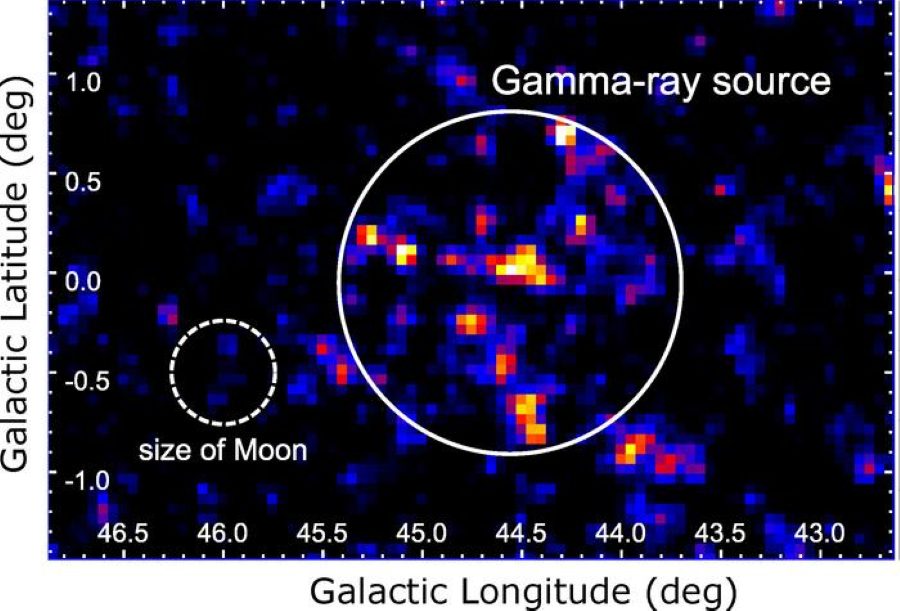
Using these observations, the scientists built a detailed multiwavelength model and ultimately ruled out electrons as the source of the radiation.
“There is an old Japanese proverb: One arrow is easy to break, but three arrows bound together are not,” said Tsunefumi Mizuno, associate professor at Hiroshima University’s Center for Astrophysical Sciences. “In our study, the three ‘arrows’ from different telescopes came together and proved that our target is a genuine PeVatron.”
However, although the scientists confirmed unprecedented proton acceleration, the nature of the object responsible for the process itself remains an unresolved astronomical mystery.
Nature’s Most Powerful Collider
The discovery brings scientists closer to understanding the origin of the Milky Way’s most energetic cosmic rays. Their energy is measured in electronvolts and can exceed one quadrillion (10¹⁵).
To put this scale into perspective, one petaelectronvolt (PeV) is thousands of times greater than the maximum collision energy achieved at the Large Hadron Collider, the most powerful machine ever built by humans. Natural cosmic accelerators far surpass any technology created on Earth.
Scientists suggest that, in addition to the newly discovered object, dozens of similar PeVatrons may be scattered throughout our galaxy, and humanity may finally know how to search for them.
We previously reported on how scientists managed to recreate the conditions of the first microseconds after the Big Bang.
According to eurekalert.org
