

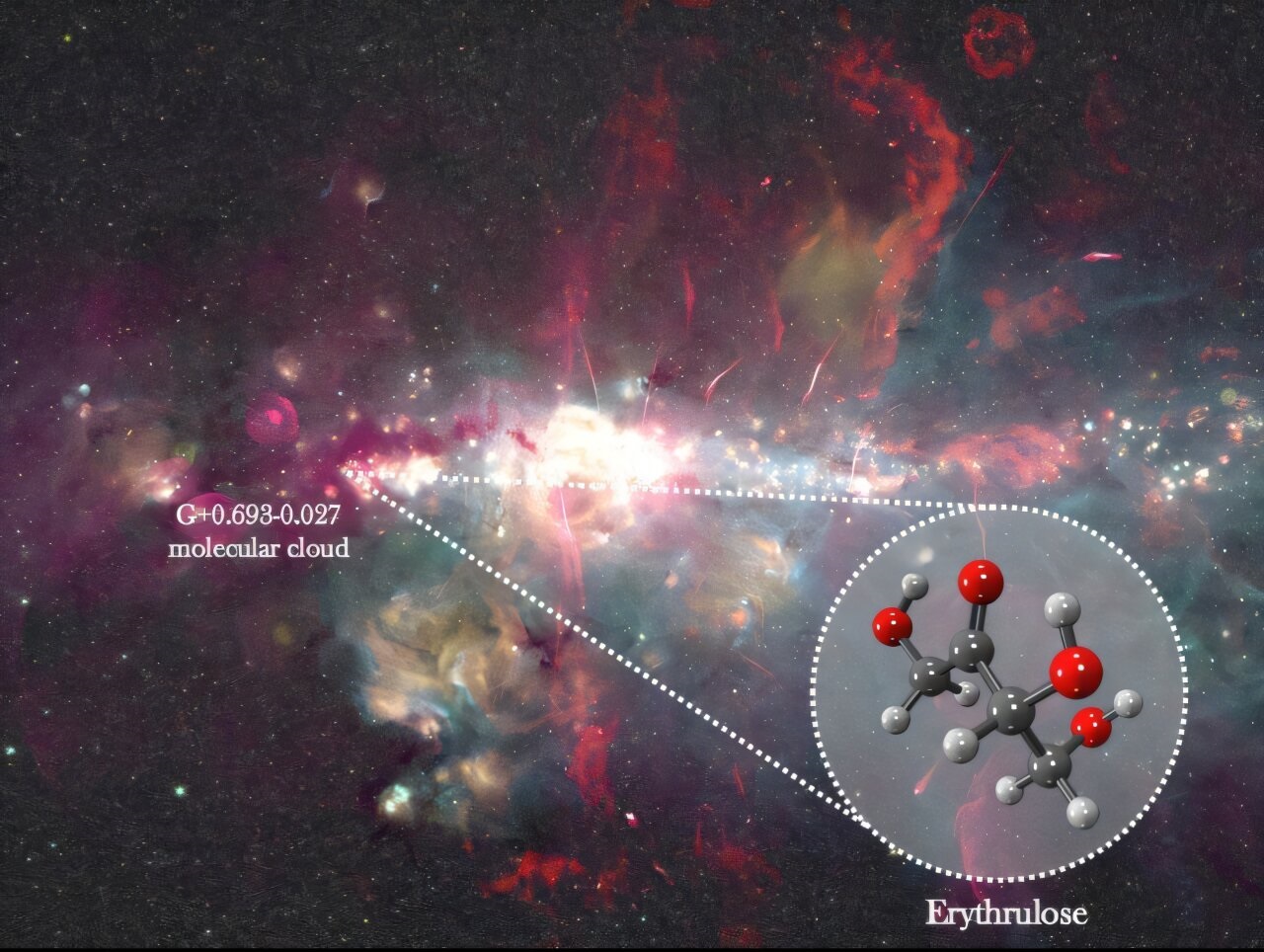
An international team led by researcher Izaskun Jiménez-Serra has identified the first sugar in interstellar space: erythrulose. This class of substances plays a crucial role in biochemical processes inside the cells of living organisms on Earth.
Sugar in interstellar space
Sugars are not only the familiar white and sweet substance known to everyone. This is the name for an entire class of substances, also called carbohydrates. In addition to glucose, which forms the basis of the sugar familiar to us, they also include fructose, cellulose, and many other fairly complex substances that perform a wide range of functions in the cell and are closely connected with the work of DNA and RNA.
And now scientists know that these substances are also present in interstellar space. At least, this is reported by phys.org, citing a paper published in the journal Nature Astronomy. The study says that astronomers have detected erythrulose in interstellar space. This substance is found in raspberries and in tanning creams.
Sugar-like organic compounds have been found before, and some true sugars have been found in meteorites that have fallen to Earth. They are thought to have formed in the protoplanetary cloud from which the solar system emerged. They almost certainly formed from the same protoplanetary cloud as the rest of the Solar System. But this could only be discussed indirectly. Now, however, the discovery concerns these molecules directly in the gas that fills interstellar space.
How the discovery was made and what it means
The object of the study was the interstellar cloud G+0.693−0.027, located near the center of our Galaxy. To study it, scientists used the 40-meter Yebes radio telescope and the 30-meter telescope of the Institute for Radio Astronomy in the Millimeter Range, or IRAM.
Both are equipped with spectrometers for the relevant wavelength ranges, so scientists were able to obtain 12 emission lines corresponding to erythrulose. Therefore, there is no reason to doubt its presence there. Moreover, there is a great deal of it there.
Most importantly, our own Solar System once formed from a cloud roughly like this one. Scientists can now even say that, together with meteorites, between 0.5 and 50 million tonnes of this sugar alone fell onto it during the earliest period of its existence.
The discovery suggests that complex organic molecules, considered essential “building blocks” of life, could be widely formed in interstellar space before the birth of stars and planets. Although life most likely originated on Earth, some of the organic compounds needed for this could have been brought to our planet from space by comets, asteroids and interplanetary dust.