Five images made NASA’s weekly selection. The Curiosity rover captured a morning scene near mysterious rock formations on Mount Sharp, James Webb peered into the stellar nursery NGC 7129, and Hubble revealed an edge-on spiral galaxy. Aboard the ISS, astronaut Jessica Watkins prepared living cells for 3D-printing cartilage, while in Mississippi, an RS-25 engine for the SLS rocket fired for eight and a half minutes. Here is what each image shows.
Morning Near Mars’s Wind-Carved Rocks
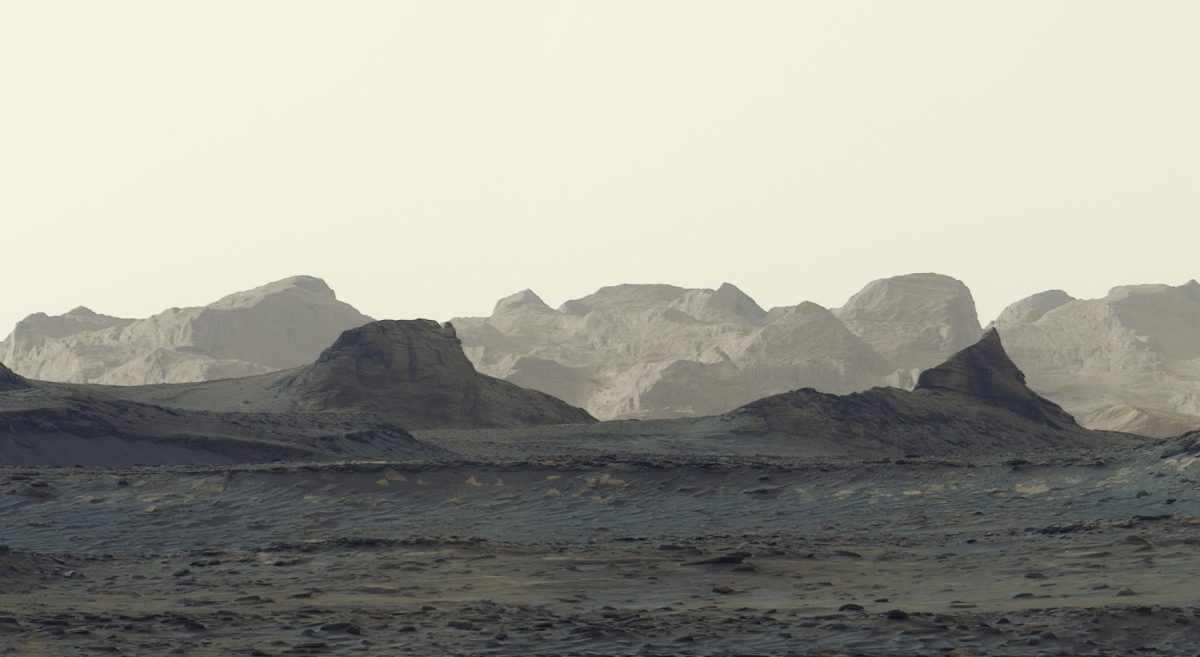
Curiosity captured this panorama on August 11, the 4,982nd Martian day of its mission, at 8:30 a.m. local time. Its Mastcam took six images, which were stitched together on Earth. Mastcam images are usually white-balanced so that their colors resemble those under terrestrial lighting. This time, that adjustment was not applied, preserving the bluish morning tones in the foreground while the rocks on the horizon glow in the sunlight.
Geologists call these formations yardangs: elongated ridges carved by wind into relatively soft rock. The yardang layer stretches approximately 16 kilometers along the northwestern slope of Mount Sharp, a five-kilometer-high mountain rising from the center of Gale Crater. Curiosity has been climbing it since 2014 and recently reached an elevation one kilometer above the crater floor. No spacecraft on Mars has ever climbed so high.
Project scientist Ashwin Vasavada of NASA’s Jet Propulsion Laboratory notes that the yardang layer looks out of place. It has a different color, its strata tilt at an unusual angle, and it appears almost pasted onto the mountain. Exactly how this layer formed remains unknown. One explanation links it to ash from ancient volcanic eruptions. Mount Sharp consists of layers, each preserving a different period in Martian history. The lower layers have already revealed evidence of lakes and streams that once covered the area. The rover is expected to reach the base of the yardangs in 2027 and study them using instruments on its robotic arm.
NASA released the panorama on October 6 and added an enlarged section to its Image of the Day collection on October 19.
The Stellar Nursery NGC 7129
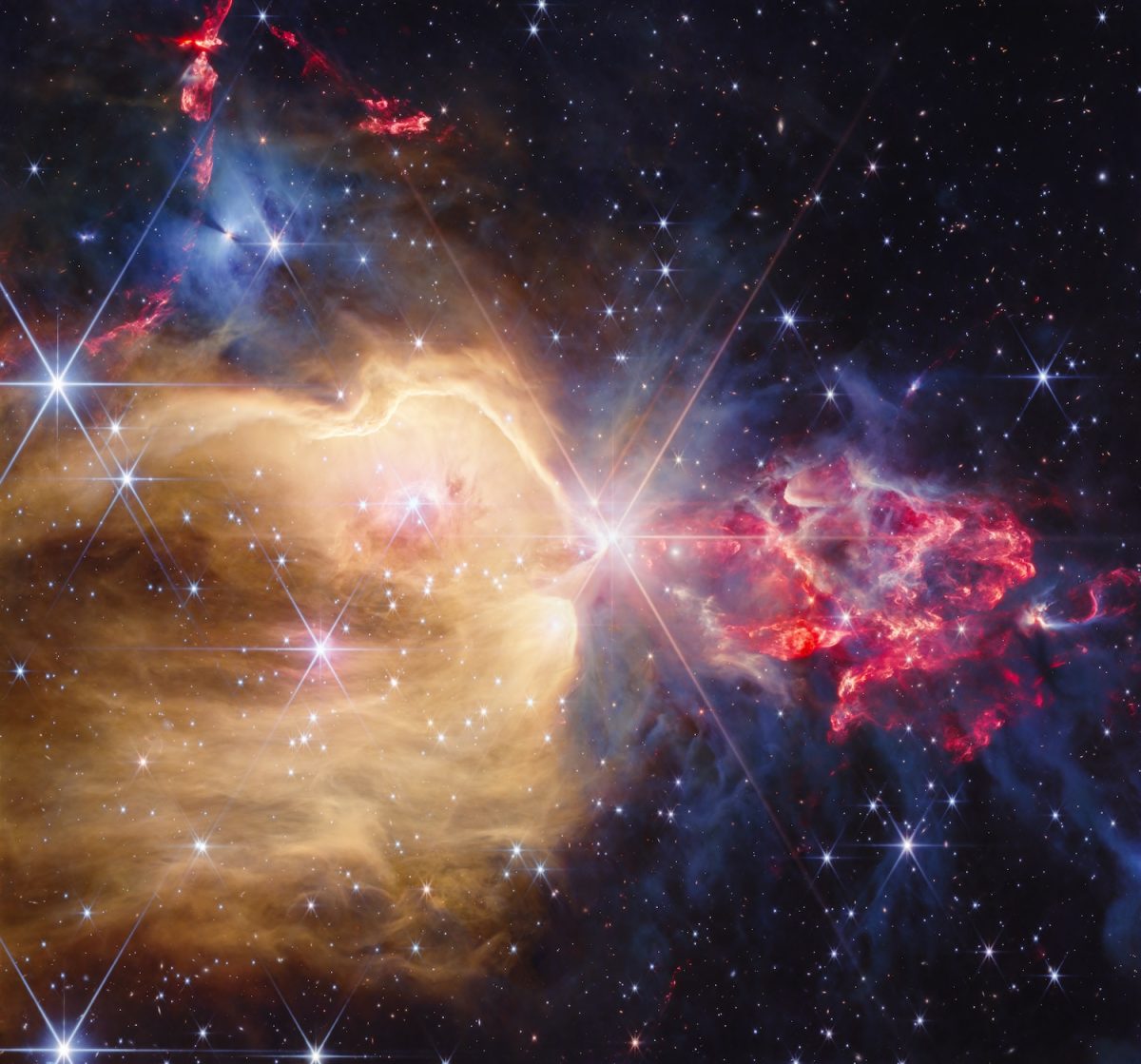
James Webb photographed the star-forming region NGC 7129 in the constellation Cepheus, approximately 3,300 light-years from Earth. Young stars are born in cold clouds of dust and gas that hide them from view in visible light. The NIRCam infrared camera can see through this veil, revealing many stars concealed from earlier telescopes.
At the center of the image shines LkHα 234, the cluster’s most massive and most mature star. It is five to eight times more massive than the Sun and has almost finished accumulating mass. It is now contracting under its own gravity and gradually heating up. Eventually, hydrogen fusion will begin in its core.
To its left lies a golden cavity approximately 3.5 light-years across. It was carved out by outflows of material the star expelled early in its life. The star’s light and these outflows heat atomic hydrogen, causing it to glow. They disperse some of the gas and compress other portions, potentially allowing new stars to form in the denser regions. The cavity’s upper edge has a sharp boundary. There, the hot environment presses against cold molecular gas, and hydrogen molecules break apart into atoms. Astronomers call such a zone a photodissociation region.
To the right of the central star is a billowing red cloud. Hidden inside are protostars—even younger objects still gathering material. They eject jets of hot gas that collide with the surrounding dense envelope, creating shock waves. The red color in the image represents molecular hydrogen heated by these collisions. Jets from numerous protostars overlap, giving this part of the image its chaotic appearance.
In the upper-left corner is another protostar surrounded by a doughnut-shaped disk. The disk casts a shadow on the surrounding nebula, similar to the “Bat Shadow” previously captured by Hubble.
NASA released the image on October 6, and it appeared in the Image of the Day collection on October 20.
Bioprinting Cartilage in Orbit
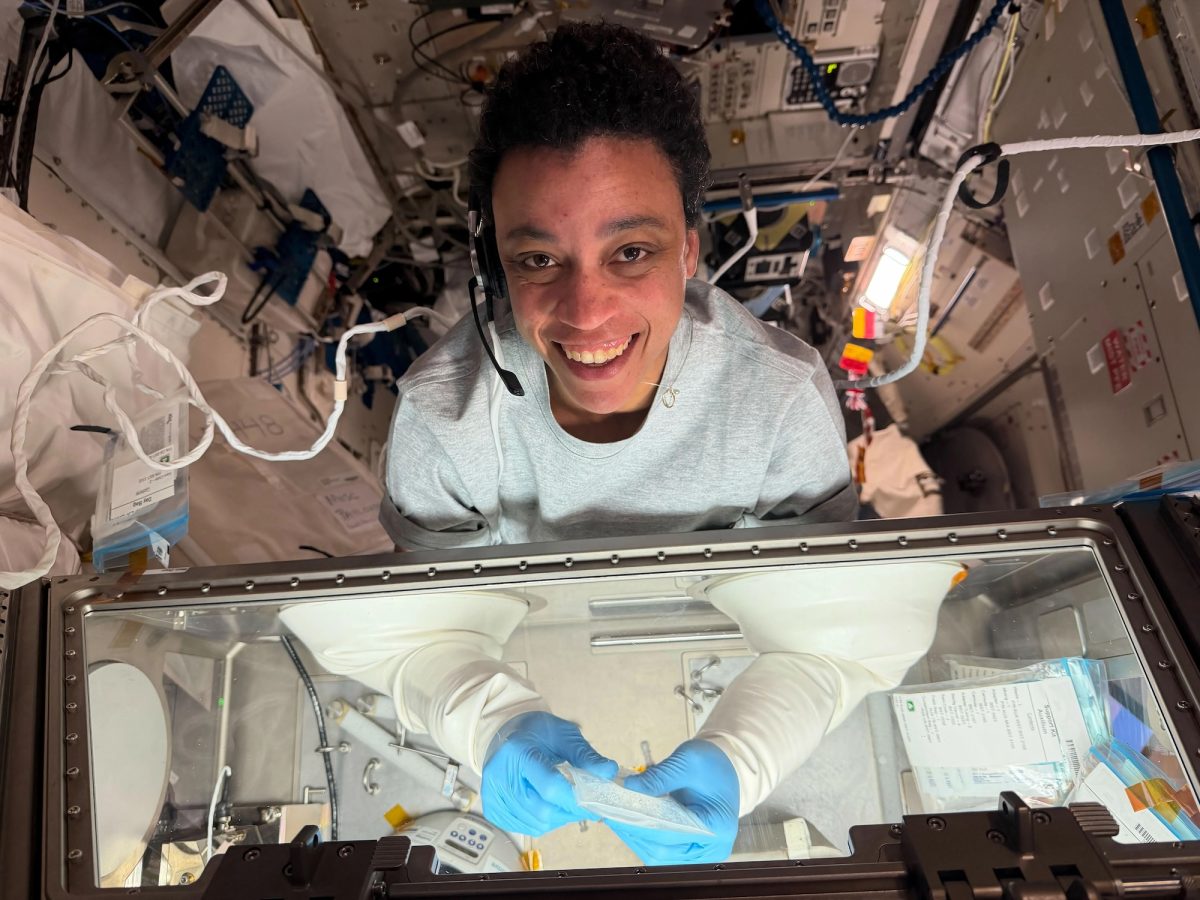
NASA astronaut Jessica Watkins, an Expedition 75 flight engineer aboard the ISS, works inside the Life Science Glovebox in Japan’s Kibo laboratory module. On October 9, she mixed living cells with bioink and loaded the mixture into a specialized cartridge. The sealed enclosure with built-in gloves allows biological samples to be handled safely in weightlessness.
The InSPA-Auxilium Bioprinter-Cell Printing experiment tests whether cartilage tissue can be 3D-printed in microgravity at a higher quality than on Earth. On Earth, soft structures made of living cells sag under their own weight; in orbit, they retain their intended shape more effectively. The results could bring cartilage production closer to reality for patients on Earth and crews on long-duration space missions.
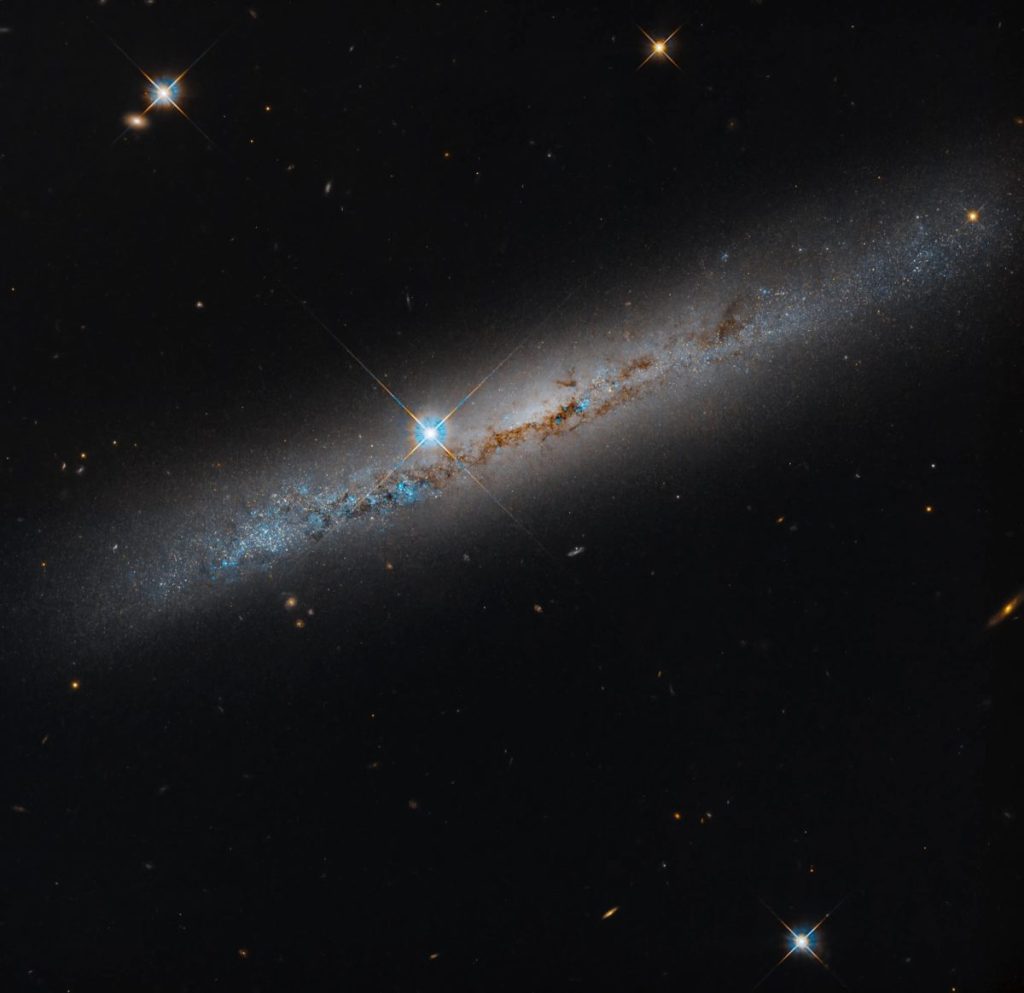
An Edge-On Spiral Galaxy
Hubble photographed the galaxy NGC 1827 in the constellation Columba, approximately 37 million light-years away. We see it edge-on, so its disk appears as a narrow strip crossed lengthwise by rusty-brown dust lanes. Bright blue specks, more numerous on the left, mark regions containing young, hot stars. A foreground star in our own Galaxy shines slightly left of center. Distant galaxies fill the background. Astronomers classify NGC 1827 as an intermediate spiral galaxy—a transitional type between barred and unbarred galaxies.
The image was obtained as part of a survey of 260 satellite galaxies surrounding 22 Milky Way-like galaxies within approximately 32 million light-years of Earth. Low-mass galaxies allow scientists to test cosmological models on small scales, where calculations disagree most strongly with observations. One well-known discrepancy concerns the number of dwarf satellites around large galaxies.
NASA released the image on October 16, and it appeared in the Image of the Day collection on October 22.
500 Seconds of Fire in Mississippi
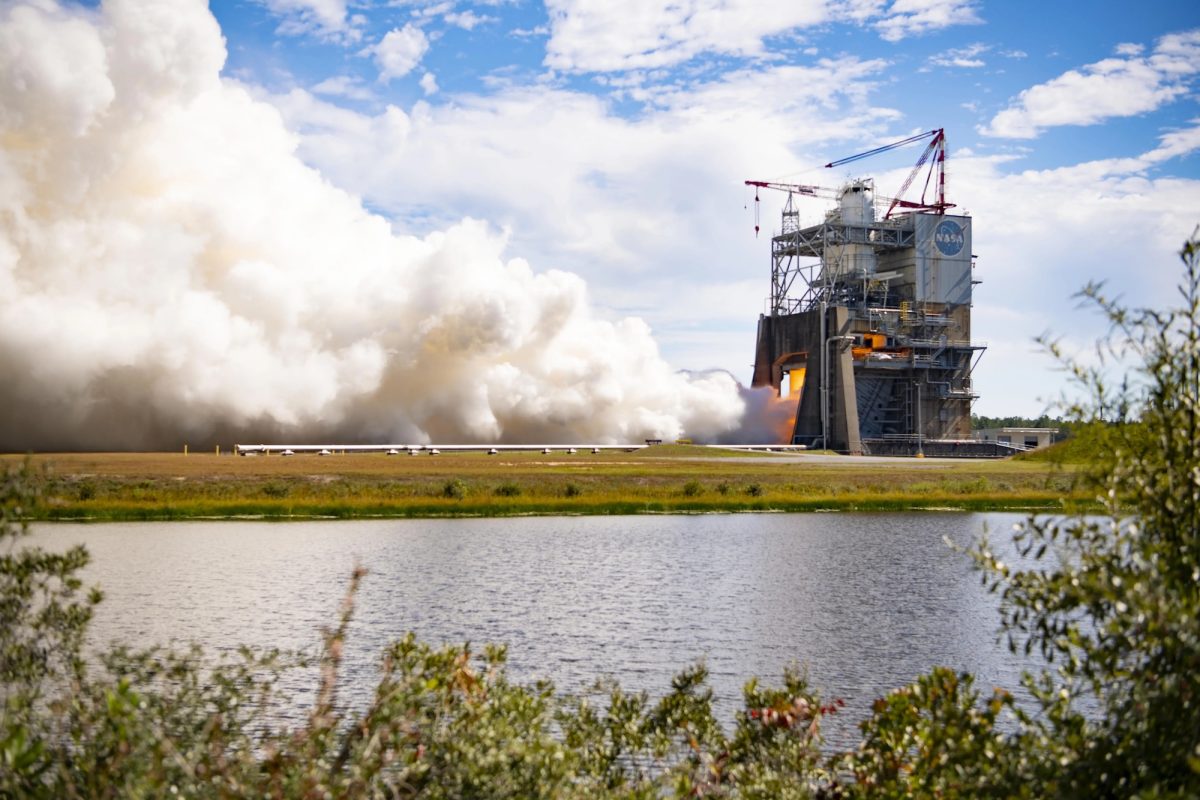
On October 21, RS-25 engine number 10001 was tested at NASA’s Stennis Space Center near Bay St. Louis, Mississippi. It fired for nearly eight and a half minutes, or 500 seconds—the same duration that RS-25 engines operate during an SLS (Space Launch System) launch. The engine reached 111% of its rated power level. During each Artemis mission, four RS-25 engines together produce up to two million pounds of thrust, approximately 8.9 meganewtons.
The white cloud in the image consists mainly of water vapor. The RS-25 runs on liquid hydrogen and liquid oxygen, making water the principal combustion product. Steam from the water used to cool the test stand adds to the cloud.
All RS-25 engines undergo hot-fire testing at Stennis before being cleared for flight. This particular engine is a development unit and will not fly into space. Data from such tests help NASA and prime contractor L3Harris Technologies improve engine performance and reliability.