

A U.S. startup proposes replacing a rocket’s first stage with a ground-based gun. The payload would complete the rest of its journey to orbit using its own engine. The developers promise a price several times lower than the level needed to make orbital data centers commercially viable. For now, the company is testing smaller installations and earning revenue from military testing.
A Ten-Kilometer Barrel
California-based Longshot Space Technology wants to build a gun with a barrel approximately 10 kilometers long and three meters in diameter. According to TechCrunch, it would accelerate payloads to 5 kilometers per second. That is not enough to reach orbit, since orbital velocity is approximately 7.9 kilometers per second. After leaving the barrel, the payload-carrying projectile would therefore act as a rocket’s second stage, continuing to accelerate under its own engine power.
Company CEO Mike Grace is targeting a price of $50 per kilogram. For orbital data centers to become profitable, launch costs need to fall to approximately $300 per kilogram. The ground-based installation is inexpensive to build and fuel, and it is reusable.
A Series of Pushes Instead of an Explosion
A conventional gun propels a projectile with a single explosion, placing the greatest load on it at the very beginning. In Longshot’s gun, high-pressure gas cylinders are positioned along a steel tube. When the projectile passes each successive opening, the corresponding cylinder releases gas. Acceleration builds gradually through a series of pushes.
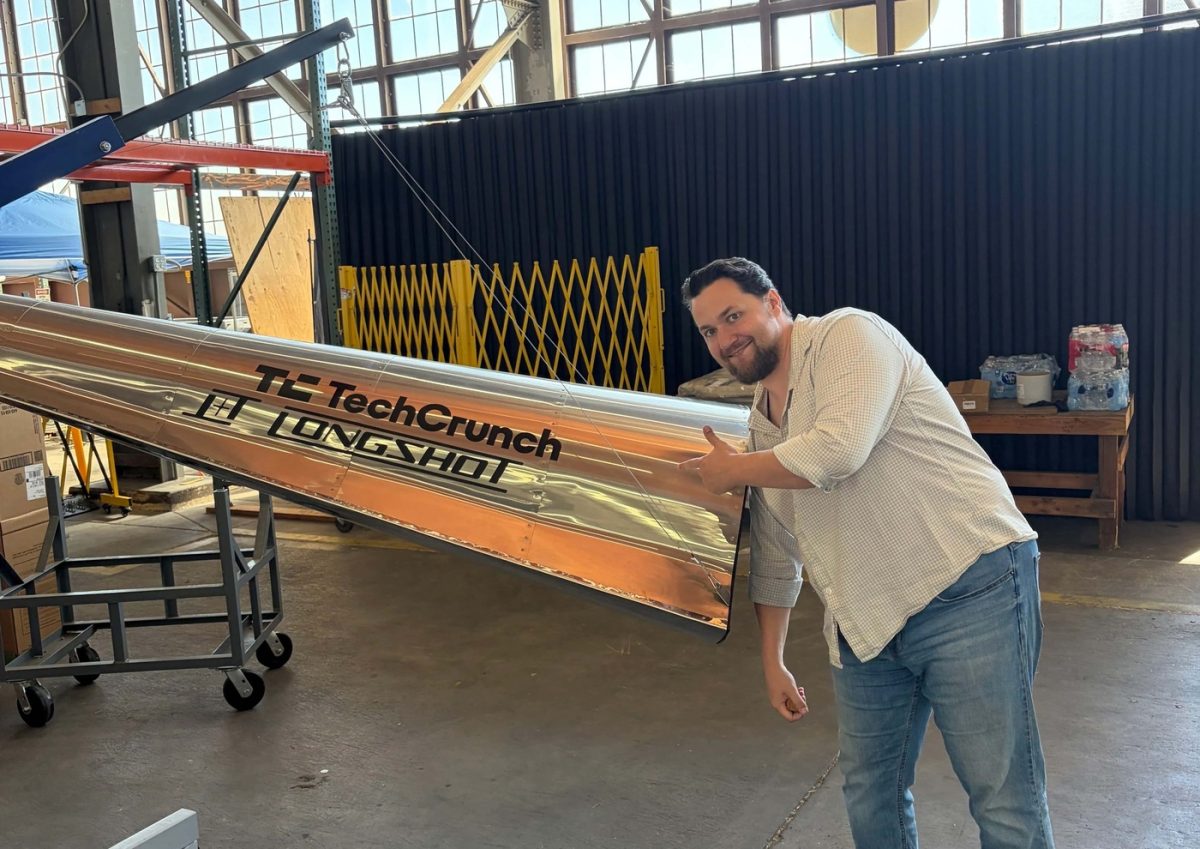
For now, the company is firing test projectiles. Their bodies function like aircraft wings, so the barrel lies horizontally, and the projectile gains altitude on its own after exiting.
According to Longshot Space Technology, the payload would experience approximately 250 g—250 times Earth’s gravitational acceleration. The developers estimate that a smartphone can withstand around 700 g.
Only spacecraft specifically designed for this launch method would be able to withstand it. The company has not yet published acceleration profiles or satellite test results.
An Idea from the Last Century
Mike Grace and Chief Technology Officer Nato Saichek are drawing on multichamber guns from World War II and research conducted in the 1960s. Grace compares this approach to SpaceX’s strategy of scaling up NASA’s developments.
A conventional gun had already reached space back then. In 1966, a projectile from the Canadian-American HARP project reached an altitude of approximately 180 kilometers.
Targets for the Military
The startup is already testing a 21-meter gun near Barstow. Later, the company hopes to build an intermediate, nearly kilometer-long gun for hypersonic testing, capable of accelerating 100-kilogram payloads to Mach 8—almost 10,000 kilometers per hour.
These installations are already generating revenue, as the U.S. military has awarded the company several contracts for hypersonic testing. According to Mike Grace, a training exercise to intercept a Chinese or Russian hypersonic missile costs around $30 million. Using a gun-launched projectile as the target for interceptors would bring the cost down to between a quarter and half a million dollars.
Investors have already put approximately $20 million into the startup. Nato Saichek acknowledges that the hardest part is not building the gun, but finding a site where construction of a ten-kilometer barrel will be permitted.
