

Starship placed 20 of the newest Starlink satellites on a suborbital trajectory during its 13th test flight. The spacecraft itself made a soft splashdown in the Indian Ocean and, for the first time, remained afloat and intact after completing the mission. Six of the newly deployed spacecraft also managed to photograph its heat shield and transmit detailed images back to Earth.
Engine Tests and Return
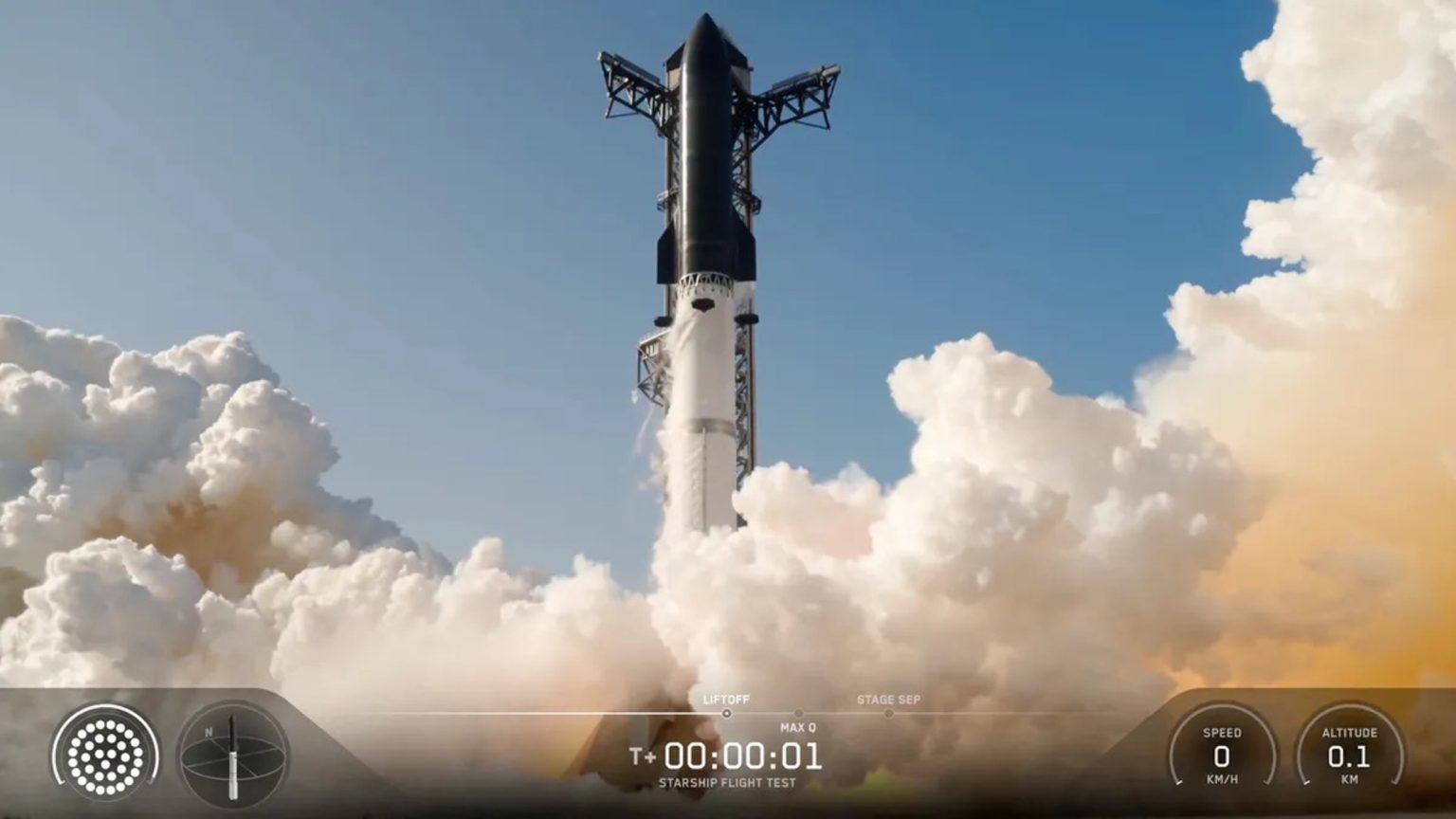
The flight began on July 25, Kyiv time, from the Starbase launch site in Texas. All 33 Raptor engines on the first stage ignited successfully, something SpaceX had failed to achieve one week earlier. On that occasion, six engines did not ignite, resulting in the launch being canceled.
During the return phase of the Super Heavy booster, some of its engines failed to relight. As a result, it descended too quickly and crashed into the Gulf of Mexico. Starship itself continued eastward and sequentially deployed 20 Starlink satellites at an altitude of approximately 200 kilometers. The spacecraft then reentered the atmosphere as planned.
Record-Breaking Splashdown
The conclusion of the flight was the most successful in the entire history of Starship testing. The spacecraft hovered vertically above the Indian Ocean before gently descending onto the water more than 16,000 kilometers from the launch site. It remained intact, with only small patches of flame visible along its sides. Universe Space Tech livestreamed the flight on our YouTube channel.
Recording of the livestream of Starship’s 13th test flight, during which the spacecraft placed 20 Starlink V3 satellites on a suborbital trajectory for the first time. Universe Space Tech
Previous attempts had ended in explosions during splashdown or the vehicle breaking apart in flight. SpaceX engineer Kate Tice called the launch “lucky flight 13.” NASA Administrator Jared Isaacman congratulated the team and noted that the data collected would be useful for future missions.
The successful splashdown brings the program closer to its main objective. NASA is relying on Starship to land astronauts on the Moon as part of Artemis III, while orbital docking with the spacecraft is expected to be tested as early as next year. Elon Musk sees Starship as a means of transportation for a future city on Mars.
Imaging the Heat Shield from Orbit
Six of the 20 deployed Starlink satellites carried cameras. After separating from the spacecraft, they photographed its heat shield and transmitted the images back to Earth. The image quality proved exceptionally high, even after Starship was already rocking on the waves in the ocean.
In addition to the cameras, pressure sensors were installed on the heat shield. Most of the thermal-protection tiles were black, but some were deliberately painted white to simulate the absence of a protective coating. This allowed engineers to test the shield’s resistance to extreme loads. Elon Musk confirmed that the team had collected all the necessary data—and even more.
Communication with the satellites lasted only 20 minutes. During that time, they exchanged data through laser and radio links before entering the atmosphere above the Indian Ocean. SpaceX now has more than 10,700 active Starlink satellites in orbit, making it the world’s largest satellite constellation.
47,000 Terminals in Ukraine
Every upgrade to the Starlink satellite constellation has direct implications for Ukraine. According to the Ministry of Digital Transformation, 47,000 terminals are currently operating in the country. For the military and critical infrastructure, this is not merely internet access, but the primary channel of resilient communication in areas where terrestrial networks have been destroyed or jammed by electronic warfare systems.
The new generation of spacecraft, equipped with laser inter-satellite links and greater bandwidth, strengthens the resilience of the entire network. Its stability is essential for coordinating military units, operating drones, and maintaining communications in areas where no other channels are available.