

The first financial half of 2026 has closed, and with it, the list of the largest investment rounds in the space industry has been formed. Over six months, more than $6.6 billion was invested in the sector. Six companies raised half a billion dollars or more each, although just last year a single round of that size was considered an exceptional event. The trend is visible in two dimensions at once: significantly more money is being invested, and it is directed not so much toward research as toward the development of orbital infrastructure, transportation, stations, inspection, and observation.
Fast Rockets and Orbital Logistics
Stoke Space, the developer of the reusable Nova rocket, expanded its October round by another $350 million in February. The total amount reached $860 million. The funds were directed toward completing Launch Complex LC-14 at Cape Canaveral. Nova is designed to deliver up to seven tons to low Earth orbit. Back in 2025, Stoke Space was selected for the U.S. Space Force’s National Security Space Launch Phase 3 program, opening access to contracts worth up to $5.6 billion.
Orbital transportation received a separate major boost. Impulse Space raised $500 million for a two-spacecraft system. Helios, which functions as an upper stage, is capable of delivering two tons to geostationary orbit. The Mira spacecraft works as an orbital tug for the final stage of delivery in orbit, with eight Saiph engines and a velocity reserve of up to 900 m/s. In 2026, the company signed a contract for three Helios launches on Falcon 9 rockets.
According to the Space Economy Institute, space logistics attracted $3.8 billion in six months. This is the third-largest sector by volume after satellite constellations and orbital manufacturing.
Stations, a Spaceplane, and Inspection
The Dream Chaser spaceplane and modules for the Orbital Reef station will receive $550 million. Sierra Space closed that round. The first free-flight demonstration of Dream Chaser is expected before the end of 2026. The Orbital Reef station is being built jointly with Blue Origin, and a significant share of the new funding is being directed toward defense applications. Dream Chaser is being considered as a platform for hypersonic research and rapid return of cargo from orbit.
Another company, Vast, raised $500 million for the Haven-1 station. Its launch is scheduled for early 2027. In February 2026, the developer successfully completed a demonstration mission with 49 experiments and expanded production in California.
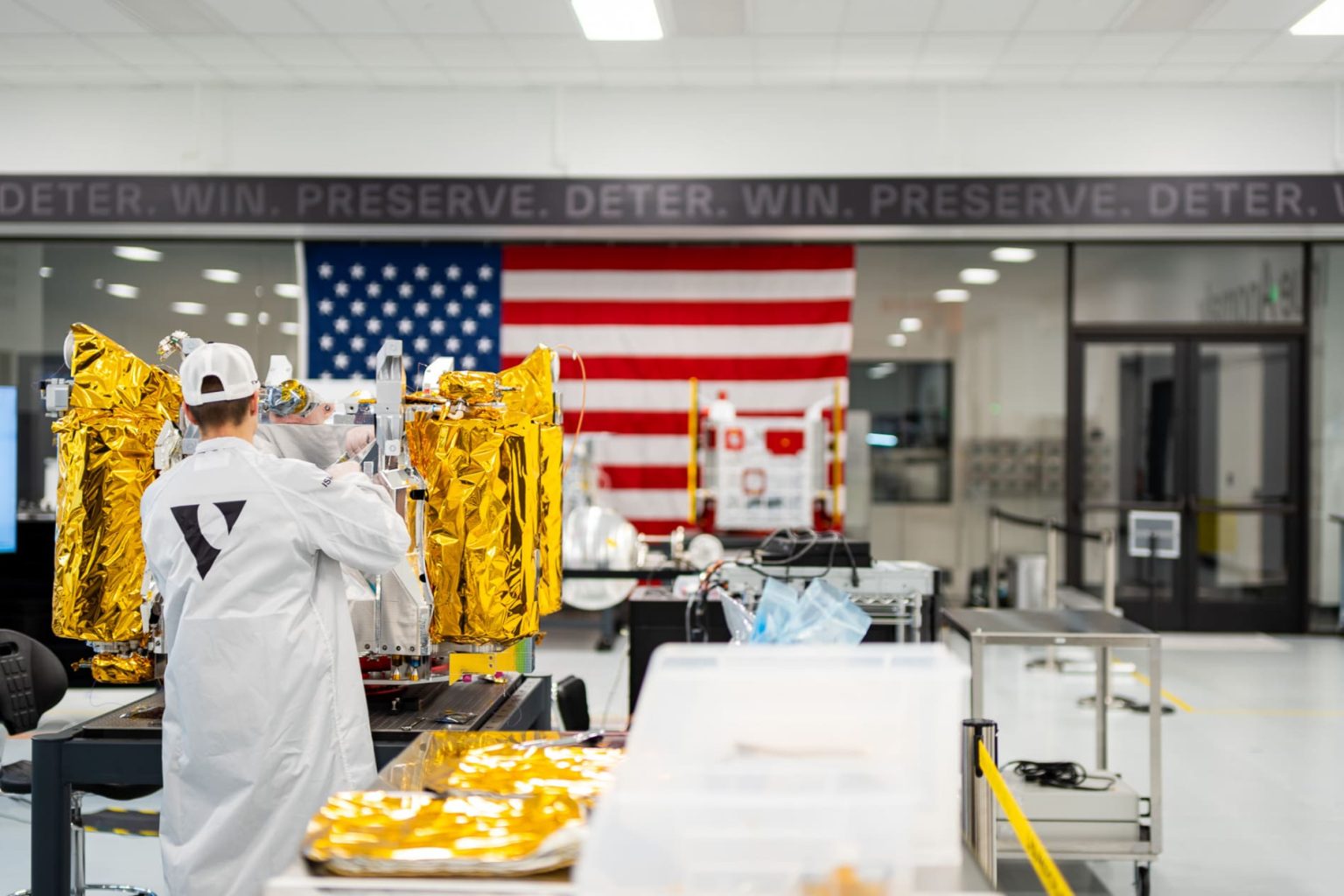
The Jackal spacecraft for orbital rendezvous and inspection brought its developer, True Anomaly, $600 million in investment. In early July, as part of the VICTUS HAZE mission, one such spacecraft intercepted a target satellite in 61 hours. That was 11 hours faster than the U.S. Space Force standard. Jackal is equipped with laser rangefinders, cameras, and the autonomous Mosaic planning system.
Seeing Through Clouds and Launching from China
Finland’s ICEYE raised $520 million. The company operates synthetic aperture radar satellites capable of seeing through clouds and darkness with a resolution of 25 centimeters. In March 2026, it placed six new spacecraft into orbit and began supplying ISR Cell containerized systems for military customers.
One of these satellites has been operating for the Main Directorate of Intelligence of the Ministry of Defense of Ukraine since August 2022. It was purchased with public donations through the Serhiy Prytula Foundation. In January 2026, Ukraine expanded its agreement with ICEYE, gaining access to the company’s entire constellation.
China’s iSpace raised $729 million, making it the largest round of the half-year. The company is developing Hyperbola rockets, competing with other private Chinese developers for the commercial launch market.
Other Investments
According to Payload, the investment surge is not concentrated in one sector or region. Significant rounds were recorded in the United States, Finland, Germany, Spain, and China. Funding is going to companies specializing in launches, infrastructure, space stations, communications, propulsion systems, orbital computing, and Earth observation.
Payload’s data cover only the largest rounds. In total, during the first half of the year, $28.7 billion was invested in the private space sector across 420 deals, and 18 new companies reached valuations above $1 billion. According to the Space Economy Institute, the total valuation of the private space sector reached $1.1 trillion.
Analysts are recording a shift from early-stage funding to later-stage rounds: investors are putting money into scaling rather than risky research. Government investment in space and defense demand remain high, but Payload analysts recommend watching whether a SpaceX IPO changes the landscape in the second half of the year.