

The surface of our star is a turbulent region that continuously emits streams of plasma and solar wind, which frequently reach our planet. Historically, scientists held the view that these cosmic phenomena influenced Earth’s atmosphere predominantly over extended periods. However, recent research indicates that intense magnetic storms can alter Earth’s weather almost immediately.
Illustration produced by Gemini AI
Based on the findings of a study published in Geophysical Research Letters, geomagnetic storms induce weather anomalies that persist for a few hours to several days. Moreover, the magnitude of these changes is directly proportional to the intensity of the storm.
We have long recognized the subtle influence of the 11-year solar cycle on our atmosphere. However, what is particularly noteworthy is our recent observation of a significantly more potent short-term effect. This effect becomes evident within the first 24 hours following a solar storm, as explained by Joachim Raeder, Professor Emeritus of Physics at the University of New Hampshire and author of the study.
Discoveries in the long-standing archives
Approximately every 11 years, the Sun’s magnetic field reverses its polarity. In the days preceding this event, solar activity attains its zenith: the number of sunspots, solar flares, and coronal mass ejections escalates markedly. Prior scientific investigations have indicated a correlation between the phases of the solar cycle and climate variables such as precipitation and temperature. Nevertheless, due to the intricate interdependence of most climate variables, comprehending their true physical nature remains a significant challenge.
To elucidate this enigma, Professor Raeder meticulously examined space weather archives spanning the past seventy years and integrated this data with the most recent atmospheric condition reports. Utilizing advanced computational models and anomaly-mapping techniques, the researcher successfully identified patterns that were previously concealed.
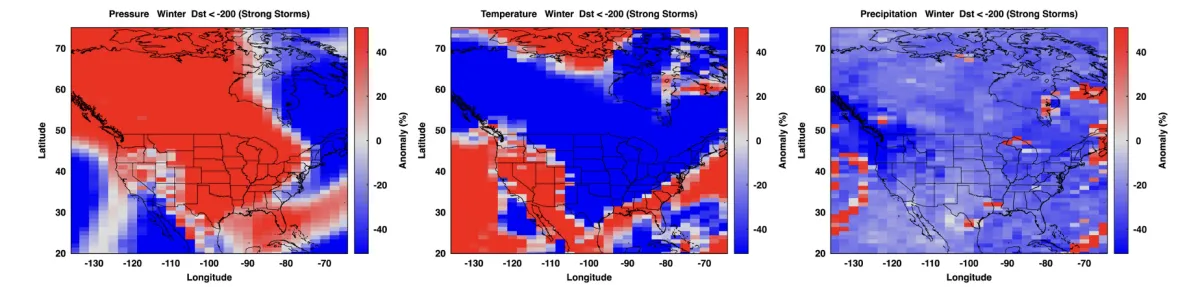
The analysis demonstrated that powerful solar storms can have a weak but statistically significant effect on atmospheric circulation over North America. For instance, a notable reduction in precipitation was documented over Hudson Bay in Canada and the Rocky Mountains in the western United States immediately subsequent to geomagnetic storms. Notably, significant winter and summer storms exerted a more pronounced ‘suppression’ of rainfall or snowfall compared to spring or autumn storms. Local variations in wind velocity, surface pressure, radiation, and temperature were also observed, albeit in a scattered distribution across North America.
Unraveling a complex mechanism
Although the recent investigation distinctly demonstrates the correlation between geomagnetic storms and abrupt weather variations, it does not yet establish a direct causal relationship. Nonetheless, this data is crucial for understanding the physics underlying the interaction between space and Earth.
Professor Raeder posits that solar storms can diminish precipitation via electromagnetic radiation of solar flares. This radiation permeates the lower atmospheric layers through the polar vortex — a vast region of low pressure and cold air encircling the Earth’s poles. He considers this the most plausible explanation for the observed climatic anomalies.
The scientist concludes, “My findings narrow down the list of possible physical processes and challenge current atmospheric models, compelling them to adapt in order to accurately reproduce this solar influence on the weather.”
We previously discussed the impact of solar eclipses on Earth’s atmosphere.
Provided by unh.edu
