

The event AT2019ijn, which occurred in 2019, belongs to the rare class of fast-evolving optical transients. A new study suggests that it is equally likely to have been a jet launched by a supermassive black hole at the center of a dwarf galaxy.
Mysterious Blue Transient
Chinese scientists have investigated the unusual event AT2019ijn, which was observed by the Zwicky Transient Facility seven years ago. According to phys.org, a study was recently published in The Astrophysical Journal Letters in which the researchers attempted to determine the nature of the event.
In astronomy, transients are generally defined as phenomena that can be observed in the sky only for a short, limited period and then disappear permanently or for an extended period. The best-known example is a supernova, but the more carefully scientists examine the darkness of the night sky, the more diverse types of such events they discover.
At the time of its observation, AT2019ijn was classified as a fast-evolving optical transient—a very rare type of temporary event whose entire development cycle lasts no more than a couple of weeks and whose peak emission intensity falls within the blue part of the visible spectrum. However, the researchers have now collected data from all available astronomical instruments operating in different parts of the spectrum regarding what they observed seven years ago and reached an interesting conclusion.
What the Research Showed
The new study was based primarily on information that had already been known. The unidentified event occurred near a dwarf galaxy with a redshift of 0.27. This means that it is not located at the edge of the Universe, but it is also not close enough for its details to be easily observed.
The researchers were able to determine the light curve more precisely. The event’s absolute magnitude initially increased to −21 within five days and then slowly declined over the course of a month. This closely resembles fast-evolving optical transients, although the decline in brightness lasted unusually long.
This prompted the scientists to compare AT2019ijn with other types of transients. In particular, a prolonged decline is more characteristic of superluminous supernovae and tidal disruption events. The most interesting findings emerged from the analysis of the event at radio wavelengths. In this range, the brightness increased for an exceptionally long period and reached its peak only 641 days after the event began.
At radio wavelengths, the brightness of AT2019ijn was significantly greater than that of any fast-evolving optical transient or superluminous supernova, although it was comparable to the emission produced during a tidal disruption event, when a black hole tears a star apart.
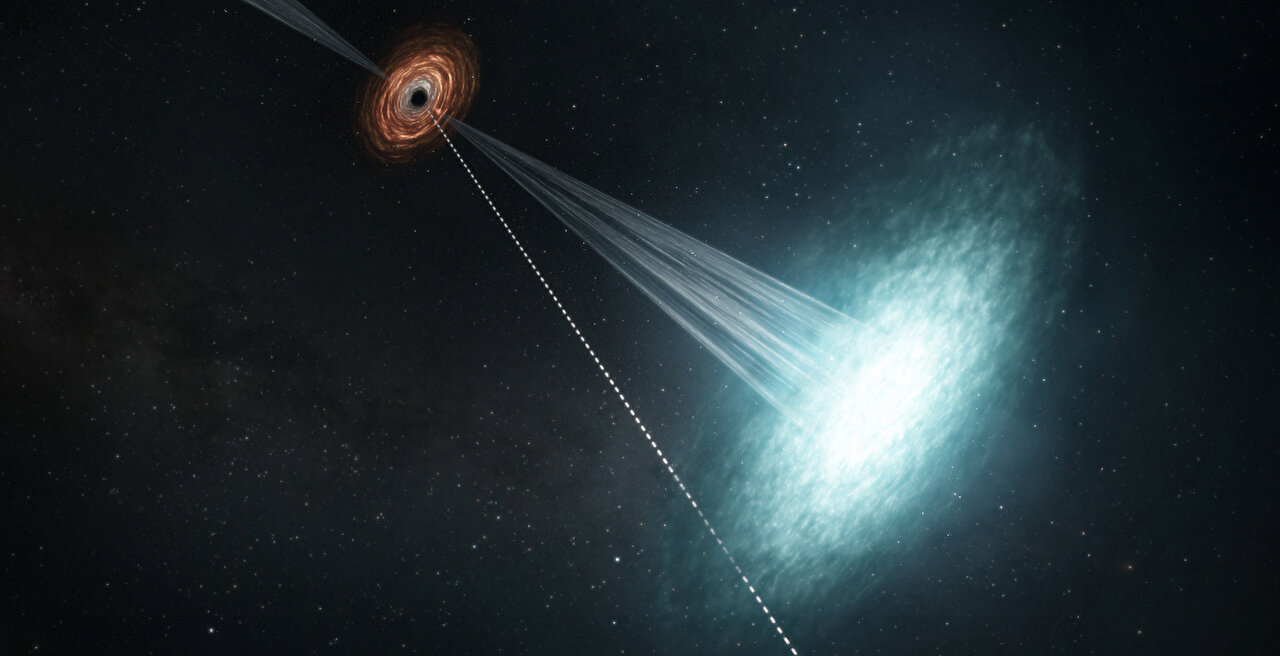
Ultimately, the scientists concluded that there are two possible explanations for the event that produced AT2019ijn. It may have been either a flare near a supermassive black hole accompanied by the formation of a relativistic jet, or a similar jet launched by a magnetar. The delayed fading may be explained by the jet being directed toward Earth. However, the possibility that it represents an entirely new phenomenon cannot be ruled out.