

The Chandra X-ray telescope has helped scientists determine the nature of a mysterious cosmic structure nicknamed the “Treble Clef” because of its shape. They believe it is an outflow from the surroundings of a supermassive black hole, produced by a collision between galaxy clusters.
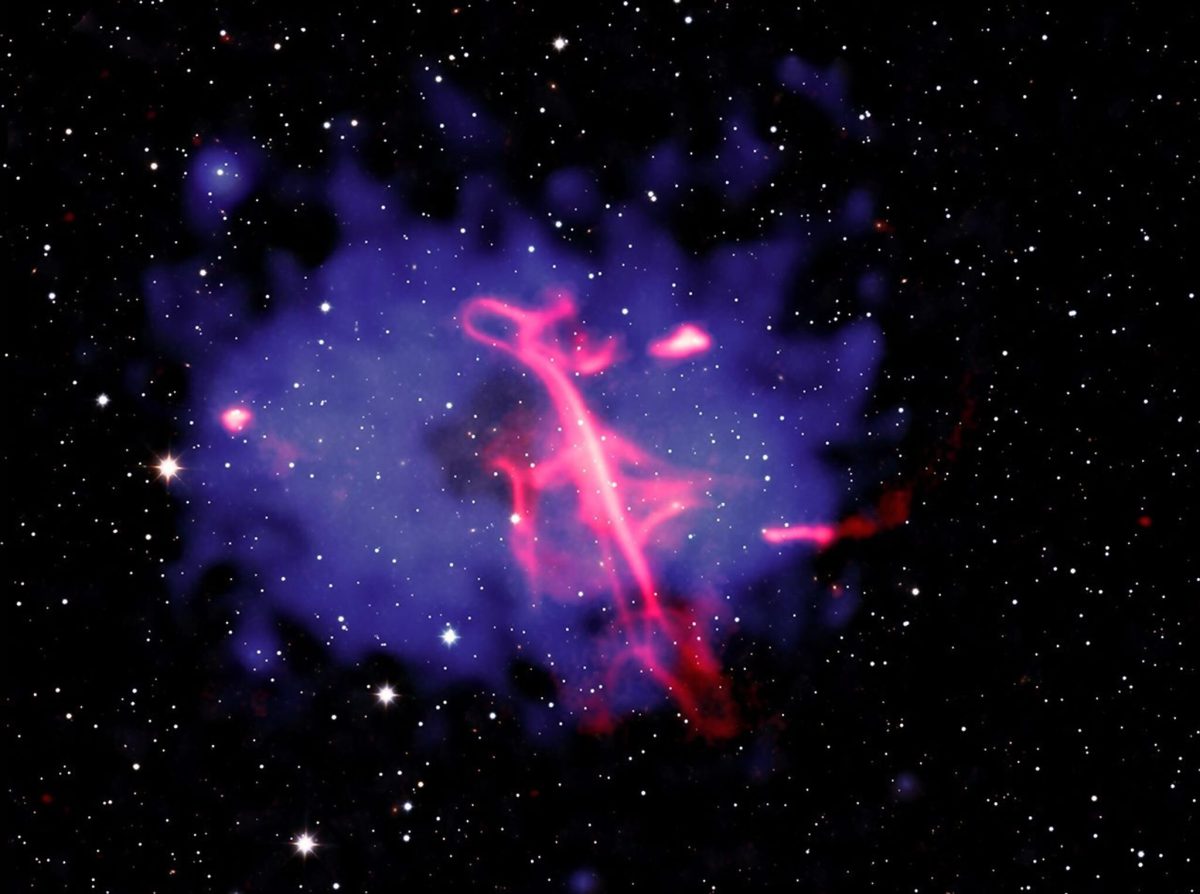
A Treble Clef in Space
Did you know that a giant treble clef, resembling the symbol used in musical notation, hangs far out in space? It was discovered some time ago using the French LOFAR (LOw Frequency ARray) radio telescope. Now, according to phys.org, scientists have figured out how it formed.
Researchers from Italy’s National Institute for Astrophysics published a paper on the subject in Astronomy & Astrophysics. It describes findings from observations by two space telescopes operating at X-ray wavelengths: the American Chandra and the German eROSITA (Extended RÖntgen Survey with an Imaging Telescope Array).
Of course, there is no actual mysterious symbol suspended in space. The unusual shape is not even visible in the portion of the electromagnetic spectrum that human eyes can detect. It is simply a cloud of gas hanging in space many millions of light-years away.
An Outflow and a Collision
But what caused this cloud of gas, roughly the size of a small galaxy, to emit energy at X-ray and radio wavelengths—and to take on such a shape? Its location within a galaxy cluster provides the answer.
It began when the black hole at the center of one of the stellar systems making up the cluster could not “digest” all the material falling toward it and expelled some of it into intergalactic space. The material ended up between several stellar systems undergoing a collision.
This event ionized the gas and caused it to emit energy. Gravity then came into play. Colliding galaxies also set enormous quantities of ordinary, uncharged gas in motion, causing it to press against the outflow. When researchers used computers to remove the spherical component of the “treble clef,” formed entirely by the original outflow, it became clear that the structure had been shaped by the collision of several shock waves.
