

The radio galaxy J023721.13−010528.5 is surrounded by vast clouds of ionized gas that emit powerful radio waves. Scientists have found evidence that the supermassive black hole at its center launched jets during four separate episodes, leaving behind four pairs of radio-emitting structures.
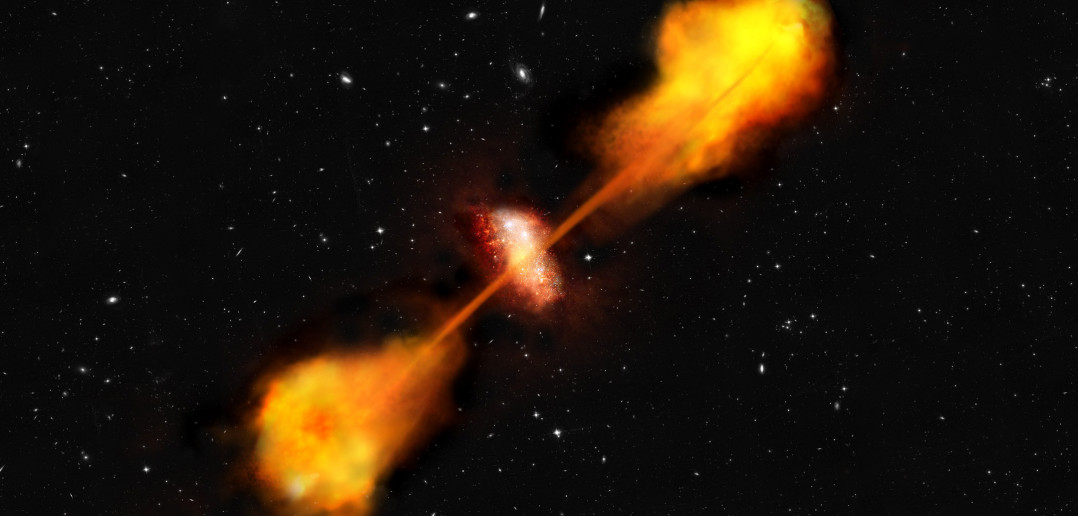
Radio Galaxy Outbursts Leave Lasting Traces
According to Phys.org, astronomers have identified what may be the first member of a new class of radio galaxies. Its central black hole appears to have produced powerful jets on four separate occasions. High-resolution observations with the upgraded Giant Metrewave Radio Telescope (uGMRT), combined with data from MeerKAT and the Very Large Array, revealed four pairs of radio structures positioned symmetrically on either side of the host galaxy.
Radio galaxies have active galactic nuclei whose central supermassive black holes launch powerful jets of particles that emit radio waves. Particularly powerful radio galaxies, classified as FR II, develop bright hotspots where their jets collide with the surrounding gas. The resulting structures can extend for millions of light-years, making them some of the largest structures associated with a single object in the universe.
In a small subset of FR II radio galaxies, the central black hole appears to restart its jets repeatedly. Each episode leaves behind a distinct pair of hotspots. Structures from older episodes generally lie farther from the galactic core, while those associated with more recent activity are found closer to the center.
Galaxies showing two such episodes are called double-double radio galaxies, with approximately 192 examples known. Triple-double radio galaxies preserve evidence of three episodes and are much rarer: only seven confirmed or candidate examples have been identified. Until this discovery, no radio galaxy had been found with evidence confirming four separate episodes of jet activity.
For this study, a team led by Pavan Vijay Khadekar of the Indian Institute of Science Education and Research, Pune, investigated the radio source J023721.13−010528.5. It is hosted by a massive elliptical galaxy at a redshift of 0.372.
Determining the Spectral Ages of the Hotspot Pairs
Combining observations from three radio telescopes across multiple frequency bands, the researchers identified four distinct pairs of hotspots, labeled N1–N4 and S1–S4, extending outward from the core. They calculated the physical distance between each hotspot and the core and estimated the pairs’ kinematic ages by assuming a typical hotspot advance speed. They also derived spectral ages by examining how the radio spectra steepen as the emitting particles age.
The team conducted additional tests to distinguish separate episodes of activity from an alternative explanation: that the structures were simply knots within a continuously active jet. Under the latter interpretation, the knots would be expected to have nearly identical radiative ages. Separate episodes, by contrast, should produce a clear pattern of increasing age with distance from the core.
The estimated spectral ages of the hotspots range from 4.5 to 20.5 million years. The researchers found that the emitting material generally becomes older farther from the center, matching the pattern expected from successive episodes of jet activity. The outer structures therefore preserve older radio-emitting particle populations than the inner ones.
The team notes that observations of the fainter southern side, particularly the S3 region, are less reliable. This results in larger uncertainties and less clearly defined trends than those seen along the northern jet.
A Quadruple-Double Radio Galaxy with S-Shaped Jets
The researchers then performed a statistical analysis of the structures’ symmetry. Under the assumptions of their model, the observed arrangement favored the interpretation of separate hotspot pairs by a factor of approximately three million over the alternative involving randomly positioned knots.
They concluded that J023721.13−010528.5 records four distinct episodes of jet activity, making it a quadruple-double radio galaxy, or QDRG.
The team also discovered a systematic change in the orientation of the hotspot pairs. Taking the innermost pair, N1–S1, as a reference, the axes of the other pairs are rotated counterclockwise by progressively larger angles: −7° for N2–S2, −16° for N3–S3, and −24° for N4–S4. This suggests that the direction of the jets has changed over time, potentially reflecting a slow wobble, or precession, of the central black hole’s spin axis.
This progressive change in orientation is consistent with the radio source’s S-shaped morphology. The separation between its outermost hotspots is approximately 3.9 million light-years, or 23 quadrillion miles, making it the second-largest known S-shaped radio source. The researchers suggest that giant S-shaped radio galaxies may be particularly promising targets in the search for other rare systems that preserve evidence of multiple episodes of jet activity.