

According to a new University of Florida study, plants begin responding to spaceflight almost immediately after leaving Earth. The research, which captured the earliest stages of biological adaptation during a commercial suborbital mission, was published in the journal Microgravity. It reports the results of an experiment conducted by an astronaut during Blue Origin’s New Shepard NS-26 flight on August 29, 2024.
A Plant Experiment During a Suborbital Flight
For more than two decades, University of Florida space biologists Rob Ferl and Anna-Lisa Paul have worked together to understand how living organisms respond to spaceflight. For this study, they designed an experiment to capture biological changes during different stages of the mission, according to phys.org.
Scientists have long studied how plants and other organisms respond after spending days, weeks, or months in space. Far less is known about the biological changes that occur during the first few minutes of spaceflight and how these responses change as a mission progresses.
“The science that can be done on a suborbital flight is real and worth the trip,” Ferl said. “There is tremendous intrinsic value in the suborbital environment itself, including understanding rapid changes in biology during different phases of spaceflight, especially the first few minutes in space.”
Preserving Samples in Tubes at Four Stages of Flight
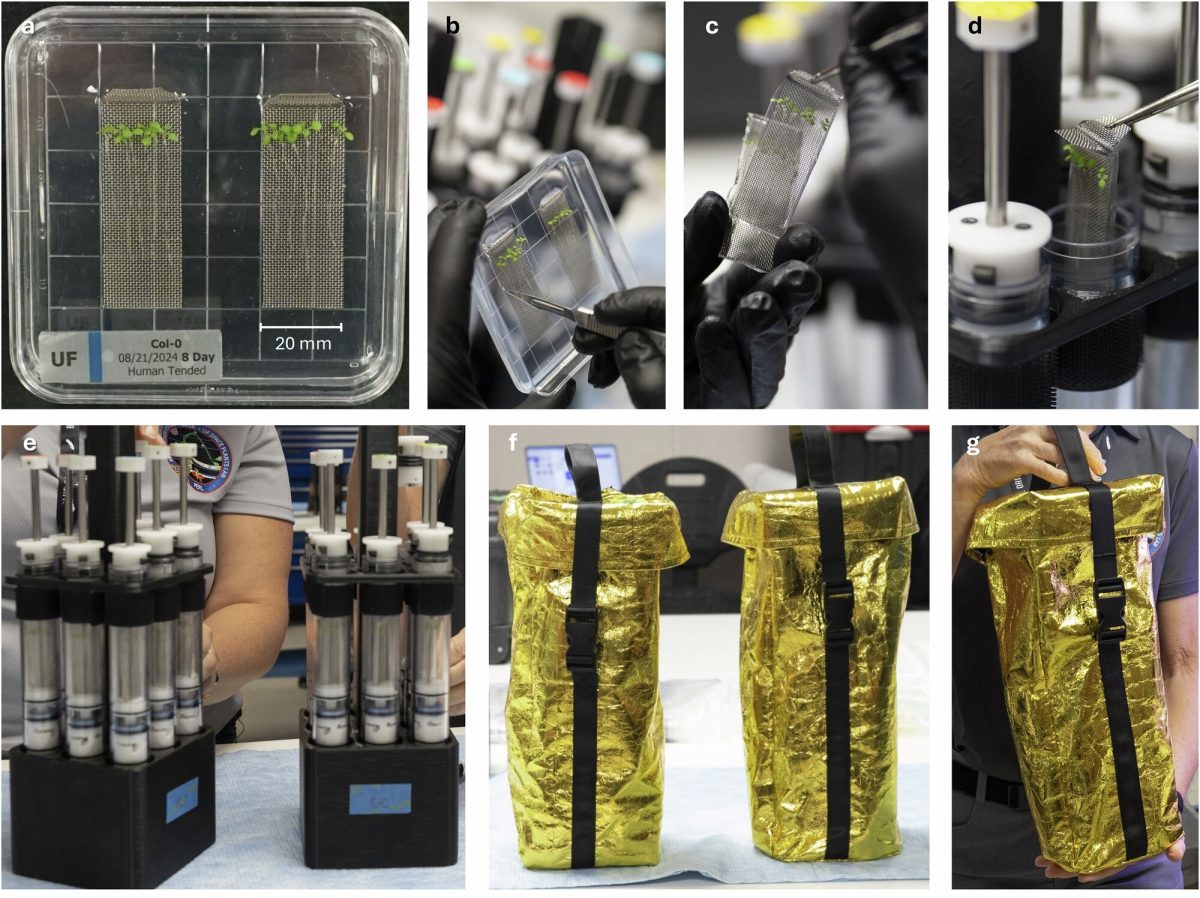
For the mission, Ferl carried dozens of Arabidopsis plants in specially designed tubes attached to his suit. He activated them at four different points during the journey to space and back: before launch, upon reaching microgravity, at the end of weightlessness as descent began, and upon landing. Paul and colleague Jordan B. Callaham prepared the plant tubes for flight, after which Paul handed them to the Blue Origin capsule team before launch.
At the ground payload-processing facility, Callaham tracked Ferl’s progress and activated a corresponding set of control tubes at the same time, while Paul headed out to meet the capsule and oversee landing operations on site. This coordinated effort allowed the researchers to compare plants undergoing spaceflight with identical plants that remained on Earth and examine how the samples changed from one mission phase to the next.
The devices, known as Kennedy Space Center Fixation Tubes, preserve biological material at the moment of activation. The tubes, which the University of Florida team helped develop, have been used for hundreds of samples collected during space shuttle and International Space Station missions. Using them aboard New Shepard allowed the researchers to apply proven orbital research technology to suborbital spaceflight.
Paul said the hours of training and preparation the team completed before the mission proved invaluable. Activations had to occur at precisely the right moments, both in flight and on the ground, to produce meaningful comparisons between the spaceflight samples and their ground controls.
Plant Gene Activity Changes with Each Mission Phase
Gene activity changes during flight. The findings provide one of the clearest pictures of what happens during the transition from Earth to space. The researchers identified more than 1,200 genes whose activity changed during the flight. Responses differed between leaves and roots and varied across the mission’s phases.
Many of the affected genes are involved in how plants respond to stressful conditions and environmental changes. The findings suggest that acclimation to spaceflight is not a single biological adjustment that occurs once an organism reaches space. Instead, it is a gradual process involving distinct responses during launch, entry into microgravity, descent, and return to Earth.
The experiment’s results give scientists a more detailed understanding of how biological acclimation to spaceflight unfolds.
How Do Scientists Conduct Experiments Directly in Space?
Beyond the biological discoveries, the mission demonstrated that an academic researcher can personally conduct an experiment during spaceflight in a “shirtsleeve” environment, without relying entirely on automation or specially trained astronauts.
Many spaceflight experiments must either operate autonomously or be conducted by astronauts responsible for a wide range of research. During NS-26, Ferl flew specifically to tend to the experiment he and Paul had designed. He could observe the sampling process, check that preservatives properly covered the samples, adjust the movement of the tubes to ensure rapid preservation, and record observations about the timing and quality of each sample.
Ferl wrote an article about scientists flying into space, sharing his experience aboard Blue Origin’s New Shepard and making the case for sending researchers into space alongside their experiments. “Involving the researcher directly in the process creates better science and better scientists,” Ferl writes, arguing that personally observing an experiment can provide insights that are difficult to obtain remotely.
The successful mission showed that scientists can effectively manage their experiments during spaceflight and that commercial suborbital spacecraft can serve as research platforms. This approach gives researchers direct access to the environment surrounding an experiment and opportunities to make observations unavailable through automation or remote control.
