

The private aerospace company Blue Origin, founded by Jeff Bezos, has presented a new technological solution for powering future lunar missions — the vertical Power Tower solar system. The structure is designed to operate in the extreme conditions of the Moon’s south pole, where sunlight falls at a very low angle.
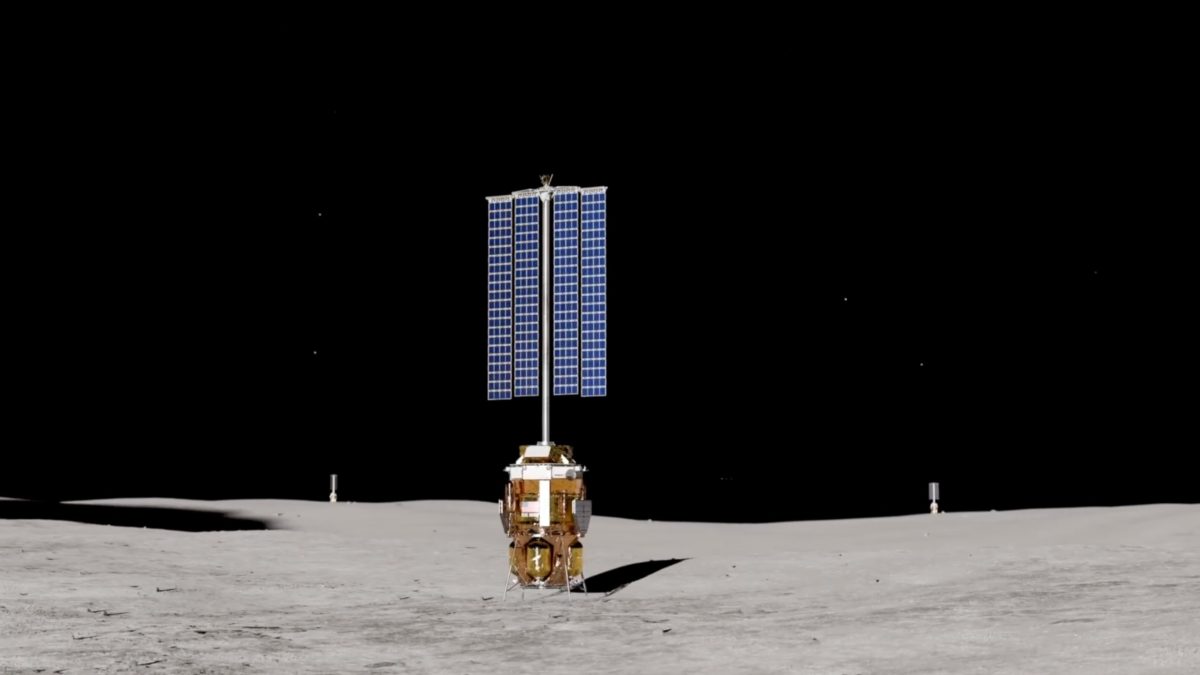
According to Blue Origin representatives, the Power Tower is a 20-meter tower with vertically deployed solar arrays. It is capable of generating more than 10 kW of electricity, which is a critically important figure for the autonomous operation of a lunar base and related equipment.
The company released an animation showing the tower landing and deploying on the lunar surface, as well as video footage of an actual ground test conducted on July 22, 2026. During the test, the mast automatically extended from the base, after which supports unfolded from the central section, deploying the foldable solar panels.
The modular architecture of the system makes it possible not only to power the lander itself, but also to transmit energy to other elements of lunar infrastructure — from lunar rovers to research modules.
The Power Tower is an evolutionary continuation of the LAMPS (Lunar Array Mast and Power System) project. This technology was developed by Honeybee Robotics — a Blue Origin subsidiary — and was successfully tested at NASA’s Johnson Space Center in Houston in 2024.
Power changes what’s possible on the lunar surface.
Our Power Tower is a 20-meter-tall, vertically deployed solar array system designed to provide more than 10 kilowatts of power for Moon Base operations at the lunar South Pole. Its modular architecture will support future surface networks, extending power beyond the lander to the assets that need it most.
Explore the concept in our animation below, then watch a successful real-world deployment: https://t.co/Ff5cuAWguB
— Blue Origin (@blueorigin) September 25, 2026
Honeybee Robotics is one of the key participants in NASA’s VSAT (Vertical Solar Array Technology) project. The goal of this program is to create reliable sources of solar power to support a long-term human presence on the Moon.
Blue Origin sees the Power Tower as an element of a future lunar base that NASA plans to build near the south pole as part of the Artemis program. The first stage of the project is planned through 2029, while full operation of the lunar settlement is expected by 2032.
Previously, we reported on how Blue Origin overtook SpaceX and will be the first to fly to the Moon.
Based on materials from Space
