

The brightest nuclei of distant galaxies have been found in record numbers all at once. All of them come from a time when the Universe was only a few hundred million years old. The light from the two oldest objects traveled to Earth for more than 13 billion years, and the first giant black holes had already managed to grow to impressive sizes by then. Previously, scientists knew of only a handful of similar objects from that era.
The Nature of Quasars
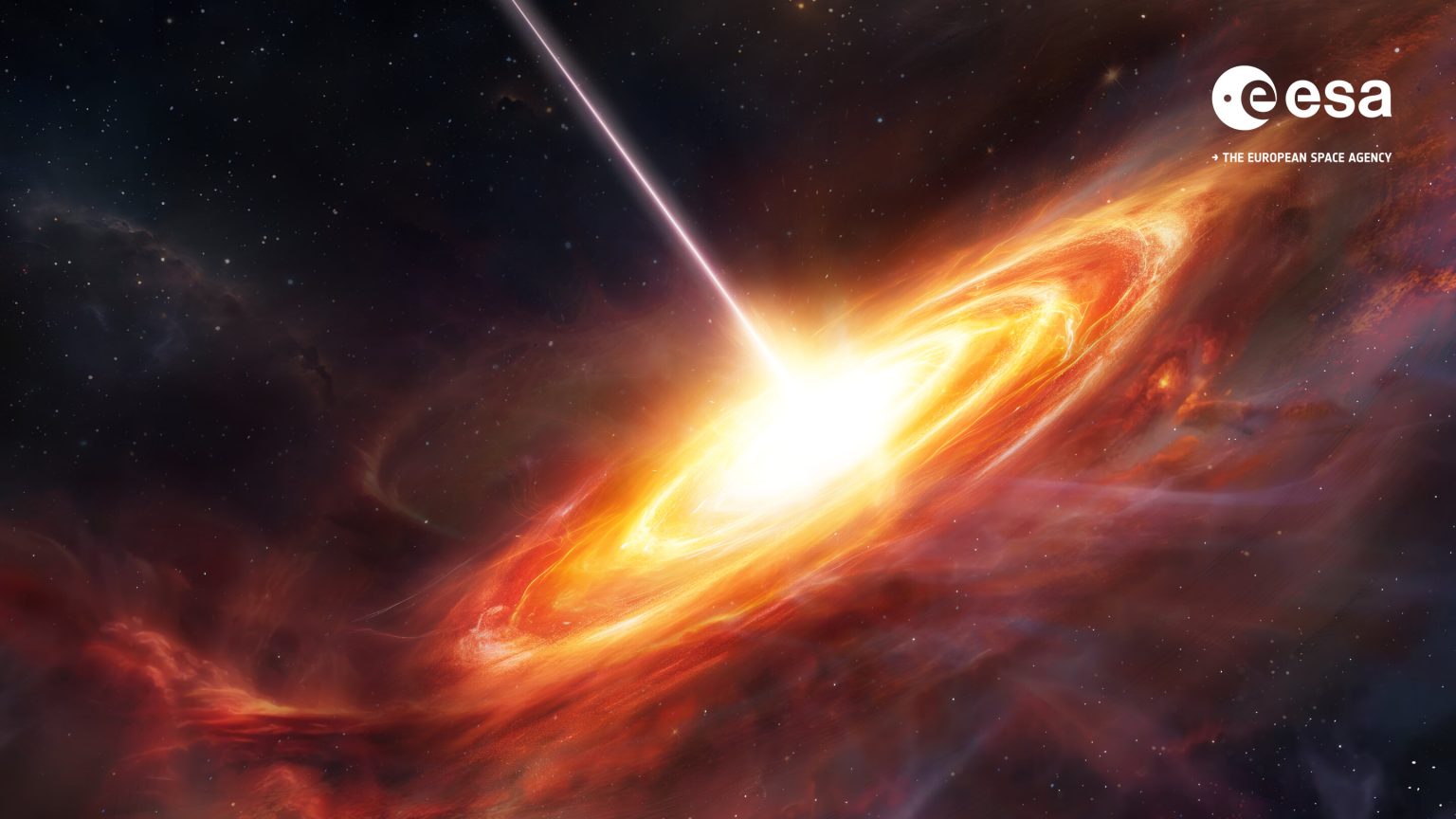
A quasar is a stage in the life of a galaxy when large amounts of matter spiral toward the supermassive black hole at its center. This process is accompanied by the release of an enormous amount of energy, so at this stage the galactic nucleus shines brighter than almost anything other objects in the visible Universe.
At such a moment, it outshines everything around it by hundreds, and sometimes even thousands, of times. However, this state does not last long by cosmic standards, so observing something like this is rare.
Difficulties of the Search
The most distant quasars are extremely rare, because few galaxies had enough time to grow to the necessary size so early. Their light is also very faint and can easily be confused with radiation from stars much closer to us.
ESA’s Euclid telescope, launched in 2023, was designed precisely to study this difficult region of cosmic history. According to the agency, the known number has now increased to thirty-one, and the search boundary has been pushed back to a period when the Universe was only 5% of its current age, phys.org reports.
Record Distance
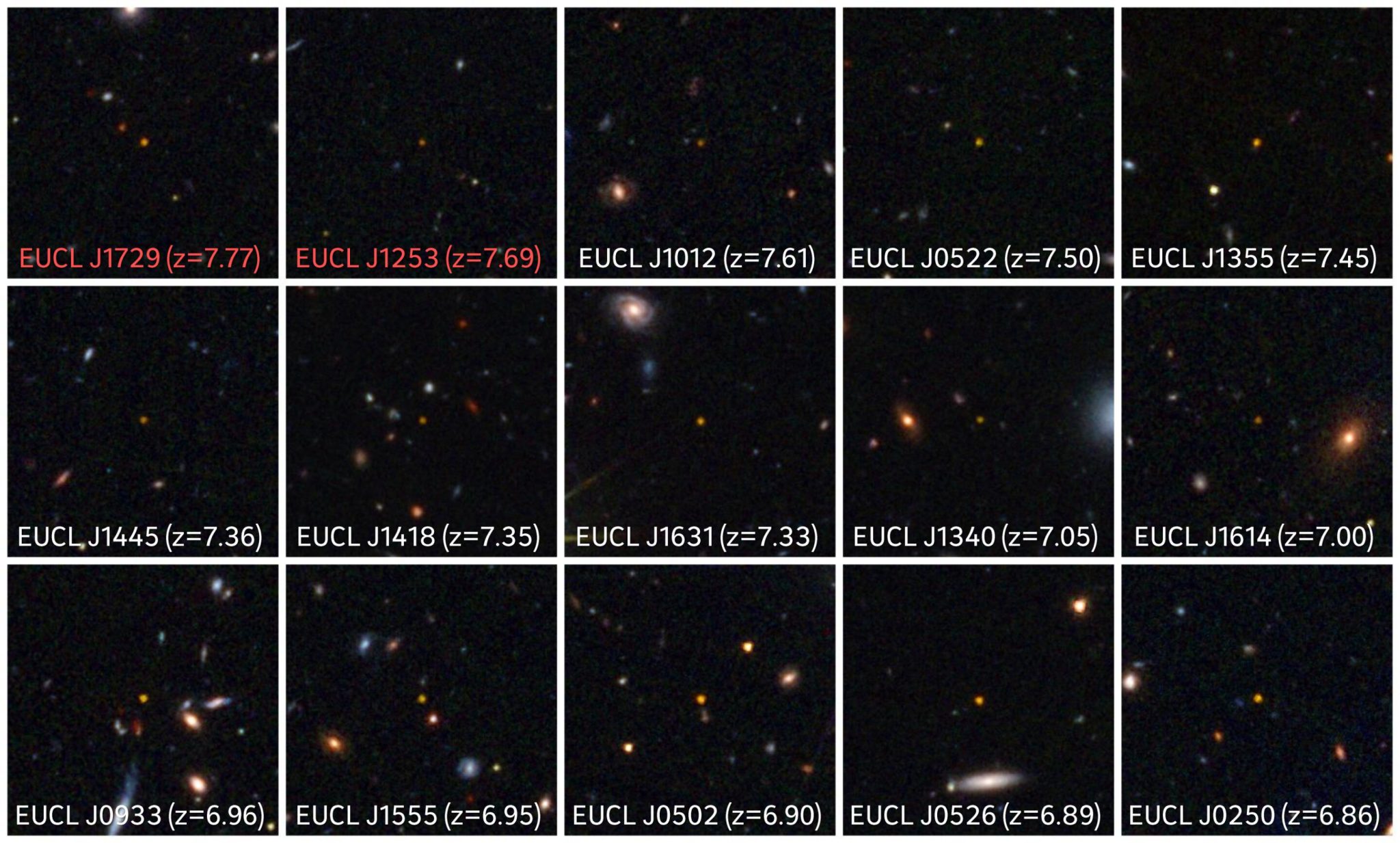
Of the total number, twelve quasars have a redshift of 7 or higher, corresponding to the first 770 million years of the Universe’s existence. Two of them turned out to be among the most ancient ever found.
They were designated EUCL J172902.75+641018.1 and EUCL J125308.55+705432.3, and their redshifts — that is, the extent to which the expansion of space stretched the wavelength of their light — are 7.77 and 7.69, respectively. They appeared within the first 670 million years of the Universe’s existence.
If the entire history of the cosmos were compressed into a single day, both would have lit up just over an hour after its beginning. “This discovery more than doubles at once the number of known quasars this ancient,” says Antonio La Marca, an ESA research fellow on the Euclid team. Astronomers spent more than a decade finding the first roughly ten such objects, while Euclid found the same number or more in just twelve months.
The Epoch of Reionization
“The Euclid team has carried out the first true census of quasars at the dawn of the Universe,” Antonio La Marca notes. Scientists can now study early supermassive black holes not one by one, but as a large group.
They take us back to a special period in cosmic history known as the epoch of reionization. At that time, outer space was gradually emerging from a cold and dark state known as the Dark Ages. Ultraviolet radiation from the first stars and galaxies began to ionize neutral hydrogen, transforming the intergalactic medium into a thin, hot plasma and opening the way for light to freely propagate through the Universe.
“Ancient quasars are rare finds,” says Valeria Pettorino, ESA’s Euclid project scientist. “They are interesting in their own right, but at the same time they are time machines for studying the early Universe and how the first generation of galaxies formed.”
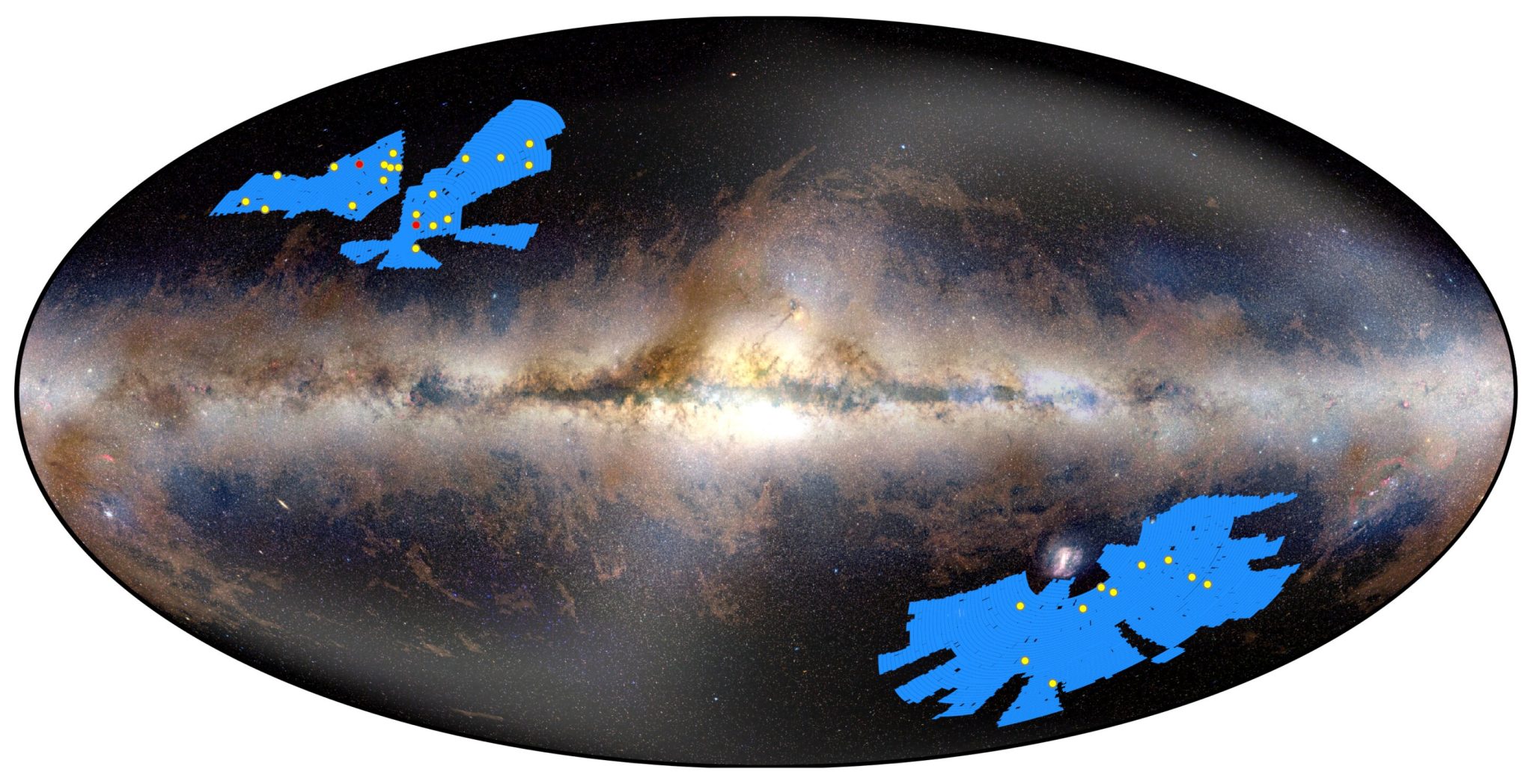
According to Valeria Pettorino, the large survey area, depth of observations, and ability to detect radiation in the infrared spectrum together make the search for rare and extremely distant light sources far more efficient than before. The resulting data are processed by thousands of scientists and engineers from the Euclid Consortium, who identify such objects for further study by ground-based telescopes.
Continuing the Sky Survey
The second-oldest quasar in this sample was additionally studied by a group led by Silvia Belladitta. Observations showed that it is located inside a gas-rich galaxy actively forming new stars. This is the first concrete hint of what the host galaxy of one of the first supermassive black holes may have looked like.
All of this was found in data from a single survey called the Euclid Wide Survey, which, once completed, will cover more than one-third of the entire sky. The study describing these findings was led by Damin Yang. The paper was published in the peer-reviewed journal Astronomy and Astrophysics.
