

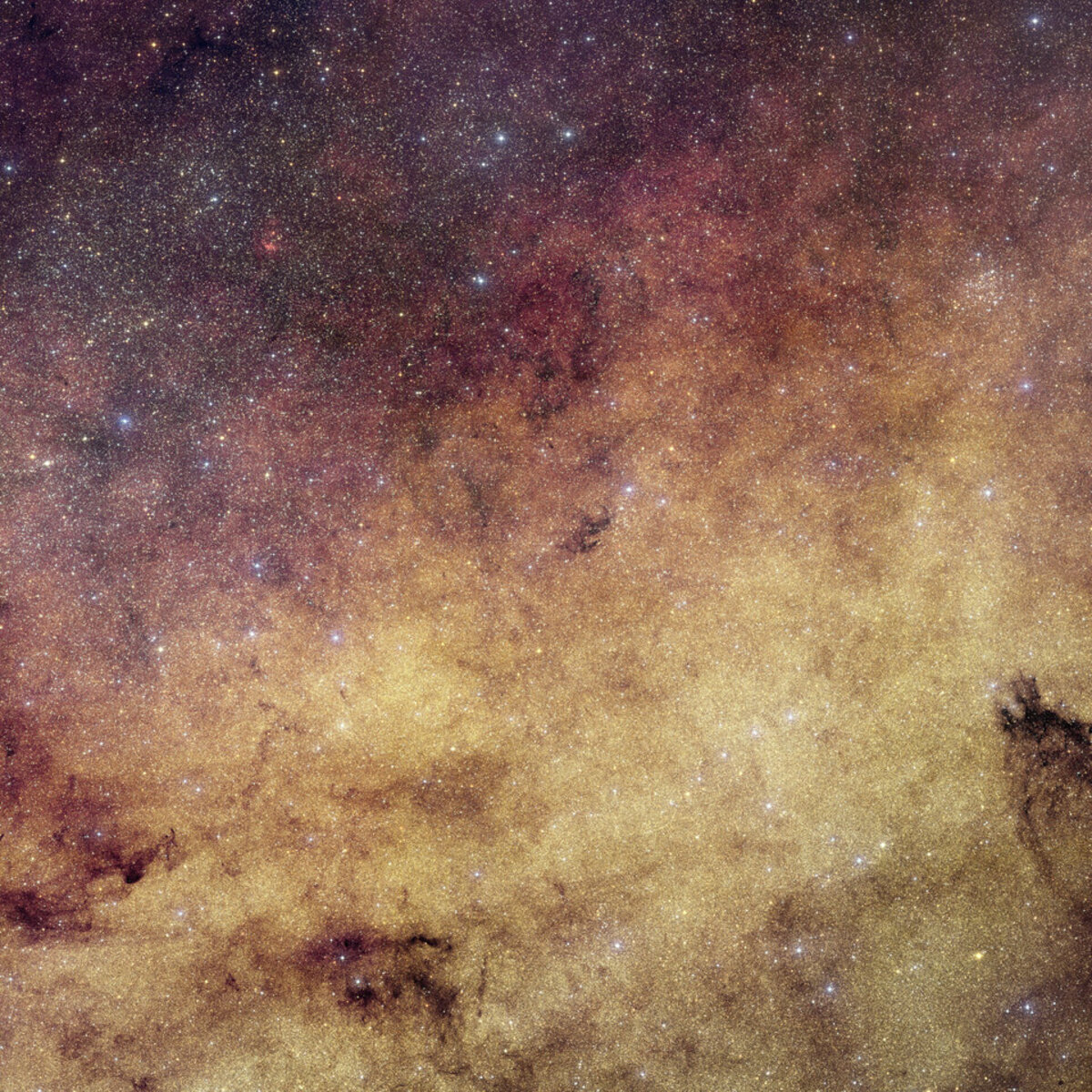
Hundreds of thousands of stars appeared in the frame of the Euclid Space Telescope when it was pointed for several hours toward the center of our galaxy, instead of its usual search for dark matter. The resulting image is exceptionally detailed, capturing a region of the inner bulge where individual stars are difficult to distinguish due to extreme stellar density.
An Unexpected Perspective
The Euclid telescope was designed to study the distant Universe. Its main mission is to map billions of galaxies in order to trace how dark matter and dark energy have influenced their formation throughout cosmic history.
However, the mission team decided to point it in another direction — toward the center of our own stellar system. The bulge region is densely filled with gas, dust, and stars of different ages. Observing it is extremely difficult because thick clouds absorb and scatter much of the visible light.
What the Image Shows
The visible-light camera VIS captured around 350,000 individual stars. At the same time, the infrared instrument NISP detected cold objects hidden behind veils of dust.
The level of detail enabled astronomers to distinguish stellar streams left behind by ancient clusters. The combination of wide-field optics and high sensitivity made it possible to trace these structures in the center of the bulge with a clarity that had previously been out of reach.
Imaging Features
In just a few hours, Euclid covered an area of the sky 100 times larger than the field of view of Hubble’s camera. The same region would have required dozens of hours of exposure with Hubble to reach a comparable depth.
Although this was an unusual direction for the telescope, the image confirmed its ability to obtain sharp data even from the densest regions of the Galaxy. It was more a demonstration of Euclid’s capabilities than part of its main scientific program. At the same time, the data obtained will help calibrate algorithms ahead of the main survey phase.
The Zodiacal Background
About 10% of the light in the images consists of diffuse emission known as zodiacal light. It appears when sunlight is scattered by dust particles in the plane of the Solar System.
This background cannot be completely removed at the point of observation, because it is present in any image of space taken from within our planetary system. Cleaning the data from the zodiacal background became a separate technical challenge for Euclid’s science team. A similar problem is faced by the teams behind all space telescopes, and each develops its own methods for addressing it.
A View Through the Galaxy
Euclid’s true target remains far beyond the Milky Way. The telescope will search for the most subtle distortions in the shapes of billions of galaxies caused by the gravity of dark matter.
This will help refine our understanding of how dark matter is distributed across the cosmos and may bring physicists closer to understanding the nature of dark energy, under the influence of which the expansion of the Universe is accelerating.
According to esa.int
