

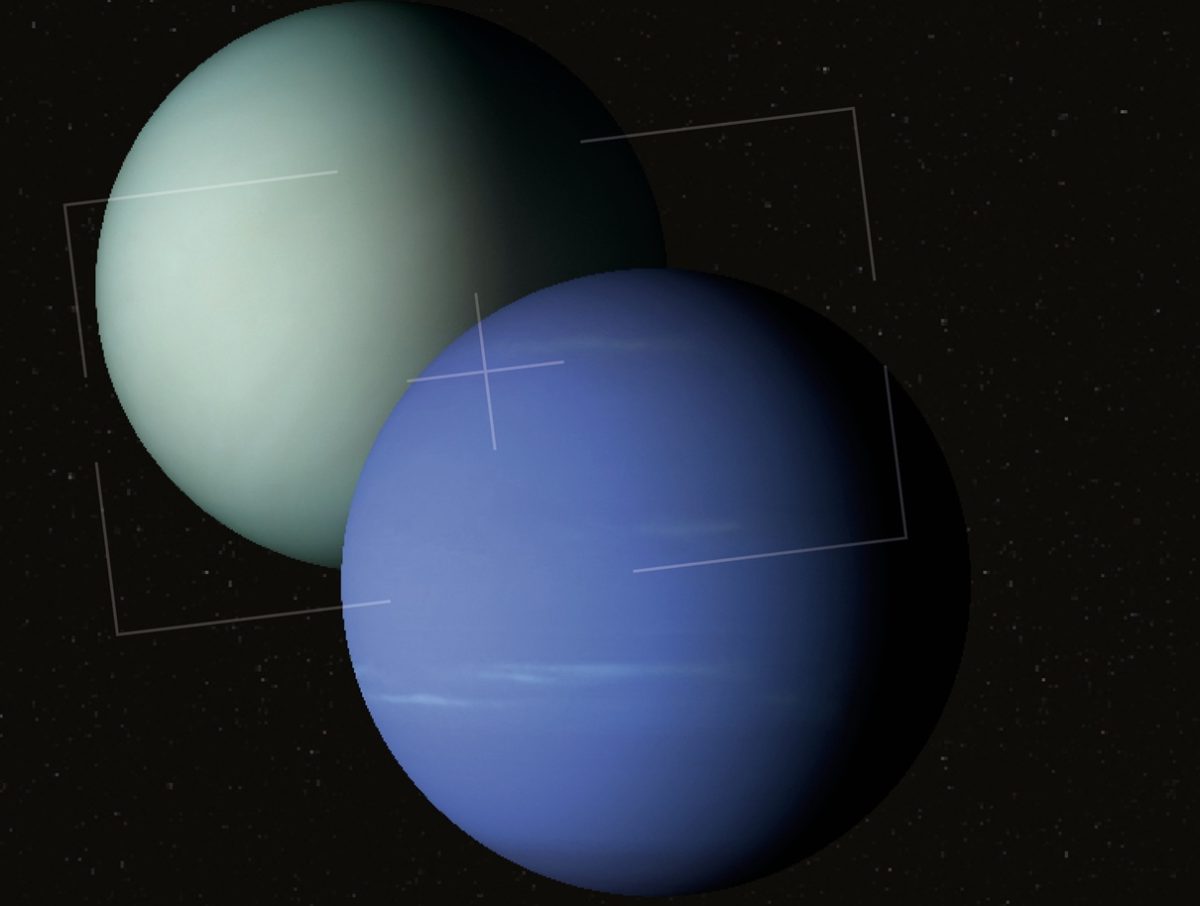
Scientists have analysed the isotopic composition of argon in the atmospheres of Neptune and Uranus. It could suggest that their interiors contain considerably more rock than ice. However, the researchers concluded that it more likely reflects the conditions in which the planets formed.
Two Sources of Atmospheric Argon
According to phys.org, measurements of an argon isotope could help scientists understand whether the interiors of Uranus and Neptune, our Solar System’s so-called ice giants, consist primarily of ice or rock. A new study conducted by the Southwest Research Institute (SwRI) and published in The Planetary Science Journal measured atmospheric argon-40 on these planets to estimate the amount of rock beneath their surfaces and search for clues to their origins, including where and how they formed.
Despite decades of research, astronomers still know surprisingly little about what lies beneath the atmospheres of Uranus and Neptune or about their physical structure. Scientists are considering whether these planets might contain far more rock than their classification as ice giants suggests, and whether argon-40 could help distinguish between these possibilities—or whether there are better ways to use this unique chemical marker in future research.
Argon-40 found in the atmospheres of Uranus and Neptune has two possible origins. Some atmospheric argon-40 may have been inherited from the protosolar nebula, the cloud of dust and gas that formed the Solar System approximately 4.6 billion years ago. Additional argon-40 can be explained by billions of years of radioactive decay of potassium-40 contained in rocky material deep inside the planets.
By distinguishing the proportion of argon-40 inherited during planetary formation from that produced in the interiors and released into the atmospheres, the team believed it could potentially estimate how much rock each planet contains.
Primordial Atmospheric Argon Drowns Out Signals from the Interior
The main challenge facing the team was determining how to distinguish between the isotope’s two possible sources. To address this, Dr Olivier Mousis and his team combined calculations of argon-40 production with a numerical model of the protosolar nebula. The model tracked the condensation, trapping and transport of “primordial” argon within ice grains as the nebula evolved. These particles subsequently accumulated, contributing to the formation of Uranus and Neptune.
“Based on our research, the primordial argon and its isotopes delivered to Uranus and Neptune completely overwhelm any contribution produced by radioactive decay inside the planets,” Mousis said, adding that the contribution of argon-40 from the protosolar nebula is much greater than previously thought. “Taking this into account, we concluded that atmospheric argon-40 measurements probably tell us more about the planets’ formation conditions and history than about their rocky or icy cores.”
The team’s simulations showed that particularly argon-rich planetary building materials could have formed near the argon snow line, a boundary at the edge of the protosolar nebula where low temperatures cause gaseous argon to condense into solid ice. The accumulation of argon-bearing particles near this snow line could have influenced the chemical composition of the materials from which Uranus and Neptune formed.
“Understanding the composition of the material from which Uranus and Neptune formed is crucial to reconstructing their formation history,” said Dr Robin Canup, vice president of SwRI’s Solar System Science and Exploration Division and a co-author of the study. “Our results show how changing conditions in the early Solar System could have left chemical signatures that persist in planetary atmospheres billions of years later.”
Testing Formation Theories with Future Atmospheric Probes
The findings could guide future studies of the atmospheres of Uranus and Neptune. According to the researchers, future probe missions, such as NASA’s proposed Uranus Orbiter and Probe mission concept, could directly sample noble gases and measure isotope ratios that cannot be reliably determined through remote observations. Measurements of nitrogen, carbon and other atmospheric components could help test theories about how the ice giants formed.
“Argon-40 measurements could help us answer two fundamental questions that have long puzzled scientists,” Mousis said. “What are Uranus and Neptune made of, and where did their building blocks form before being incorporated into the planets? Future atmospheric probes equipped with sufficiently sensitive mass spectrometers could bring us closer to answering both questions.”
This latest study is part of ongoing research into Uranus and Neptune. In October 2026, another study involving SwRI suggested that their chemical origins might differ despite similarities in their size, mass and atmospheric conditions, as well as similar formation timescales.
