

To the naked eye, stars seem eternal and unchanging. Our Sun—a relatively ordinary, low-mass star—will continue to shine steadily for billions of years. Powerful telescopes, however, reveal a very different picture. Astrophysicists observe millions of stars of different ages and types, recording the inevitable changes they undergo throughout their long life cycles.
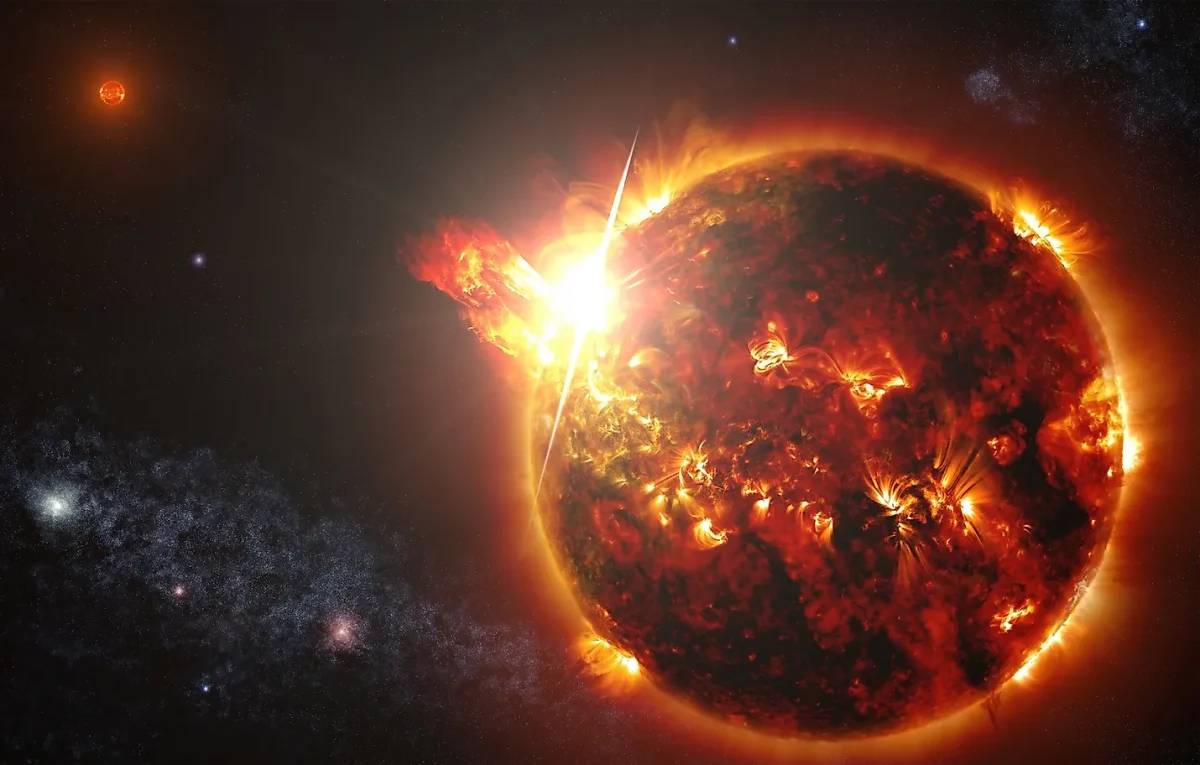
When relatively low-mass stars exhaust the hydrogen in their cores, they enter a new evolutionary stage, becoming red giant branch (RGB) stars. These objects are easy to study because they are bright and abundant. Prominent examples of RGB stars in our night sky include Arcturus, Aldebaran and Pollux.
The Mystery of the Anomalous Dip in Luminosity
As a star moves up the red giant branch, it gradually cools and expands, while its luminosity increases predictably. Along the way, however, there is a curious episode: a sudden, brief decline in luminosity known as the “RGB luminosity bump”. The name comes from how this effect appears in the colour–magnitude diagrams of star clusters.
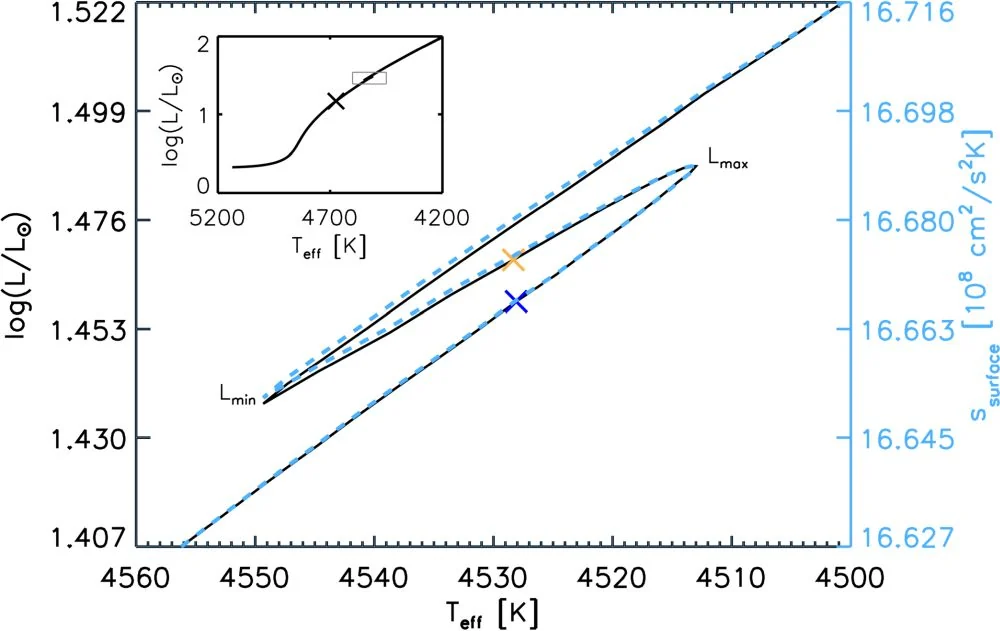
Scientists have long understood what brings this episode to an end, but precisely what triggers the anomaly remained a mystery. Until now, there has been a clear discrepancy: in theoretical computer models, the bump occurred later and at a higher luminosity than telescope observations indicated. Closing this gap in our knowledge required uncovering the underlying physics of the process.
A Thermodynamic Explanation
In a study published in The Astrophysical Journal Letters, Saskia Hekker, a professor of theoretical astrophysics at the Heidelberg Institute for Theoretical Studies, proposed a quantitative explanation for this phenomenon.
Unlike the Sun, a red giant has a core of inert helium that does not produce energy. Nuclear fusion takes place in a thin shell around the core, with an extensive convective envelope above it. As the star evolves, the core contracts, forcing the deepest layer of the convective zone to descend into regions with a different chemical composition. This leads to a process known as “dredge-up”, in which material from deeper layers mixes into the convective envelope.
Hekker found that the decisive factor is not simply a mechanical collision between layers, but a thermodynamic property: specific entropy, which characterises the degree of disorder in the gas at the boundary of the convective zone. As the boundary moves deeper, the entropy difference across this layer decreases. Once it crosses a critical threshold, the luminosity bump is triggered within the star.
Implications for Astrophysics
This explanation provides the first quantitative description of the onset of this process. In place of mechanical assumptions, scientists now have a clear thermodynamic marker. The new understanding will allow stellar models to be refined, bringing theoretical calculations of luminosity and stellar surface composition into agreement with actual observations.
We previously explained why gas giants do not favour red dwarfs.
Based on reporting by Universe Today.
