

The first billion years after the Big Bang were an era of dramatic transformations: dark matter formed the first gravitational wells, the first generation of stars lit up the primordial gas, and supermassive black holes began to emerge at the centres of young galaxies. As galaxies collided and merged, their black holes swallowed colossal amounts of matter. Some of this accreted mass was converted into powerful radiation, outshining billions of surrounding stars—these are the objects astronomers call quasars.
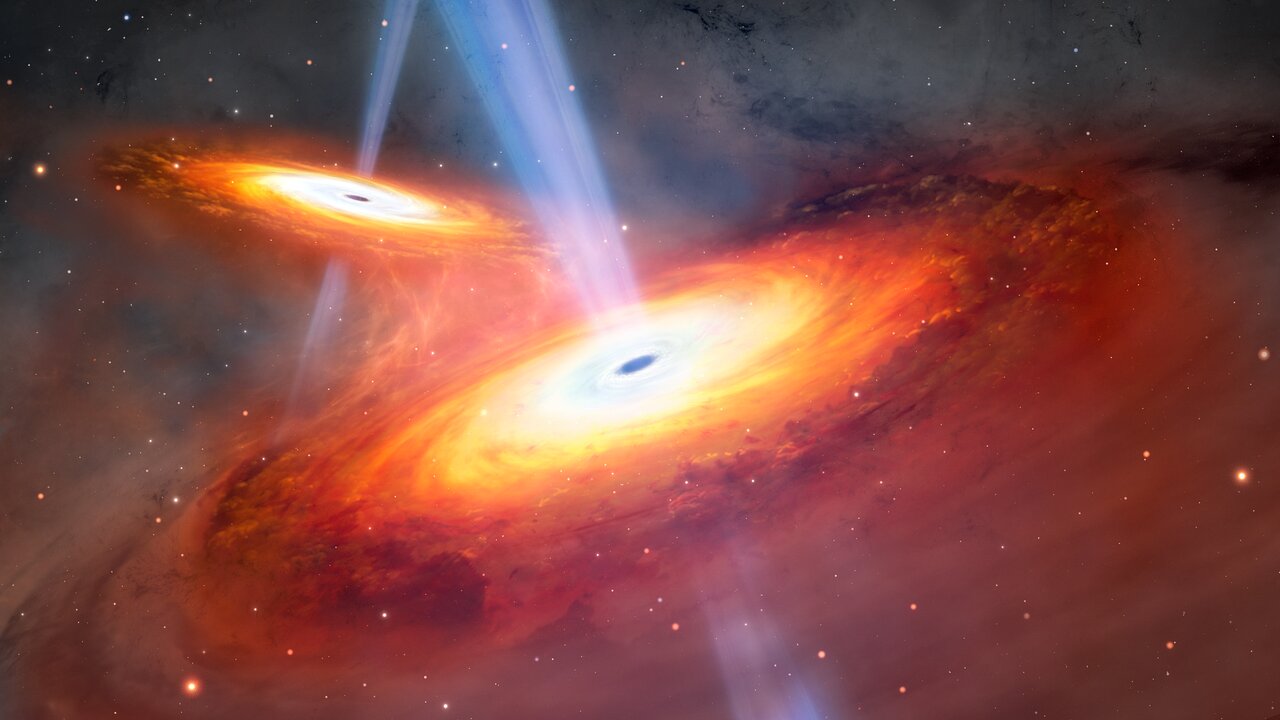
Because galactic collisions were frequent in the young Universe, scientists have long predicted the existence of close quasar pairs. Detecting them, however, is extremely difficult: the phase of active accretion is relatively brief, the objects lie at enormous distances, and their small separation makes them appear as a single point to most telescopes.
An international team of astrophysicists led by Silvia Onorato of NSF NOIRLab recently solved one of these challenging cosmic puzzles by discovering the object J1602+4228AB. The findings have been published in The Astrophysical Journal Letters.
The Mass Paradox
The object was given the Hawaiian name Nāpōwawāʻenakaulua, which translates as “Two celestial bodies with fathomless, powerful darkness in the glow of warmth, reincarnating energy into the Universe”. The name was created through the cultural and scientific programme A Hua He Inoa.
Astronomical measurements show that we see this system as it was just 900 million years after the Big Bang. The two active black holes are separated by approximately 18,100 light-years, roughly one-fifth of the diameter of our galaxy, the Milky Way.
Most striking are the masses of its components: one black hole is 1.5 billion times the mass of the Sun, while the other is 400 million times its mass.

“Current theory has no definitive explanation for how even one such giant black hole could have formed so early, let alone the simultaneous existence of two such giants,” Onorato notes. At the time, the Universe was only one-thirteenth of its current age, yet both objects had already reached the scale of present-day supermassive black holes.
A Spectroscopic Breakthrough
The discovery was made while analysing data from the Aether survey, conducted using the JWST space telescope under the leadership of Emanuele Paolo Farina. The survey covers 200 known quasars from the early Universe. During a visual inspection of JWST’s spectroscopic data, scientists noticed a faint companion source near the quasar J1602+4228A.
Definitive confirmation and separation of the two sources required detailed observations with the GNIRS infrared spectrograph on the ground-based Gemini North telescope, located on the extinct volcano Maunakea in Hawaii. Because the second component was extremely faint and lay close to its bright neighbour, detecting it from Earth seemed virtually impossible. Exceptionally transparent skies and ideal observing conditions over two nights made the observations successful. Additional data from the GMOS optical spectrograph allowed the team to refine the system’s characteristics.
A Laboratory for Extreme Evolution
Scientists suggest that the Nāpōwawāʻenakaulua system originated in a region of space with a local peak in matter density. In such exceptionally dense regions of the early Universe, gravitational interactions between galaxies simultaneously stimulated bursts of star formation and extraordinarily rapid growth of their central black holes.
This unique system will serve as a natural laboratory for astrophysicists studying how the earliest galaxies and their supermassive cores formed through direct collisions at the dawn of cosmic history.
We previously reported on how quasars in the early Universe hindered star formation.
Based on reporting by phys.org.