
Supermassive black holes are usually found at the centers of large galaxies. However, scientists have long suspected that they can be ejected from these locations. They have now found evidence supporting this idea.
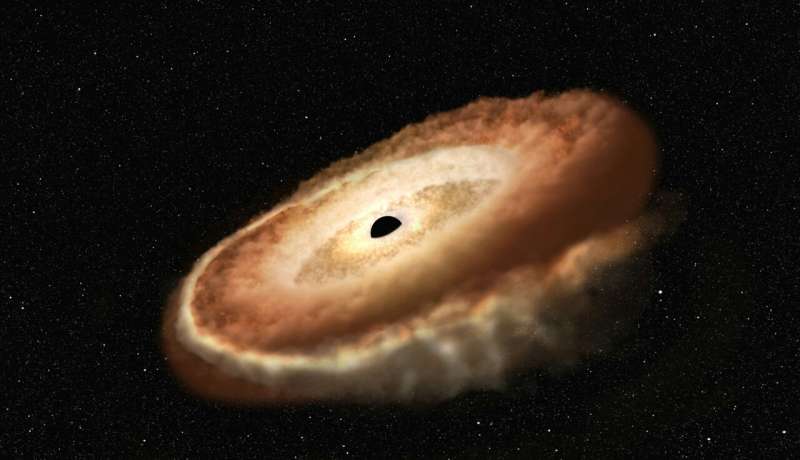
Supermassive Black Holes Displaced from Their Positions
Analyzing data on approximately 100,000 quasars, or exceptionally bright galactic nuclei, researchers at Eötvös Loránd University (ELTE) found statistical evidence that some supermassive black holes at the centers of galaxies are displaced after forming. The relationships now identified in the data were predicted ten years ago by members of the same research group—Péter Raffai and Zsolt Frei, together with Zoltán Haiman. The new study was led by Bence Bécsi, an ELTE graduate now working at the University of Birmingham, according to phys.org.
At the center of every large galaxy lies a supermassive black hole whose mass can be millions or even billions of times that of the Sun. When two galaxies merge, their central black holes also approach one another, form a binary system, emit gravitational waves, and eventually merge, leaving behind an even larger black hole.
Extremely powerful gravitational waves are generated during the final moments of the merger. If these waves are not emitted evenly in all directions, the remnant black hole receives a strong “kick,” similar to the recoil of a cannon. A black hole propelled this way can reach speeds of several million kilometers per hour, ejecting it from the galactic center.
However, the displaced black hole does not simply disappear. If the kick is not strong enough to eject it from the galaxy entirely, the black hole falls back, races through the galactic center, slows down on the other side, and reverses direction. It then oscillates around the galactic nucleus for a long time, like a pendulum. Just as a pendulum moves fastest at the lowest point of its swing, the black hole moves fastest when passing through the galactic center.
General relativity predicts that such recoil should occur, but the phenomenon has not yet been conclusively confirmed. Astronomers have identified several individual candidates, but alternative explanations could not be ruled out in those cases.
This study therefore did not search for a single unusual object. Instead, it tested whether a statistical signature of displaced black holes could be detected in data from tens of thousands of quasars.
What Quasars Reveal About Black Hole Motion
Some supermassive black holes are active: they consume large quantities of surrounding gas while producing exceptionally intense radiation. These bright, active galactic nuclei are known as quasars. Their light contains the two types of information the researchers needed.
The first is the black hole’s velocity. Gas close to the black hole moves along with it, while gas farther away does not. The light emitted by these two regions is therefore slightly shifted relative to each other, much as the siren of an approaching or receding ambulance sounds higher or lower in pitch than that of a stationary ambulance. This small shift reveals how fast the black hole is moving relative to its galaxy.
The second concerns the amount of dust. Dust around a black hole makes the quasar’s light appear redder, much as a sunset appears red because its light passes through a thick layer of atmosphere. If a quasar is redder than similar objects, it means that more dust obscures it.
A Prediction Made at ELTE Ten Years Ago
In 2016, Raffai, Haiman, and Frei used computer models to investigate what we might observe if some quasars contained displaced black holes oscillating around their galactic nuclei.
They concluded that there should be a relationship between velocity and dust content: a black hole moves fastest at the galactic center, where dust is also densest. Quasars containing faster-moving black holes should therefore, on average, be obscured by more dust. The authors noted at the time that this relationship could be investigated using real data from large quasar catalogs.
“Our results could help us understand the processes taking place in the nuclear regions of galaxies and the role Einstein’s gravitational waves play in them,” said Raffai, an associate professor at ELTE and lead author of the 2016 study.
The Prediction Confirmed in a Sample of 100,000 Quasars
Bécsi and his colleagues conducted the study testing this theory. They analyzed approximately 100,000 quasars from the Sloan Digital Sky Survey quasar catalog, selecting objects with sufficiently high-quality data. For each quasar, they determined the black hole’s velocity and the quasar’s redness, then examined whether the two were related.
The relationship predicted ten years earlier appeared in the data: quasars containing faster-moving black holes are, on average, redder, indicating greater dust obscuration. Natural differences between individual quasars make this relationship difficult to identify in any single object, but it is statistically very strong across this enormous sample. The most striking difference appears among the dustiest quasars: heavily obscured objects are three times more common among quasars containing the fastest-moving black holes than among those containing the slowest.
The key to the study was that, rather than searching for individual candidates, the scientists looked statistically for evidence of an entire population. This allowed them to identify a relationship consistent with theoretical predictions.
The researchers also performed several checks. Their results remained consistent across different data-selection and measurement methods. However, when they compared only light from gas clouds that do not move with the black hole, the positive correlation disappeared.
The most natural explanation for the observed relationship is that some quasars in the sample contain supermassive black holes displaced after an earlier merger. If this interpretation is correct, the strength of the signal also suggests that two black holes merged relatively recently in approximately half of the quasars studied. However, the authors emphasize that this estimate remains uncertain and that other physical processes cannot be completely ruled out. Further observations and more detailed models are needed.
Prospects for Further Research
The result is the first observational test, using a large sample, of the prediction formulated at ELTE ten years ago. If further research confirms this interpretation, the method could also be used to investigate how often supermassive black holes merge, how fast they are ejected, and what environments surround them.
Studying displaced black holes also contributes to preparations for a major future gravitational-wave observatory. In 2035, the European Space Agency plans to launch LISA: three spacecraft flying in formation, 2.5 million kilometers (1.6 million miles) apart, which will directly detect gravitational waves from supermassive black hole mergers. These are precisely the events whose traces the researchers have now identified in quasar light.
ELTE researchers have participated in the scientific preparations for LISA since 2006, and from 2026 they will continue this work under a new framework. Following a decision by the National Research, Development and Innovation Office, the Kármán Tódor National Laboratory for Space Science will be established at ELTE in August, with the Konkoly Observatory of the HUN-REN Research Centre for Astronomy and Earth Sciences as a collaborating institution.
The four-year program is led by principal investigator Frei. Its gravitational-wave research will focus on developing waveform models needed to extract information about black hole masses, distances, and their future evolution from LISA’s signals. The current findings help lay the groundwork for a question that LISA may answer definitively within the next decade.
“If the signal is indeed caused by displaced black holes, then two supermassive black holes have recently merged in a substantial number of quasars, meaning that such events are common. This directly determines how many of these events LISA may be able to detect. We proposed this idea at ELTE ten years ago, and now we have tested it ourselves, under the leadership of Bécsi, who graduated from our university. Few research groups are fortunate enough to maintain this level of continuity,” said Professor Frei, head of the HUN-REN–ELTE Extragalactic Astrophysics Research Group.
