

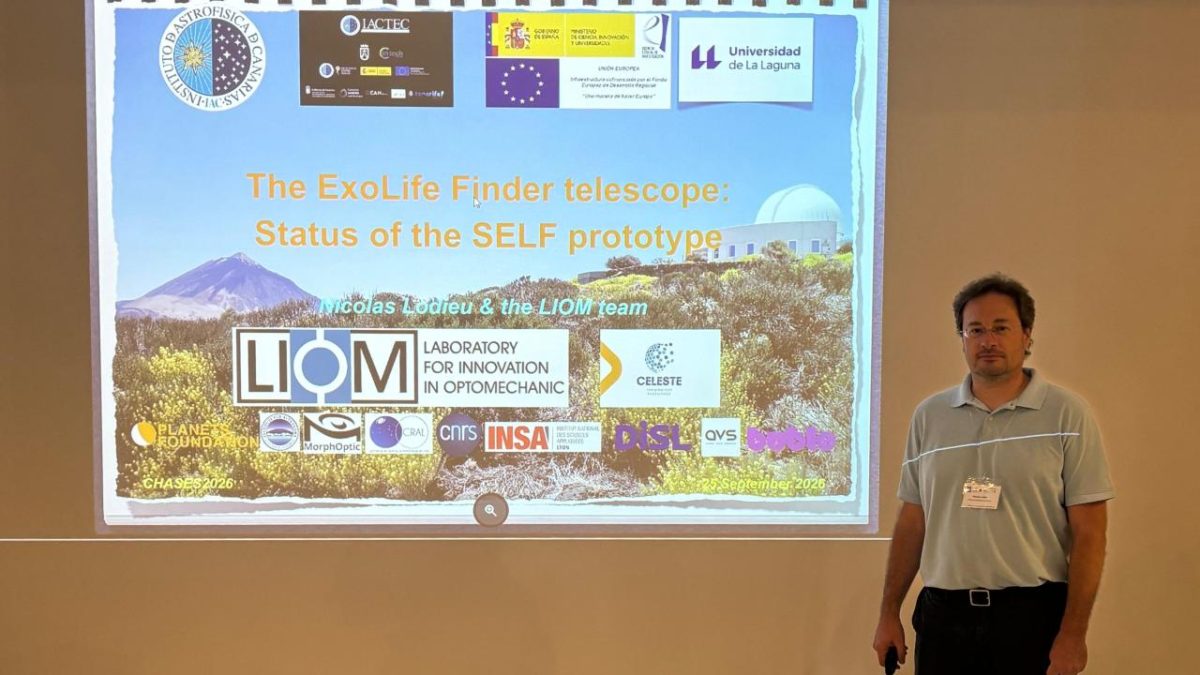
At the CHASES 2026 conference, held in late September on the Italian island of Elba, the results of the development of the new SELF telescope were presented. It is expected that with a diameter of 3.5 m, it will be able to directly image exoplanets and study them.
Testing New Technologies on an Experimental Telescope
The Institute of Astrophysics of the Canary Islands (IAC) presented its progress with the SELF (Small ExoLife Finder) telescope at the international Charting the Future of Stellar and Exoplanet Spectroscopy (CHASES 2026) conference. SELF is a technological prototype designed to test new solutions for the future direct observation of exoplanets and, in the long term, the search for possible signs of life beyond the Solar System.
SELF is an experimental telescope approximately 3.5 m in diameter, consisting of 15 primary mirrors, each half a meter across, arranged in a circular structure. Its goal is not to compete in size with today’s large telescopes, but rather to serve as a realistic platform for developing and testing new optical, mechanical, and control technologies that can later be scaled up for much larger facilities.
This prototype is a preliminary step toward ELF (ExoLife Finder), a telescope concept with a large aperture, specifically designed to directly image planets orbiting other stars and study their properties. One of its long-term scientific goals is to analyze the atmospheres and surfaces of these worlds in search of possible biomarkers associated with life.
“SELF allows us to test these technologies on a real telescope before transferring them to a much larger infrastructure such as ELF. We need to determine how the optics, structure, and control systems work together under real conditions, because this knowledge will be essential for designing the next generation of telescopes dedicated to the direct study of exoplanets,” explains Nicolas Lodieu, a scientist working on the SELF project at the IAC’s Laboratory for Innovation in Optomechanics (LIOM).
Direct observation of an exoplanet is an enormous challenge because its light is extremely faint compared with the brightness of the star it orbits. The ELF strategy is based on combining the light collected by several mirrors in such a way that the star’s signal can be reduced with very high precision while preserving the signal from the planet.
Assembly of the SELF Telescope Structure
During 2026, the project made significant progress. At the beginning of the year, the main SELF structure was delivered to the IACTEC facilities at the Las Mantecas Technology and Science Park, where it successfully passed factory acceptance tests. After that, a new stage began, focused on the integration, alignment, and validation of the various subsystems.
During the presentation in Italy, the team showed recent images of the fully assembled structure and the planned location of the telescope at the Teide Observatory, where it will be installed for testing under real sky conditions. The dome that will house the instrument has already been installed at the observatory.
SELF will make it possible to test new solutions gradually. At the initial stage, it will use a conventional structure and mirrors, which can later be replaced with lighter and more experimental technologies developed by LIOM, such as ultralight mirrors and structures based on prestressed cables. The goal is to determine whether these concepts will make it possible to build large-aperture telescopes with significantly lower mass and cost.
A Laboratory for Observing Other Worlds
The SELF project is being developed within the Laboratory for Innovation in Optomechanics (LIOM) of the Institute of Astrophysics of the Canary Islands (IAC), which specializes in the development and testing of optical and mechanical technologies for the next generation of ground-based and space telescopes.
Its research areas include ultralight mirrors, tensegrity structures based on rigid elements and tensioned cables, advanced photonics, and new methods for measuring and correcting deformations that affect light during astronomical observations.
During the presentation at the CHASES 2026 conference, some of the developments the laboratory is working on in parallel were also demonstrated: from laboratory-scale optical prototypes to photonic sensors and artificial intelligence algorithms for mirror control. These technologies are particularly important for the direct observation of exoplanets. Separating the faint signal of a planet from the much more intense light of its star requires extremely high levels of resolution, sensitivity, and contrast, as well as exceptionally precise control of the position and shape of each telescope mirror.
Capabilities of the SELF Telescope
In addition to serving as a technology demonstrator, SELF will have its own scientific capabilities. Planned scientific tasks include the direct detection of certain exoplanets, the study of possible moons around planets and brown dwarfs, analysis of the rotation and variability of planetary-mass objects, and the search for substellar companions around nearby stars.
One of its main advantages will be having a telescope specifically dedicated to this type of research, with a significant number of observing nights available for programs requiring long-term monitoring.
Thus, SELF will combine two functions: producing its own scientific results while simultaneously providing the team with the technical experience needed to advance toward the creation of ELF and future instruments capable of studying Earth-like planets in greater detail.
Strategic Direction of the CELESTE Project
The development of SELF and LIOM activities is part of the CELESTE project (Cutting Edge Leap to Excellence in Space and Optics Technologies), an initiative led by the Institute of Astrophysics of the Canary Islands (IAC) aimed at strengthening the Canary Islands’ capabilities in advanced optical technologies and space science.
Through CELESTE, LIOM and other specialized laboratories form a technological ecosystem covering the entire range of activities — from research and design to integration, validation, and the transfer of new technologies. This strategy is aimed at strengthening the IAC’s capabilities in developing advanced astronomical instruments and positioning the Canary Islands as an international center for the development of advanced optical technologies.
