

Planets with molten surfaces orbiting extremely close to their stars should have lost their gaseous envelopes long ago. Observations show the opposite. Scientists at Stanford University have explained this paradox through the slow release of gases from molten material. Previously, it was thought that there was a single distance from a star beyond which an atmosphere could no longer be retained. Calculations using the new model reveal two such boundaries.
Where the Atmospheric Boundary Lies
The concept of the cosmic shoreline has taken shape over the past decade. It is an empirical boundary separating bodies with dense atmospheres from those where an atmosphere is practically absent. Two parameters are compared: the amount of energy received from the star and the escape velocity of the body itself. Stellar irradiation strips away the gaseous envelope, while the stronger gravity of a more massive body counteracts this process.
Earth, Venus, and Titan lie on one side of the boundary. Mercury and the Moon, which effectively lack atmospheres, lie on the other. The concept has proved to be a promising way of selecting targets worthy of detailed study.
Lava Worlds with Atmospheres
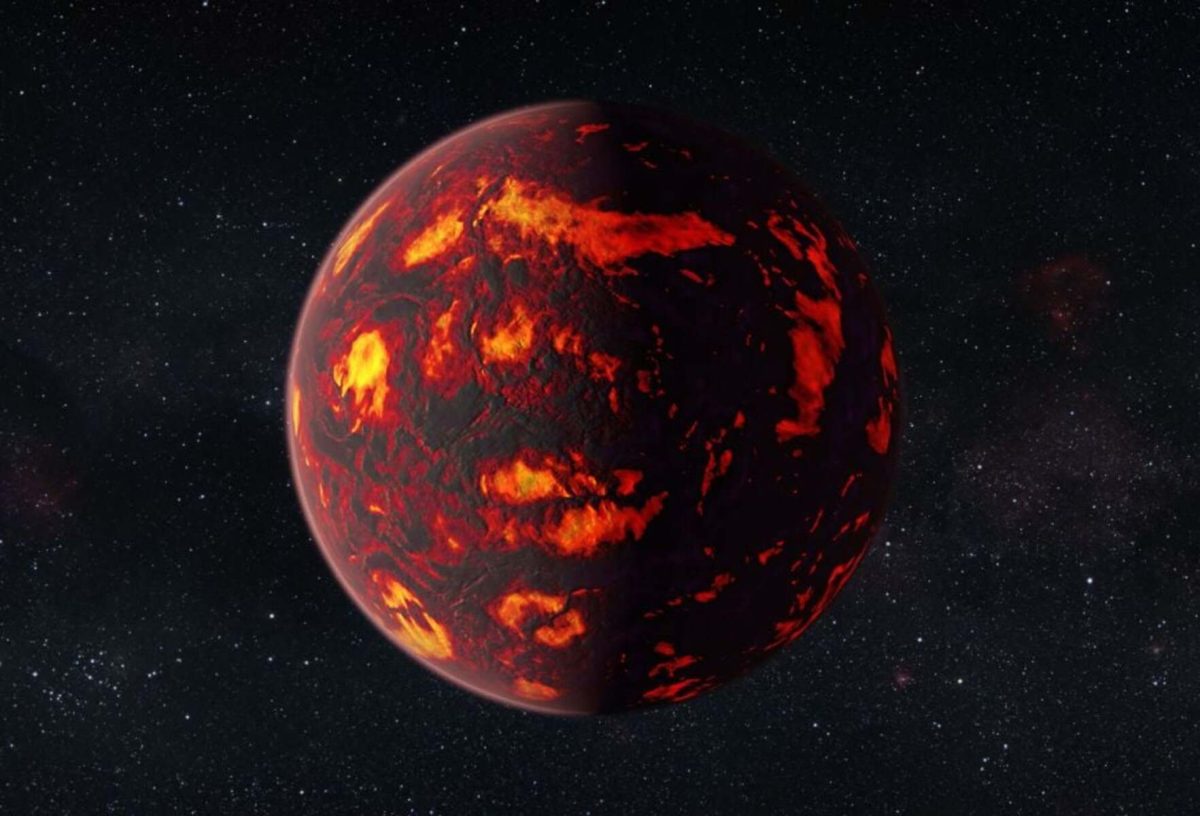
The most striking exception has been the super-Earth 55 Cancri e. The planet orbits about 20 times closer to its star than Mercury does to the Sun, completing a full orbit in less than 18 hours. It is almost eight times as massive as Earth, and its surface is molten, which is why such a world is called a lava planet.
Initially, scientists assumed that it was surrounded by a tenuous veil of vaporized rock. Measurements with the James Webb Space Telescope in 2024 ruled out this scenario and pointed instead to a dense envelope, probably rich in carbon dioxide or carbon monoxide. Its source may be a magma ocean.
Several similar objects have already been found, as Universe Today notes. They include the Earth-sized planet TOI-561 b and CoRoT-7b, both also covered in molten material.
How an Atmosphere Survives Above Magma
The model, described in the peer-reviewed journal The Astrophysical Journal Letters, combines the evolution of a planet’s atmosphere with that of its interior. The calculations revealed another boundary, hotter than the cosmic shoreline. The authors called it the cosmic shoal.
In this regime, the molten ocean does not solidify, helped by tidal heating in multiplanet systems. Most volatile compounds remain dissolved within it, so stellar radiation strips away only a small excess above the surface. The slow release of new portions of gas compensates for these losses, allowing a dense atmosphere to survive for billions of years.
Between the shoal and the shoreline lies an airless valley. On these worlds, the melt solidifies too quickly after formation, while volatile compounds remain trapped in the rock. There is nothing to replenish the gaseous envelope, so it gradually becomes depleted. In the Solar System, Mercury belongs to this category, while beyond it there is TRAPPIST-1b.
Observations with James Webb in 2023 already showed that TRAPPIST-1b almost certainly has no atmosphere. Measurements of thermal emission at a wavelength of 15 micrometers yielded a daytime temperature of about 500 kelvins, consistent with incandescent rock without an atmosphere to redistribute heat to the night side.
What This Changes for the Search for Life
The search for life beyond the Solar System depends on the presence of liquid water on a planet’s surface. Without an atmosphere, water cannot remain in that state. Therefore, the first question regarding any rocky exoplanet is whether it has a gaseous envelope at all.
Lava worlds in the shoal regime are unsuitable for life. However, the refined model provides clearer criteria for determining which planets should be examined in future surveys. According to Barron Nguyen, the range of parameters under which a planet can create and retain an atmosphere turns out to be broader than previously thought.
