

Space weather regularly disrupts GPS and satellites in low Earth orbit, yet scientists still have a limited understanding of exactly how Earth’s lower atmospheric layers influence the upper layers, where these disturbances occur. Now NASA has selected a mission that will study this connection.
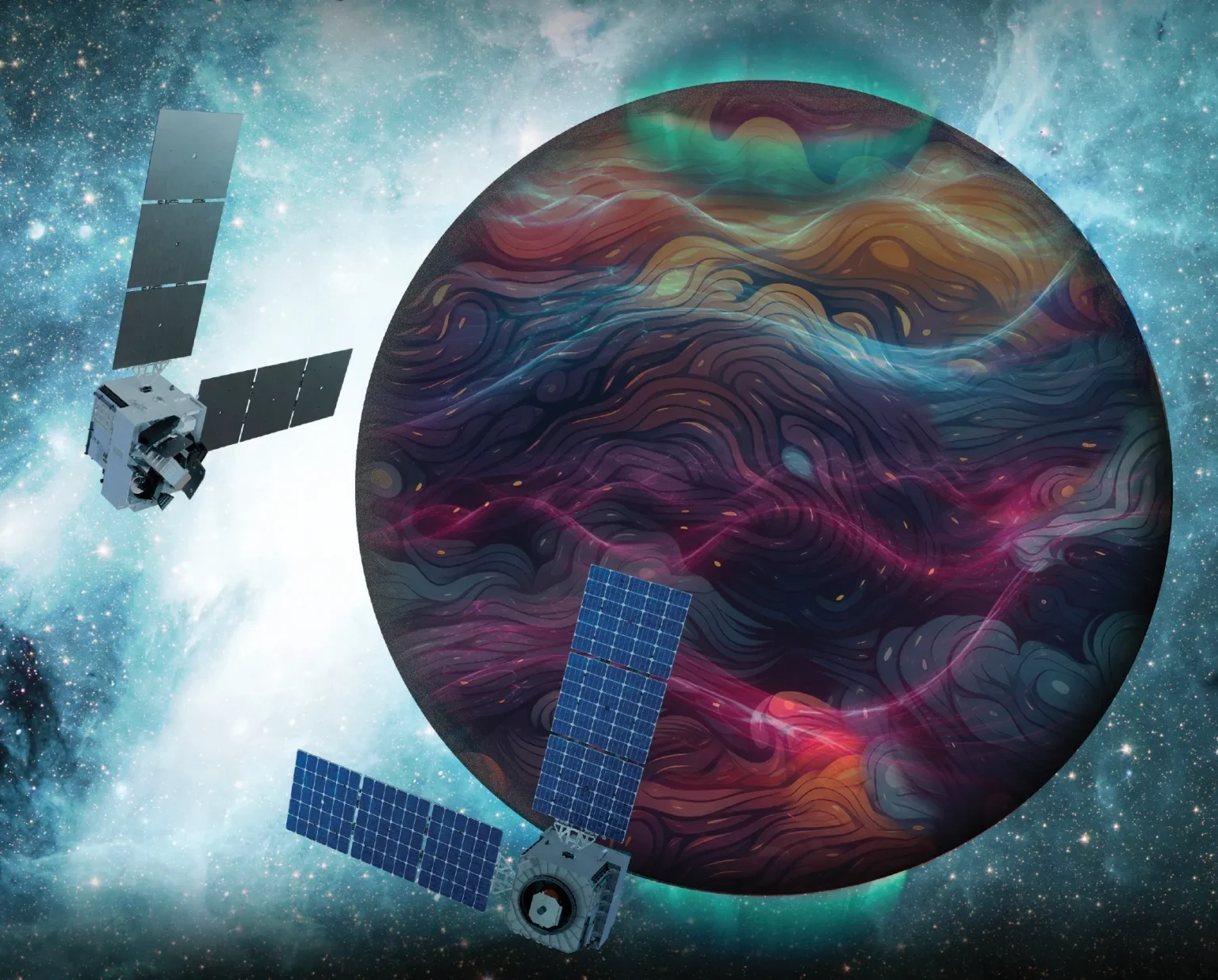
Two Twin Satellites
The mission is called DAPHNE, which stands for Dynamic Atmosphere-Ionosphere Explorer. It has moved into Phase B of development, which includes detailed planning and mission design. Two identical satellites will measure neutral winds, temperature, and gas composition in the thermosphere.
In the thermosphere and ionosphere, the neutral atmosphere gradually transitions into ionized plasma. This thin shell is simultaneously influenced by solar activity, processes in the lower layers of the atmosphere, and conditions in near-Earth space.
Three Instruments on Each Spacecraft
Each satellite is equipped with three scientific instruments. The first, the Michelson Interferometer for Global High-resolution Thermospheric Imaging, MIGHTI, measures profiles of horizontal winds and temperature along the entire orbit. The other two instruments are the Far Ultraviolet Imager, FUVI, for observing the ionosphere, and the limb-imaging spectrograph for the thermosphere and ionosphere, PLATO.
The two satellites, operating in a format of synchronized multipoint measurements, will make it possible to track how energy is transported upward through the atmospheric layers. This connection between the lower and upper atmosphere remains one of the least understood aspects of space weather science.
Mission Lead and Budget
The mission is led by Aimee Merkel of the Laboratory for Atmospheric and Space Physics at the University of Colorado Boulder. Funding and management oversight are provided by the Solar Terrestrial Probes program at NASA’s Goddard Space Flight Center in Greenbelt, Maryland.
The mission was identified as a priority in the National Academies’ Heliophysics Decadal Survey, published back in 2013, which reflects the long-standing demand within the scientific community for such measurements. The total cost, excluding launch, will not exceed $250 million in fiscal year 2023 dollars. The mission will undergo a review in 2027, with launch planned no earlier than 2029.
Protecting Astronauts and Technology
New data from DAPHNE are expected to improve space weather forecasting to protect GPS and satellites in low Earth orbit. More accurate forecasts will also be needed for planning crewed missions beyond Earth’s magnetic protection.
Nicky Fox, NASA’s associate administrator for science, noted that the mission would become part of the agency’s network of scientific spacecraft distributed across the Solar System. Data from both satellites will be provided to mission planners to assess risks from space weather.
According to nasa.gov
