

A group of researchers studying the galaxy M74 discovered a so-called extended ultraviolet disk around it. It indicates the presence of cold gas in these regions, within which star formation is taking place. This increases the diameter of this stellar system by almost two times, and astronomers suspect that this is not an isolated case in the Universe.
Gas and Dust Around Galaxies
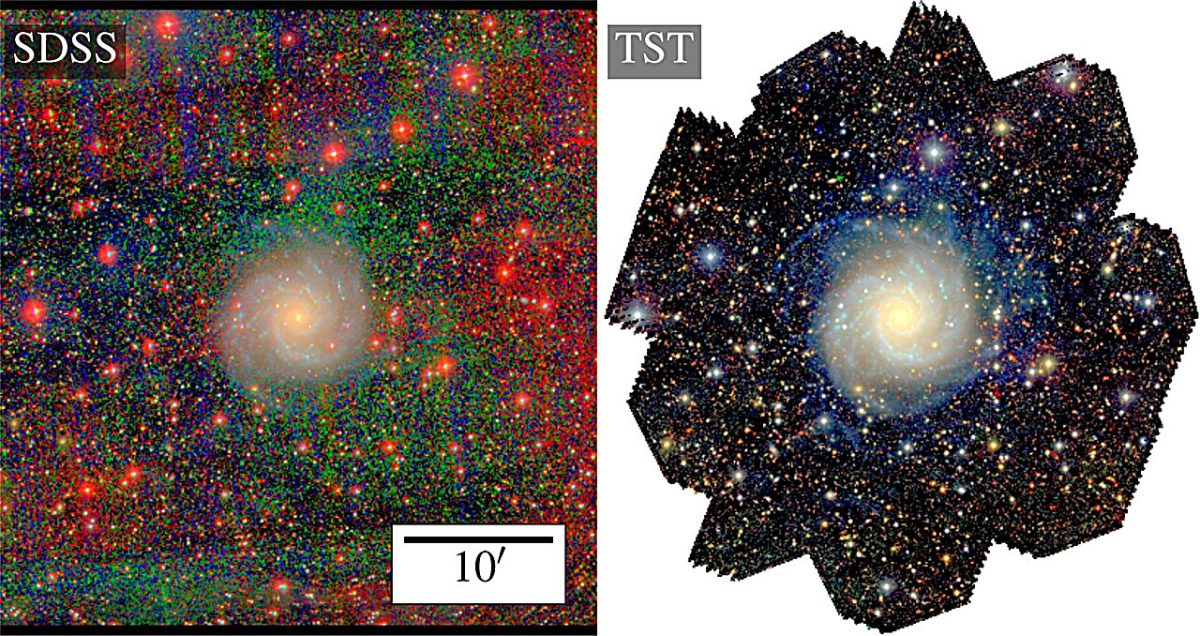
Scientists from the Institute of Astrophysics of the Canary Islands made an interesting discovery using the Transient Survey Telescope. As phys.org reports, they established that the galaxy M74, located 30 million light-years away from us, is significantly larger than previously thought.
In general, determining the diameter of spiral galaxies is a fairly complicated matter. What we see are the stars and the part of the gas illuminated by them. However, stellar systems rotate rapidly, so not all matter reaches their central regions, where the most intense star formation takes place. A significant portion remains on the outskirts, where it forms dark clouds.
Star formation also takes place there, but at a very low rate. Therefore, from a great distance, it is practically impossible to see these parts of galaxies. Only in the ultraviolet range can ghostly disks be detected extending for many light-years. Scientists debate whether these are permanent structures or whether they appear only from time to time.
Galaxy M47
In the case of galaxy M47, scientists managed to see an extended ultraviolet disk using observations with the Transient Survey Telescope that lasted 5.4 and 6.5 hours. Thanks to such long exposures, they were able to establish that this structure has a diameter of 30 kpc, or 97,800 light-years. This is despite the fact that its visible diameter is 14 kpc, or 47,500 light-years.
At the same time, the detected structure coincides with a previously identified region of atomic hydrogen. In other words, it really is one large, highly diffuse gas cloud. In addition, scientists suggested that its formation may have been caused by external factors, namely a close encounter between M47 and the galaxy UGC 1176, which is its satellite.
Scientists were able to identify stars inside the extended ultraviolet disk and, based on their metallicity — that is, the abundance of elements heavier than helium — determine their age. The estimate ranges from 260 million to 1 billion years, but the most likely value is 640 million years. This agrees very well with the timing of the close encounter with the dwarf galaxy.
All of this confirms that, at least in this case, we are dealing with a one-time event. Whether this conclusion can also be applied to other galaxies in which extended ultraviolet disks are observed will be shown by future research.