

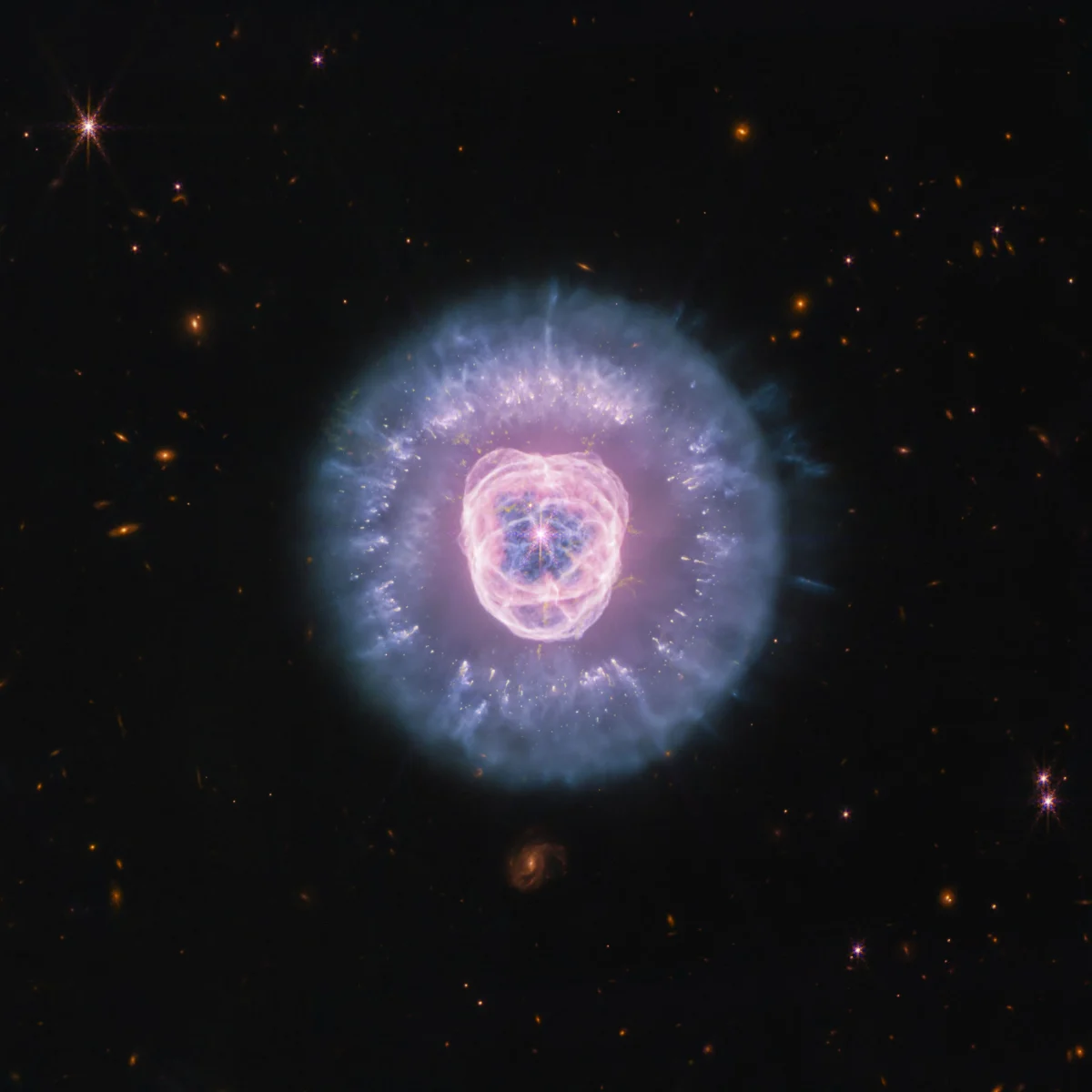
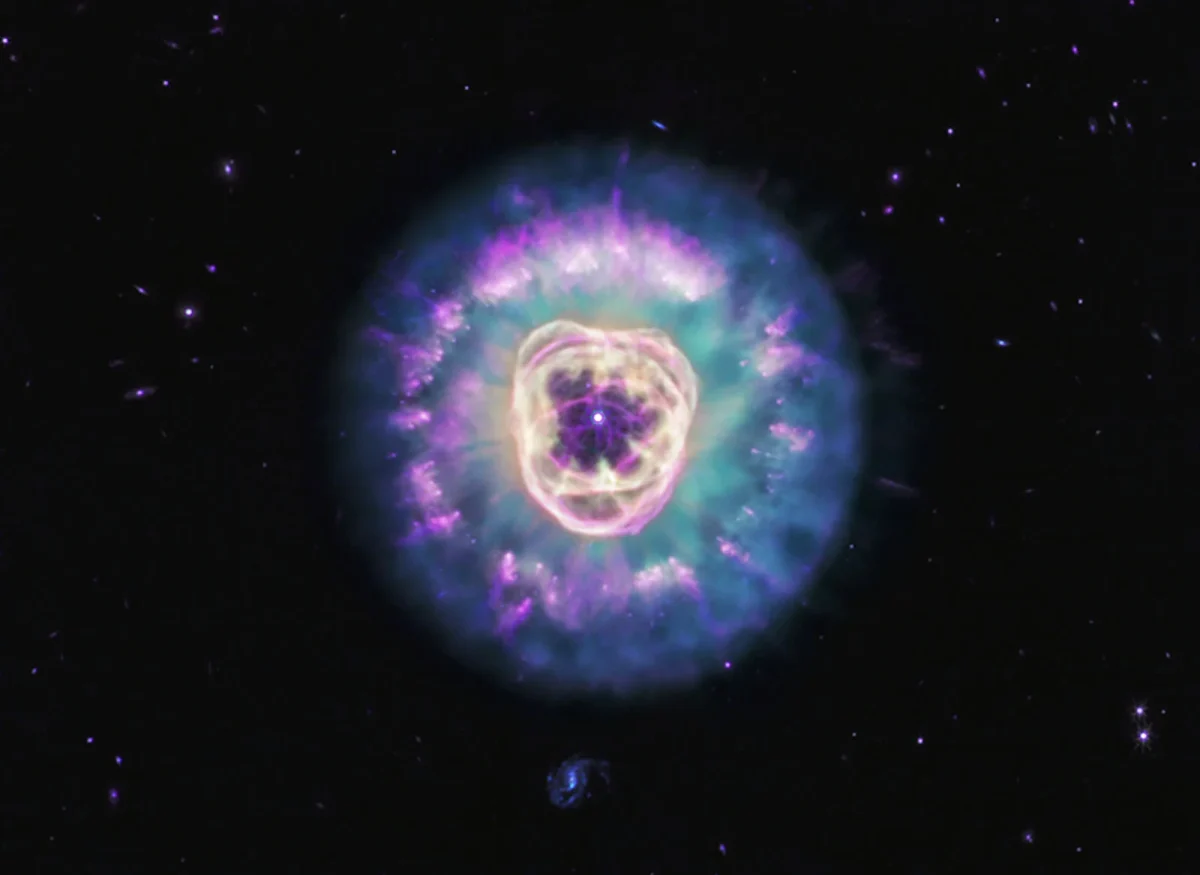
The James Webb Space Telescope has shared striking new images of the planetary nebula NGC 2392, which, because of its distinctive shape, has received the unofficial name Lion Nebula. However, the object is better known as the “Eskimo” or “Clown Face” Nebula. Thanks to advanced infrared instruments, astronomers were able to peer through dense cosmic dust and examine in detail the complex processes triggered by a dying star.
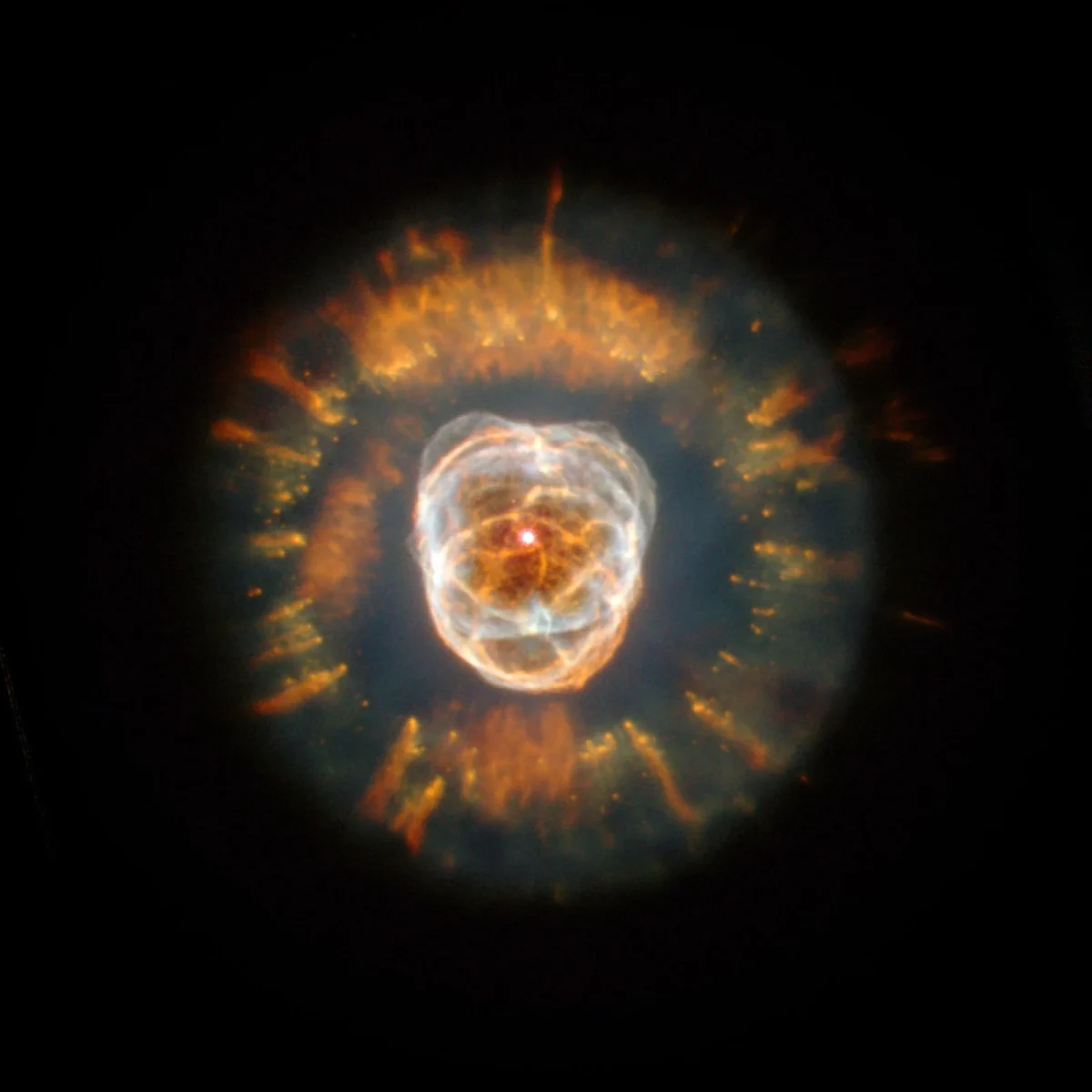
Back in 2000, the Hubble Space Telescope captured famous images of NGC 2392 in visible light. In those images, the nebula indeed resembled a lion’s face with a fluffy mane made up of structures resembling comet tails.
Today, the James Webb telescope’s high-resolution cameras — NIRCam (near-infrared) and MIRI (mid-infrared) — have made it possible to see what was previously hidden from human eyes. The new telescope’s infrared vision clearly reveals dense concentrations of cosmic dust and diffuse clouds of ionized gas. This gas-and-dust system has been evolving for several thousand years, and even now its dynamics continue to change constantly.
A Dying Star at the Very Heart
At the very center of this activity lies a tiny but extremely hot point resembling the “nose” of the cosmic beast. It is the remnant of the star — a so-called white dwarf.
How did it form? Massive stars end their lives in spectacular supernova explosions, but this phenomenon is relatively rare. Most stars in the Universe, including the one that created NGC 2392, have lower masses. When the nuclear fuel in the core of such a star is exhausted, it becomes unstable, begins to pulsate, and gradually sheds its outer layers into space. These expelled shells of gas and dust form a planetary nebula.
Despite the modest size of the remaining stellar core, its tremendous energy and intense radiation literally “heat” the nebula from within, creating an expanding bubble of ionized gas. It is this bubble that traces the recognizable contours of the lion’s face while simultaneously destroying dust in its path.
Fleeting Beauty
The nebula’s “mane” is particularly striking. It corresponds to the inner region of the dusty shell, brightly illuminated by the central white dwarf.
Within this region, structures resembling strands of fur can be seen. In reality, these are extremely dense clumps of dust that have managed to withstand the destructive radiation from the core. They act as a kind of shield, blocking radiation and protecting the material located behind them.
The image captured by the James Webb Space Telescope represents only a single moment in the long process of stellar evolution. Gas and dust continue to move rapidly away from the central stellar remnant, changing the outline of the nebula. According to astronomers’ calculations, in approximately 10,000 years, the “Lion Nebula” will completely disperse into interstellar space. By cosmic standards, this is an incredibly short period of time.
Earlier, we reported on how a three-dimensional map revealed the unexpected shape of the Ring Nebula.
According to Science Daily