

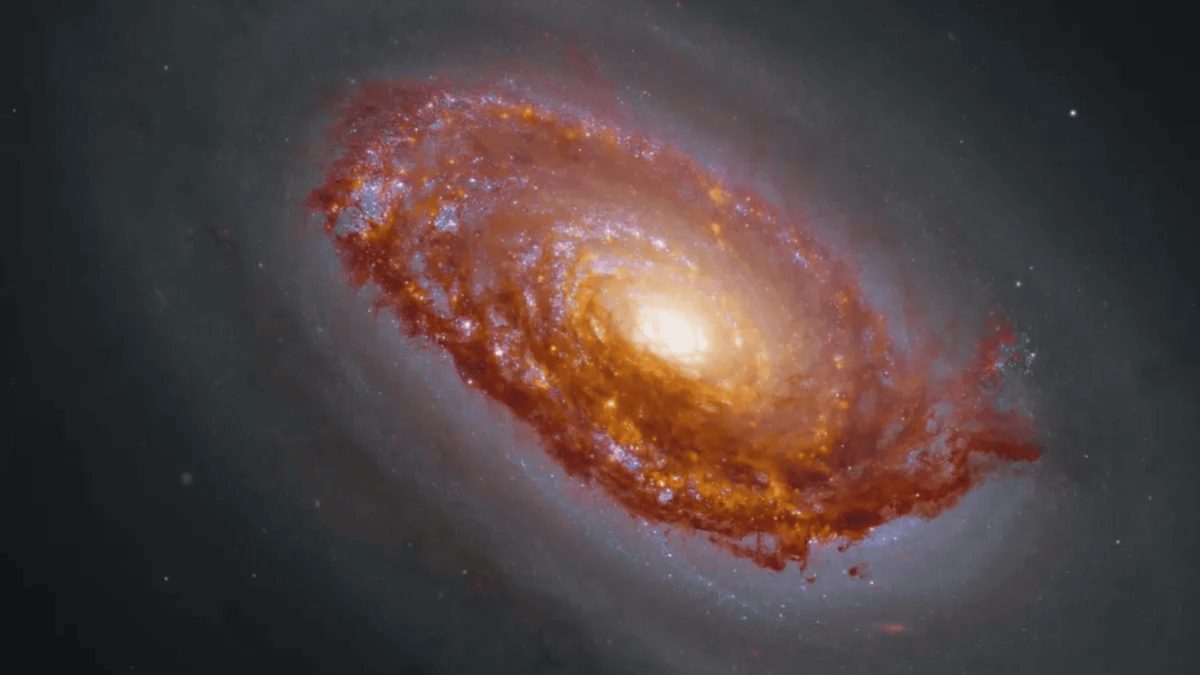
Two space observatories provided the material for a single image. It shows a spiral galaxy whose nucleus is obscured by a broad band of dark dust. Behind this dust lies the place where gas streams moving in opposite directions collide. It is there that young stars are born.
Data from Two Telescopes in One Frame
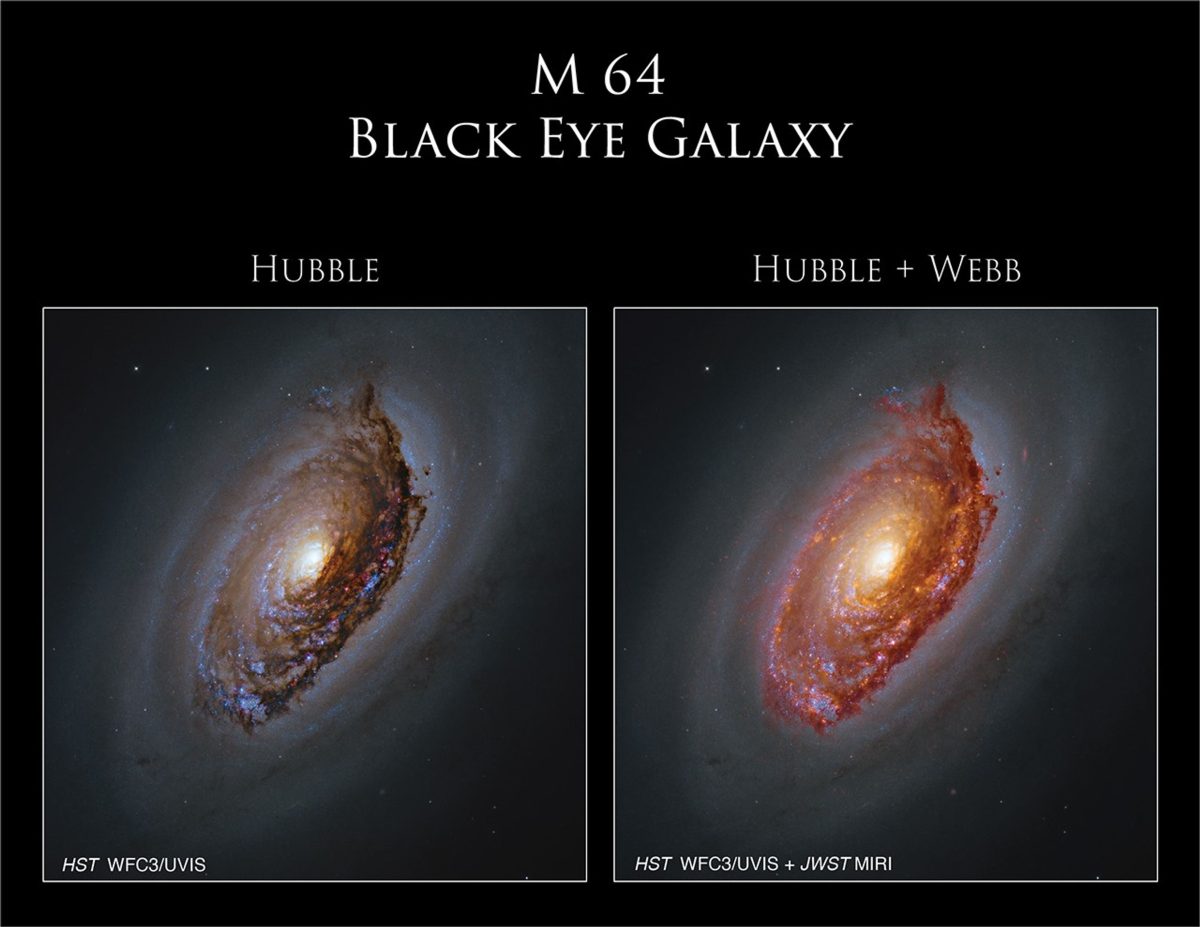
The composite image was assembled from materials obtained by two observatories. The Hubble image covers the ultraviolet, visible-light, and near-infrared ranges, while James Webb provided data in the mid-infrared.
The work was carried out not for the sake of an impressive image. Astronomers were interested in how new stars are born in nearby galaxies.
A Distant Neighbor in the Constellation Coma Berenices
The spiral galaxy M64 is known by the nicknames “Black Eye” and “Evil Eye.” Both are connected with the broad dust band that partly covers its bright nucleus.
This object is located in the constellation Coma Berenices, 17 million light-years from Earth. That is almost seven times farther away than the Andromeda Galaxy, the nearest large spiral system to us.
Opposite Rotation
The strange behavior of matter inside galaxy M64 remains the main mystery of this object. The outer layers of gas move in one direction, while the inner region together with the stars rotates in the opposite direction.
According to NASA, this may have been caused by a merger with a smaller companion more than a billion years ago. Traces of such an event are still visible, even after so much time has passed.
The Collision Zone
Where the oppositely directed gas streams meet, the matter is compressed. These dense clumps gradually lose equilibrium and give rise to young stars.
In the image, this region is marked by clusters of hot blue stars near the nucleus. Nearby are pink hydrogen clouds fluorescing under their ultraviolet radiation.
Accessible to Amateurs
This system can be seen even without professional equipment. Its apparent magnitude is 9.8, so a medium-sized telescope and dark skies away from the city will be needed.
The best time to look for it is in May. At that time, the constellation rises high enough above the horizon, and the object itself, as Space.com notes, remains a favorite target of amateur observers.