

Scientists have discovered that four white dwarfs had been hiding very close to the Solar System, no farther than 65 light-years from us. These dead stars are the second components of systems that were previously thought to be single stars. Until now, they had been hidden in the light of their companions.
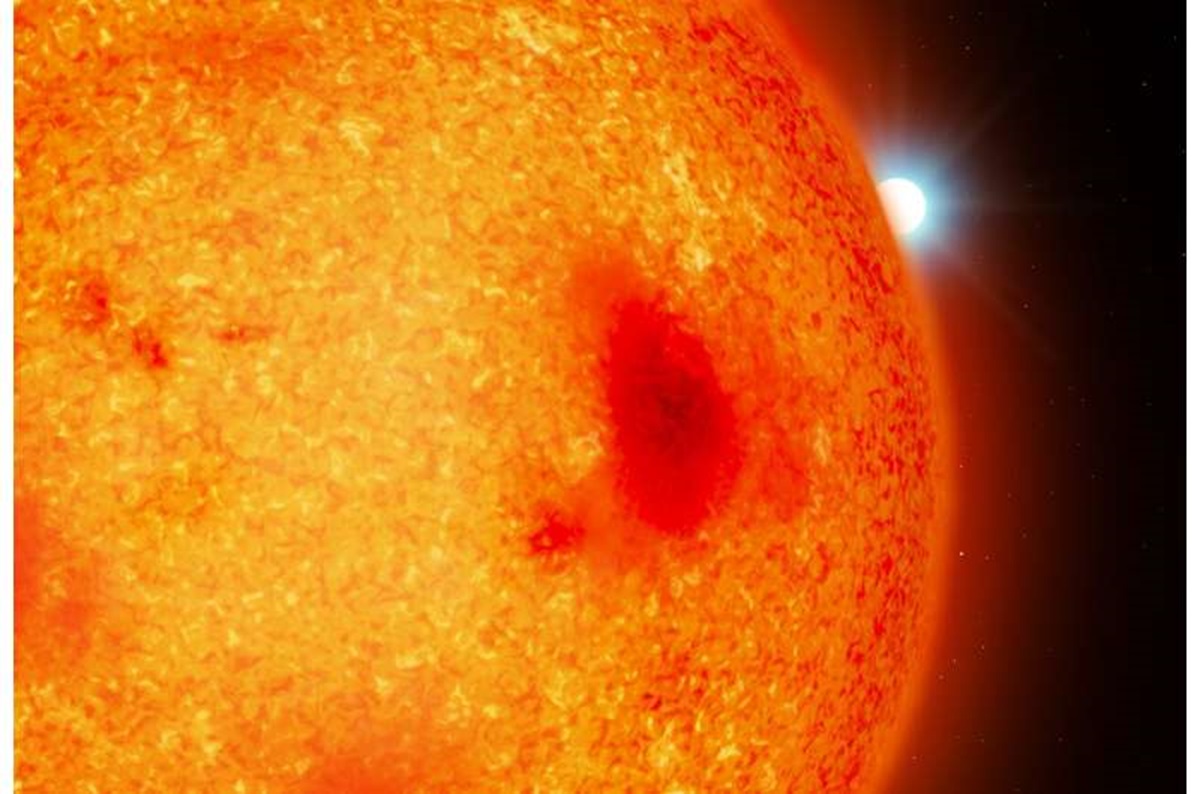
Hidden binary systems with white dwarfs
Researchers from the University of Warwick and the University of Colorado Boulder have, for the first time, directly observed four white dwarfs in binary star systems in our nearest cosmic region. All of these binary star systems are located within 65 light-years of Earth, and one of them contains the ninth-closest white dwarf to the Sun. This was reported by phys.org
Each of these four systems has a companion in the form of a red dwarf — a larger and brighter star — which makes these systems appear from the outside as if they were single-star systems. The new results, published in the journal MNRAS, show that each of these nearby red dwarfs has a hidden companion: a white dwarf.
The paper’s first author, Dr. Mairi O’Brien, a research fellow at the University of Warwick, said: “Nearby isolated white dwarfs are usually easy to find, but we could not see these four stars directly in visible wavelengths because their red-dwarf companions outshone their light. This reminds us that even in our cosmic neighborhood, we can still find surprises if we look in the right way, at the right wavelengths.”
How the hidden stars were discovered
Astronomers have been conducting detailed surveys of nearby stellar environments for decades, but white dwarfs like these have always been notoriously difficult to detect because their light is much fainter than that of their brighter companions. These four systems caught astronomers’ attention because of the star’s noticeable radial velocity changes—its periodic motion toward and away from us due to the gravitational pull of a massive but invisible companion.
Using the Hubble Space Telescope’s ultraviolet spectrograph, the team obtained detailed spectra of all four systems. White dwarfs are highly visible in the ultraviolet, but red dwarfs make them difficult to detect. Their powerful flares can produce a signal similar to white dwarf radiation. To separate these effects, the researchers used special data processing and calibration techniques that allowed them to confidently confirm the presence of four white dwarfs.
An unusual system without tidal locking
One system, G 203-47, turned out to be especially puzzling. Although it is located only 25 light-years away, it took 27 years after its radial wobble was first observed to detect its white-dwarf companion. It is now the ninth-closest white dwarf to the Sun.
G 203-47 is also unusual because its red dwarf rotates once in more than 100 days, but orbits its white dwarf every 14.9 days. Usually, gravitational forces would have brought them into tidal synchronization, as in the case of the Moon, which always faces Earth with the same side. Instead, the red dwarf rotates too slowly for this to have happened.
The scientists note: “What is interesting is that G 203-47 should not be rotating as slowly as it does if it formed in the same way as similar systems. This suggests that these binary stars had very different evolutionary histories. Some of them experienced violent and prolonged interactions early on, which led to tidal locking. Others, such as G 203-47, underwent gentler and shorter encounters, leaving them in this unusual state.”
A census of nearby dwarf systems
These four new white dwarfs allowed researchers to update the local census of white dwarfs within 20 parsecs, or 65 light-years. Importantly, population models had previously predicted the existence of about four to five close-orbiting white-dwarf and red-dwarf pairs, and the team found exactly four such pairs, matching the theoretical calculations.
Professor Pierre-Emmanuel Tremblay of the University of Warwick’s Astronomy and Astrophysics Group said: “Only about 30% of red dwarfs within 20 parsecs have been systematically searched for hidden white-dwarf companions. We believe there may be another nine or ten binary systems in our local stellar neighborhood that we have not yet discovered. If we focus on more targeted observations of red dwarfs, more surprises like these may be waiting for us.”