

American scientists have conducted the most stringent test to date of the hypothesis that ultraviolet glow in the atmospheres of giant planets may arise partly from indirect interactions between dark matter and ordinary matter.
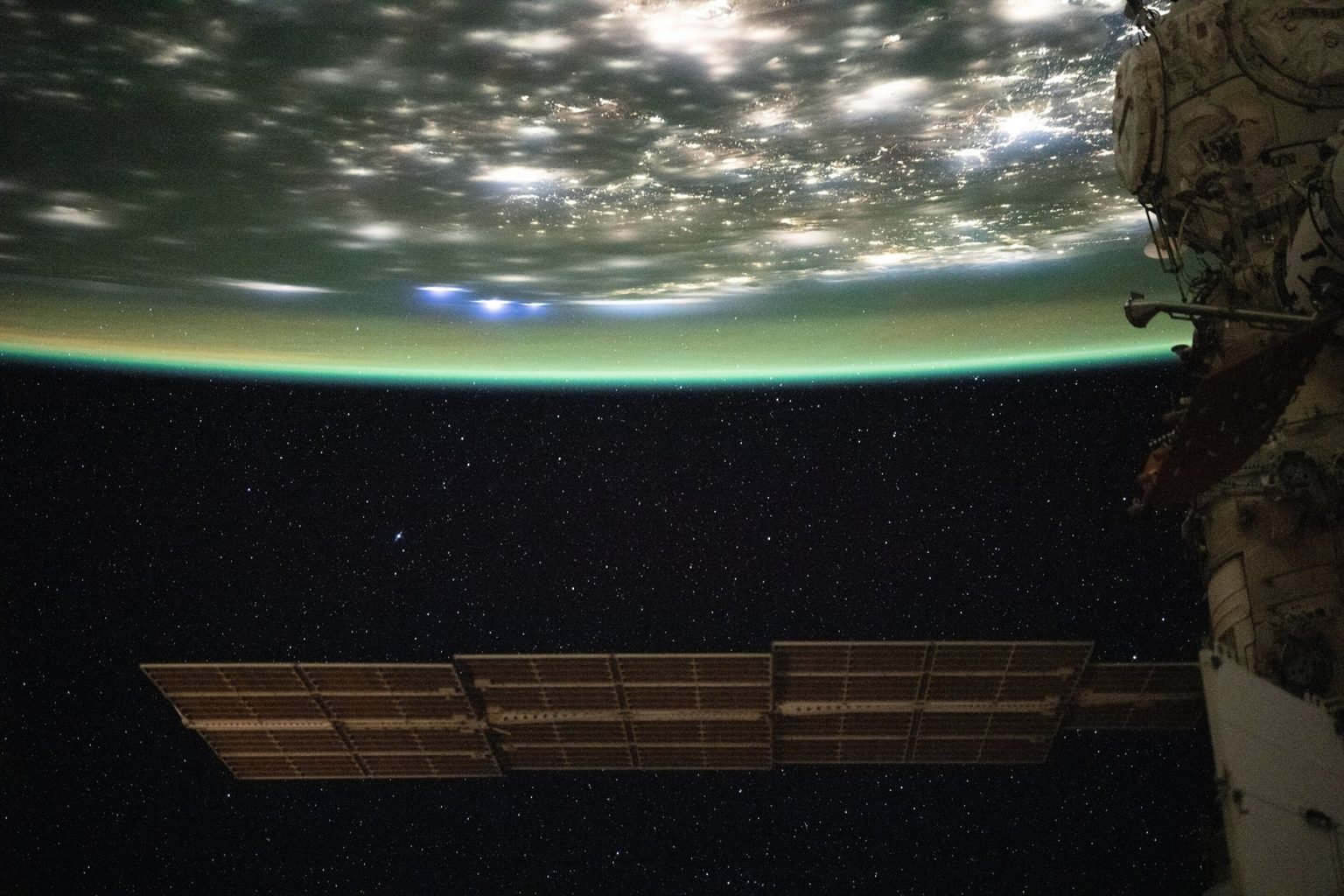
Ultraviolet Airglow in the Atmospheres of Giant Planets
The findings of a research team led by Carlos Blanco of Princeton University establish some of the strictest limits to date on the strength of interactions between dark matter and ordinary matter. The study also supports the hypothesis that the giant planets of our Solar System may be used as natural dark matter detectors. This was reported by phys.org.
When viewed through Earth’s atmosphere, the night sky is never completely dark. The upper atmosphere glows faintly all the time. One reason is the recombination of atoms and molecules ionized by solar radiation during the day. In addition, the glow is supported by chemical reactions between different components of the atmosphere.
This phenomenon, known as airglow, has been studied in detail for over a century. However, in 2024, Carlos Blanco and his colleague Rebecca Linney of the SLAC National Accelerator Laboratory hypothesized that the additional atmospheric glow could be caused by the annihilation of hypothetical dark matter particles inside giant planets.
Scientists have hypothesized that as the Solar System moves through the Milky Way’s dark matter halo, giant planets like Jupiter may capture dark matter particles with their gravity. When these particles annihilate within the planet, the energy released ionizes hydrogen molecules. Subsequent reactions produce triatomic hydrogen (H₃⁺), which emits infrared light as it transitions to lower energy states.
By comparing predictions of this infrared emission with observations of Jupiter’s upper atmosphere, Blanco and Leane established some of the first reliable constraints on whether dark matter interactions could produce a detectable atmospheric signal. However, this infrared signal depends on H₃⁺, making it much more specific to particular planetary atmospheres.
“The natural next question was whether there is a signal that works for all giant planets,” Blanco says. “The answer turned out to be ultraviolet airglow—a phenomenon people have contemplated since the time of Aristotle.”
Searching for Mysterious Radiation Produced by Dark Matter
In their latest study, Blanco, Leane, and their colleagues examined another possible consequence of dark matter annihilation. Instead of looking for infrared radiation from triatomic hydrogen (H₃⁺), the researchers tested a different mechanism. They investigated whether the energetic electrons produced during ionization could directly excite hydrogen molecules, causing them to emit ultraviolet light.
“Along with ionizing photons, ionizing electrons can also make molecular hydrogen glow in the ultraviolet—a signal we can search for on every giant planet at the same time,” Blanco explains.
Because any glow produced by dark matter would probably be overwhelmed by sunlight, the team focused on observations of the planets’ night sides. At the extremely low light levels predicted by the theory, suitable measurements are available only from spacecraft flybys. To date, such data have been provided by Voyager 1, Voyager 2, and New Horizons during their encounters with Jupiter, Saturn, Uranus, and Neptune.
Because the atmospheres of giant planets already produce faint ultraviolet nightglow through natural processes, the researchers searched for any additional emission that could be attributed to dark matter. By requiring that the predicted dark matter signal not exceed the ultraviolet light actually observed by the spacecraft, they established new constraints on the theory, obtaining some of the strictest limits to date on interactions between dark matter and ordinary matter.
Planets as Dark Matter Detectors
The team’s results strengthen the case for using the Solar System’s four giant planets as natural dark matter detectors.In particular, they can help explore regions of parameter space that are inaccessible to current underground experiments on Earth. These include very light dark matter particles and strongly interacting models, in which particles would lose energy or be completely absorbed in the atmosphere or crust before reaching ground-based detectors.
“The method is most sensitive when the mass of the dark matter particle is approximately the mass of a proton. Then it most efficiently transfers energy to hydrogen, which is the main component of the giant planets,” explains Blanco. “Due to differences in size, temperature and composition, Jupiter, Saturn, Uranus and Neptune can test different models and ranges of dark matter masses.”
At the same time, the predicted sensitivity raises new questions about the behavior of dark matter after it is captured by a planet. In particular, planetary heat may allow the lightest dark matter particles to escape before they produce an observable atmospheric signal, reducing the sensitivity of this method.
The researchers hope that many of these questions can be addressed by future missions, including ESA’s JUICE spacecraft, which is expected to enter orbit around Jupiter in 2031.
