

How did a particle of light manage to travel more than 2 billion light-years and eventually reach Earth if, according to known laws of physics, it should have been absorbed in deep space near the very beginning of its journey? Scientists Giorgio Galanti and Marco Roncadelli proposed an answer to this question in a study published in Physical Review Letters. Their work leads to the conclusion that under extreme conditions, spacetime may behave quite differently from what Albert Einstein predicted.
How Did the Powerful Photon Survive?
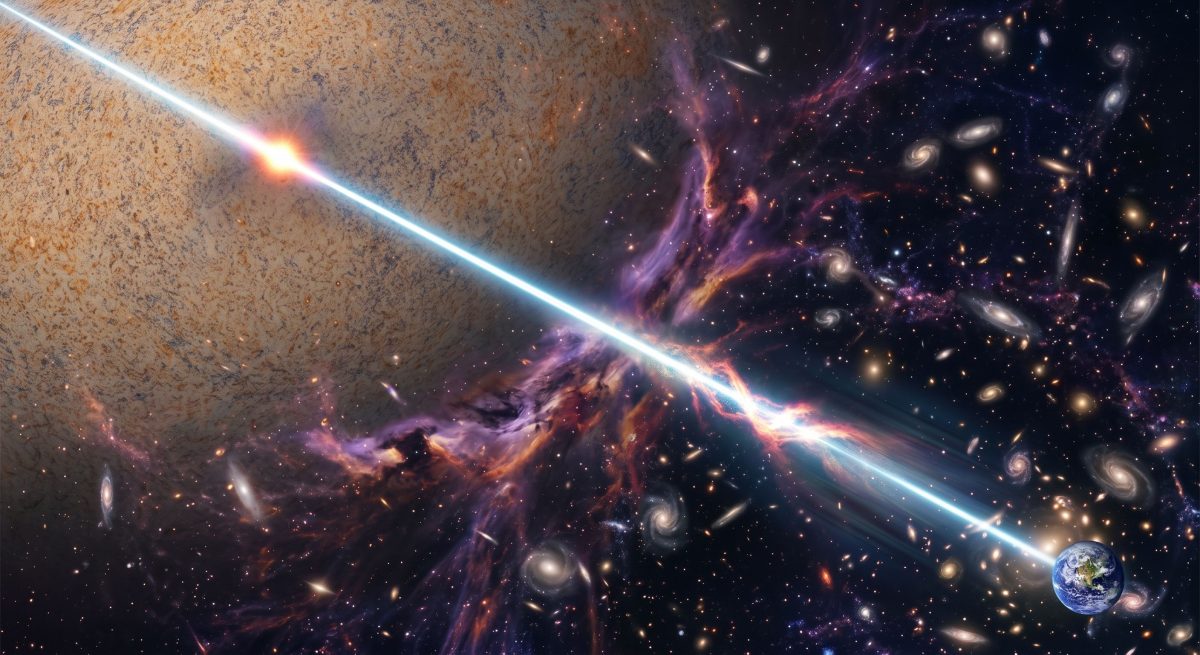
The physicists focused on the brightest gamma-ray burst ever recorded, GRB 221009A, nicknamed BOAT (Brightest Of All Time). The burst, which occurred 2 billion light-years from Earth, reached our planet on October 9, 2022, as a powerful stream of light particles. The Carpet detector at the Baksan Observatory recorded a unique photon from the burst with an enormous energy of about 300 TeV.
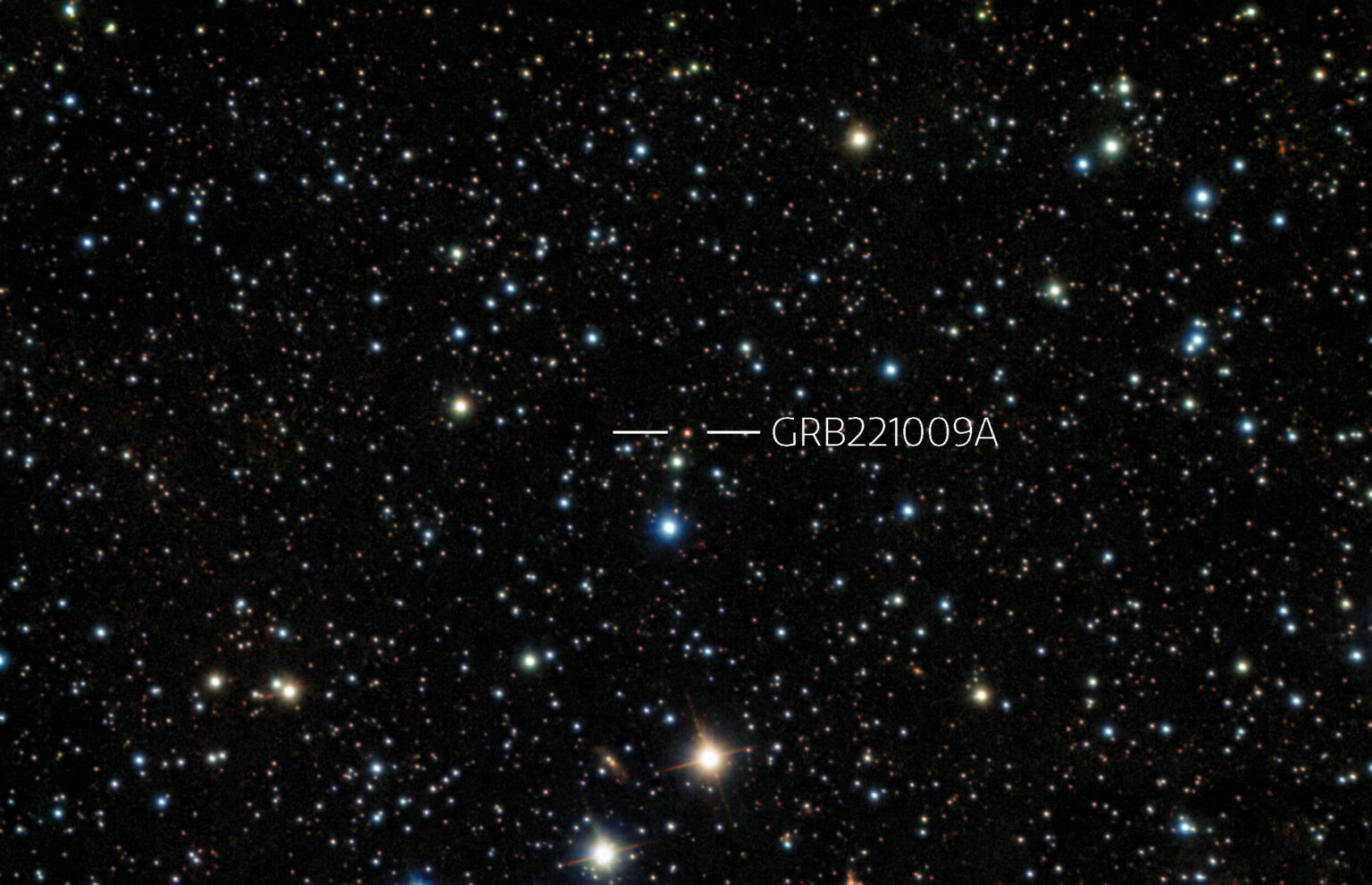
This record challenges current astrophysical models. The Universe is not empty: it is permeated by the cosmic microwave background — relic radiation left over from the Big Bang. Over a journey of 2 billion light-years, such a high-energy photon should inevitably have collided with background particles, transformed into other particles and scattered. Expecting it to survive would be like shooting an arrow through an infinitely dense forest and hoping it would not hit a single tree.
A High-Speed Lane Through Spacetime
Until now, scientists have tried to explain similar phenomena through the existence of axion-like particles (ALPs) — hypothetical ultralight particles into which photons could temporarily transform during their journey. However, the ALP model can explain energies only up to several tens of teraelectronvolts, certainly not 300 TeV.
To resolve this problem, Galanti and Roncadelli combined the ALP mechanism for the first time with the hypothesis of Lorentz invariance violation — involving one of the cornerstones of Einstein’s special theory of relativity. According to some theories of quantum gravity, at the highest energy levels this fundamental property of spacetime may change slightly.
As a result, at extreme energies the Universe becomes much more “transparent.” The photon effectively finds a “high-speed lane,” avoiding destructive interactions with background radiation.
Right on Schedule
The proposed theoretical model received another piece of support. The researchers’ calculations showed that if Lorentz invariance violation really occurs, a 300 TeV photon should be delayed and arrive at Earth approximately one hour later than lower-energy photons. A comparison with data from the Chinese LHAASO observatory confirmed that the record-breaking photon was indeed delayed by about this amount of time.
The model was able to explain two anomalous facts within a single theoretical scenario: both the survival of the particle and its delay during the journey. If future observations confirm these conclusions, space could become a vast natural laboratory for studying quantum gravity — one beyond the reach of any particle accelerator on Earth.
Previously, we reported on how photons can simultaneously exist in 37 spatial dimensions.
According to phys.org
