

SpaceX engineers have finished assembling the giant Starship rocket on the launch pad. The launch, scheduled for Monday, September 28, will be its 14th flight and, at the same time, the first one that can be considered commercial. The launch vehicle is expected to place Starlink V3 satellites into orbit.
Preparations for Starship’s Fourteenth Flight
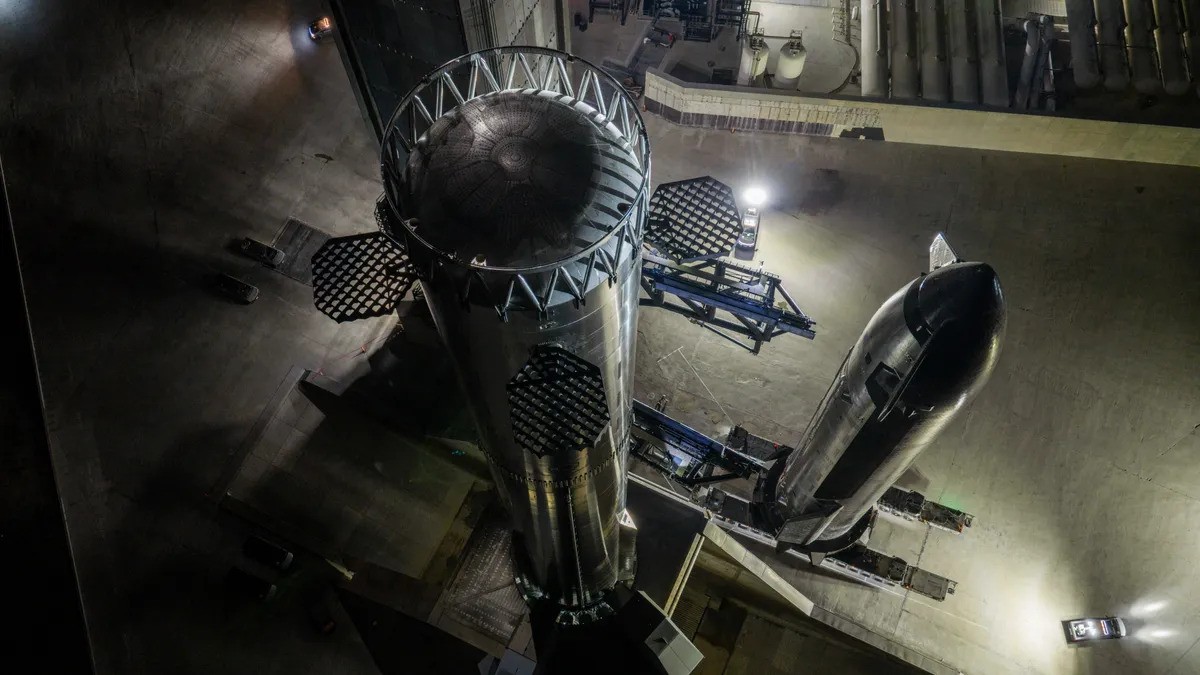
Flight No. 14 — the 14th launch of the fully integrated Starship system as part of its test program — is scheduled for a 75-minute launch window opening on September 28 at 8:15 a.m. Eastern Daylight Time (12:15 GMT). The Super Heavy first stage for Flight No. 14 — “Booster 21” — was delivered to Launch Pad 2 at the Starbase spaceport earlier this week, while its upper “Ship” stage (Ship 41) joined it on the pad during the night of Wednesday, September 23. This was reported by Space.com.
Both vehicles were installed on the launch pad in South Texas before sunrise and are now undergoing final checks before SpaceX conducts a key propellant-loading test known as a wet dress rehearsal, which is expected to take place on Thursday, September 24.
Mission Objectives
Flight No. 14 will be Starship’s first attempt to reach orbit and an important milestone for the launch vehicle, which has been under development for 10 years. If everything goes according to plan, Flight No. 14 will also include the first deployment of SpaceX’s upgraded Starlink Version 3 (V3) high-speed internet satellites. Starship had previously carried small batches of Starlink V3 satellites during earlier launches, but because those missions followed suborbital trajectories, the satellites burned up in Earth’s atmosphere instead of remaining in orbit.
Ship 41 has been loaded with 26 Starlink V3 satellites, which, if successfully deployed, will become the first members of a constellation that SpaceX CEO Elon Musk hopes to expand to more than 100,000 satellites. The larger and more powerful Starlink V3 satellites will eventually completely replace the existing Starlink network and, according to Musk, will occupy low Earth orbit alongside an even larger network of more than 1 million AI-based data-center satellites, if SpaceX receives regulatory approval.
The deployment of these first Starlink V3 satellites will depend on Starship reaching orbit — a task the rocket has not yet accomplished. Starship’s first 13 flights were intentionally conducted on suborbital trajectories while SpaceX refined the launch vehicle’s design. Like the Starlink satellites it carries, Starship itself is also at the V3 stage. SpaceX is confident that Starship V3 will be capable of accomplishing the main objectives of upcoming missions: first and foremost, reaching orbit, deploying payloads, and safely returning to Earth.
Improving the Reusable Spacecraft for Lunar Missions
Achieving much more will require overcoming several technical challenges that SpaceX has not yet solved, such as in-orbit refueling and the storage of cryogenic propellants in space. For Starship to deliver payloads beyond low Earth orbit, additional launches of Starship “tankers” will be required to replenish the main spacecraft’s fuel supplies. SpaceX will have to overcome these obstacles in the near future for Starship to become fully operational.
In addition to SpaceX’s own goal of beginning launches of the Starlink V3 megaconstellation, NASA has also contracted the spacecraft for use as a lunar lander under the Artemis program. NASA expects an orbital spacecraft capable of docking with the agency’s Orion spacecraft to be ready by mid-2027, ahead of the Artemis III mission, and a crew-certified vehicle capable of delivering astronauts to the Moon as part of Artemis IV by 2028.
If Thursday’s wet dress rehearsal proceeds without complications, SpaceX will be able to begin final preparations for Flight No. 14, scheduled for September 28, provided it receives authorization from the Federal Aviation Administration. Unlike previous suborbital flights, which lasted only about an hour, this flight is expected to last approximately 10 hours — from liftoff to Ship 41’s splashdown in the Pacific Ocean.
