

The mysterious background of very-low-frequency gravitational waves detected using pulsar networks may contain information about events that began more than 13 billion years ago — including the formation of some of the first supermassive black holes in the Universe.
Signals from the Ancient Formation of Supermassive Black Holes
As phys.org reports, in a new study published in a letter in Physical Review D, Sohan Ghodla and Cosmin Ilie of Colgate University investigate whether supermassive black holes formed in the early Universe could ultimately have produced a significant fraction of the gravitational-wave background now observed using pulsar timing arrays, or PTAs.
Their results establish a direct connection between two seemingly different observational fronts: observations of unexpectedly massive supermassive black holes in the young Universe and gravitational waves generated by binary supermassive black holes billions of years later.
Surprisingly, the researchers found that one possible population of early black hole “seeds” — black holes left behind by supermassive dark stars — could potentially explain a significant fraction of the observed PTA signal.
“Pulsar timing arrays are usually thought of as a way to study binary supermassive black holes in the relatively recent Universe,” Ilie said. “But our work shows that the signal may also contain information about how the ancestors of those black holes formed at cosmic dawn. In this sense, the gravitational waves we observe today may open a new window onto the birth of the first supermassive black holes.”
Using Pulsar Arrays to Detect Enormous Black Holes
Pulsar timing arrays use rapidly rotating neutron stars called pulsars as extremely precise cosmic clocks. Passing gravitational waves subtly alter the arrival times of radio pulses on Earth. By monitoring many pulsars over years, collaborations around the world have detected evidence of a stochastic gravitational-wave background at nanohertz frequencies.
The leading astrophysical explanation is that there is a cosmic population of supermassive black holes moving toward one another. Black holes with a combined mass greater than approximately one billion times the mass of the Sun are especially important at PTA frequencies.
But creating such gigantic black holes raises another question: where did their original “seeds” come from? Observations with observatories such as the James Webb Space Telescope and Chandra have revealed massive black holes incredibly early in cosmic history, increasing interest in mechanisms capable of rapidly producing massive black holes.
Ghodla and Ilie were interested in whether the descendants of such early “seeds” could survive, grow together with their host galaxies, eventually form binary systems, and produce the gravitational-wave background measured billions of years later.
Contribution of Dark Stars to the Gravitational-Wave Background
The researchers considered two early pathways for black hole formation: direct-collapse black holes and the collapse of supermassive dark stars.
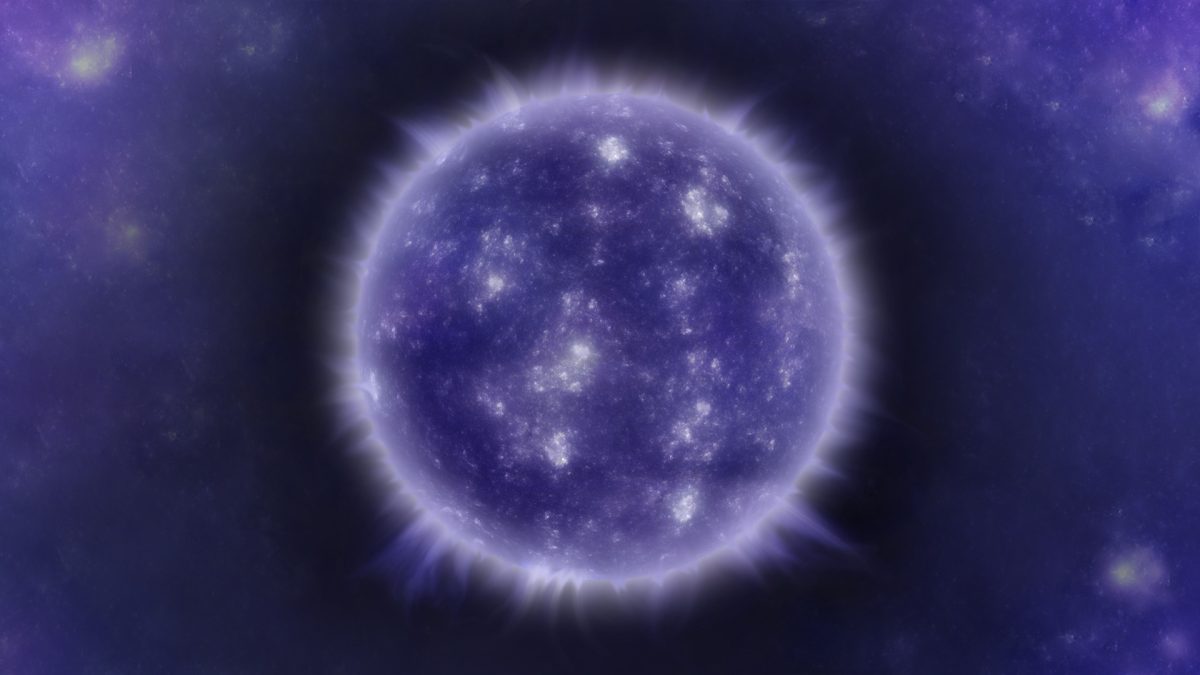
Dark stars are a proposed type of primordial star whose main energy source comes from heating by dark matter rather than ordinary nuclear fusion. In the WIMP dark-matter scenario considered in the study, dark stars can remain relatively cool and extended while continuing to accumulate matter, potentially reaching masses a million times greater than that of the Sun or even more before collapsing into massive black holes.
In this work, Ghodla and Ilie traced the cosmological evolution of black holes formed from such seeds, modeled the halos in which they reside, calculated their merger rates, and predicted the corresponding gravitational-wave background. They found that if remnants of supermassive dark stars have a density on the order of 10⁻³ Mpc⁻³, their descendants could make a significant — and possibly dominant — contribution to the PTA gravitational-wave signal.
The competing population of direct-collapse black holes considered in the study is expected to be much rarer, with characteristic densities of about 10⁻⁶ Mpc⁻³, and therefore makes a much smaller contribution.
Turning Gravitational Waves into a Census of the Early Universe
The main idea of this work is that existing PTA measurements can be used to place an upper limit on how many early supermassive black hole seeds could have existed. “If you create too many of these massive seeds, the signal detected by PTAs will be too strong. If you create too few, other sources will be needed to efficiently assemble these supermassive black holes later in cosmic history in order to match PTA observations,” Ghodla said.
For the models examined in the study, the scientists found that seed densities approximately in the range of 10⁻²–10⁻¹ Mpc⁻³ begin to exceed the measured gravitational-wave background, with the exact constraint depending strongly on the dark-matter halo masses in which these seeds formed. This means PTA observations may potentially do something unexpected: constrain populations of objects that existed at redshifts greater than 10, even though the mergers producing the gravitational waves from their descendants occur much later.
The calculation also confirms the previous result that binary systems with a combined black hole mass of approximately more than 10⁹ solar masses dominate the predicted PTA signal. Lower-mass binaries have a substantially smaller impact.
The results provide a new observational link between dark-matter physics, the formation of the first luminous objects, the origin of supermassive black holes, and gravitational-wave astronomy.
Future improvements in PTA measurements, combined with better constraints on high-redshift black hole populations and their host galaxies, could help distinguish between different scenarios for the origin of the first supermassive black holes in the Universe.
