

Humanity has never collectively decided to announce its existence to the Universe. No frequencies or greeting messages for interstellar neighbors have ever been agreed upon. Despite this, powerful radio signals have been continuously escaping from the Solar System for decades. They are a by-product of routine operations — maintaining communication with scientific spacecraft on Mars.

An analysis of data from the past 20 years, published in The Astrophysical Journal Letters by a team of researchers led by Pinchen Fan of Pennsylvania State University together with JPL specialists, demonstrates how routine command radio pulses form persistent interstellar pathways.
What Does the 77% Figure Mean?
The study’s results show that if a hypothetical observer in a distant galaxy were aligned with Earth and Mars, they would have been inside NASA’s radio beam 77% of the time between 2005 and 2024. This corresponds to approximately 9.4 months of continuous transmission per year.
This figure is not the probability that aliens intercepted the signal or even that they exist. It reflects the density of radio coverage in a particular direction. Within two arcminutes of Mars, space was illuminated by DSN radio emissions 400,000 times more often than the average across the entire sky.
Why the Radio Beam Passes Beyond Mars
NASA’s Deep Space Network (DSN) uses powerful antennas in the United States, Spain, and Australia. They focus energy into a narrow cone directed toward spacecraft. However, at the distance of the Red Planet, the beam is several arcminutes wide, while Mars itself occupies only a tiny fraction of its center.
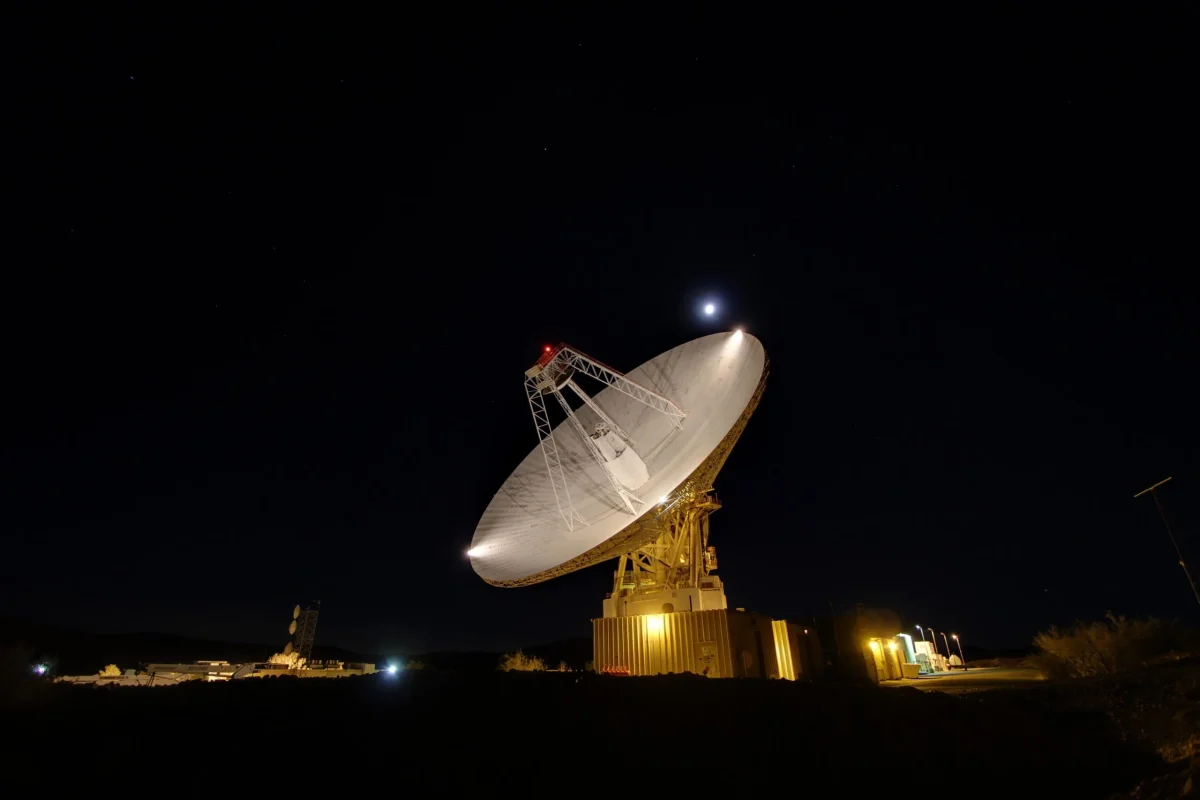
Because the dish of a rover or orbiter absorbs only a tiny fraction of the energy, the rest of the wavefront continues onward into open space. To a hypothetical observer located far beyond Mars, Earth would appear as the source of a bright radio beam aimed directly at them.
The Solar System’s Main Radio Beacon
The dominance of the Martian direction is explained by the intensity of its exploration: an entire fleet of rovers and probes operates continuously on the planet’s surface and in orbit.
In addition, the emission map highlights the flat structure of the Solar System. The researchers found that 79% of the total DSN transmission time falls within a band only 5° wide along the plane of Earth’s orbit, the ecliptic. Separate peaks in traffic were also recorded toward the L1 and L2 Lagrange points, including due to intensive data exchange with the James Webb Space Telescope.
A New Template for the Search for Extraterrestrial Intelligence
According to the authors’ estimates, a typical DSN signal could be detected using modern radio technology from a distance of up to 23 light-years (7 parsecs). Within this region lie 128 stellar systems. However, the main significance of the work is not in counting potential “listeners,” but in changing the strategy of SETI programs.
Instead of searching for deliberate interstellar messages, scientists should look for “technological leakage.” If a young civilization is actively exploring neighboring planets with probes, its transmissions would form similar narrow corridors along the orbital plane. Observing exoplanets when they align with one another offers a significantly greater chance of encountering an operational radio signal.
Quiet Infrastructure Instead of Interstellar Manifestos
The study covers only NASA data and does not include communication systems from Europe, China, or India, which means the real picture is even denser.
The scientists’ main conclusion is that the first evidence of extraterrestrial intelligence may not be a ceremonial greeting or an artificial monument, but rather monotonous, repetitive infrastructure — ordinary commands sent to robots that continue traveling into the darkness of the Universe.
According to Space Daily
