

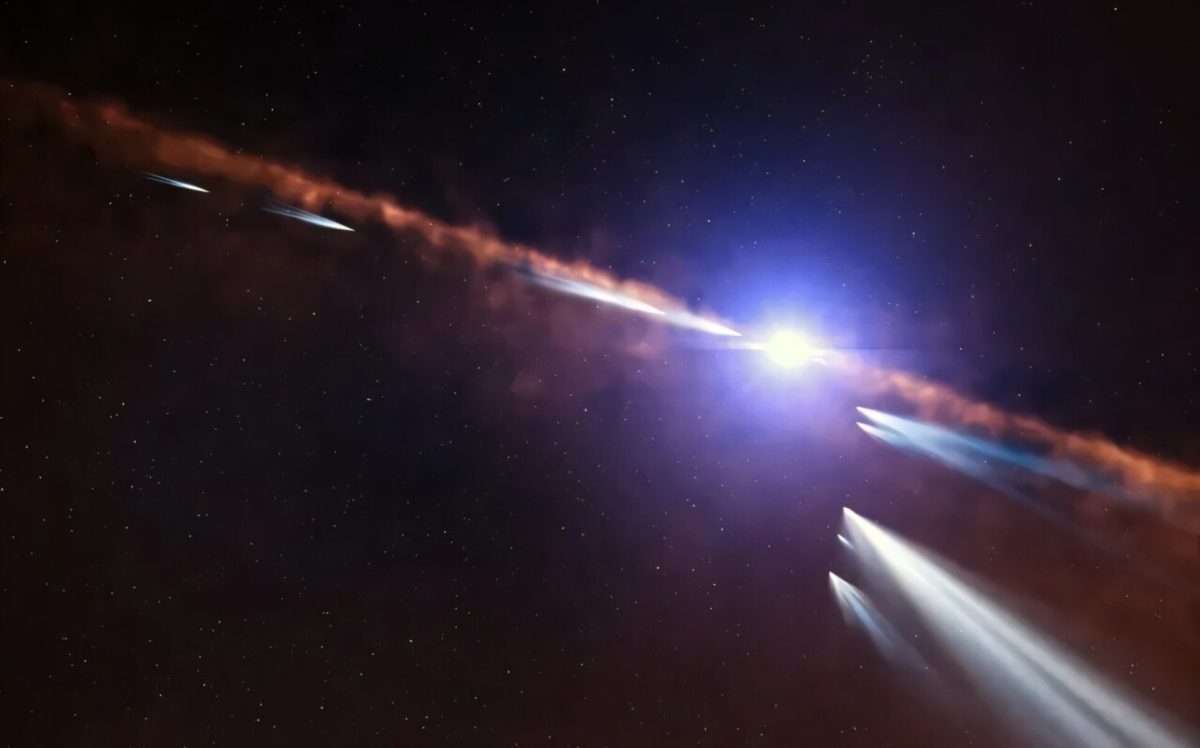
Signs of comets have been observed around a young, Sun-like star. These indications were evidenced by variations in the quantity of gaseous sodium in the vicinity of the star, which recurred over multiple nights. This signature results from ice sublimating near the star. Such icy bodies may have played a role in transporting water to the inner regions of the system, where planetary formation occurs.
A system that is five million years old
The PDS 70 planetary system is situated approximately 370 light-years from Earth, with an age of just over five million years. The system hosts at least two gas giants orbiting the central star, which is marginally cooler than the Sun.
Water vapor was detected proximate to this star as early as 2023. According to phys.org, astronomers from Lund University have now demonstrated that variations in the quantity of gaseous sodium in front of the star may serve as indicators of comets traversing the inner regions of the system.
A signal in sodium gas
In the 2018 observational data, researchers identified sodium moving at a velocity of several kilometers per second relative to the central star. The signal manifested and subsequently disappeared over multiple nights — a pattern anticipated during the passage of a comet in front of a star. As the comet approaches, the surface of the icy body undergoes heating. The ice sublimates directly into gas, circumventing the liquid phase. This process is known as sublimation, and the evaporated material produces a detectable signature in the spectrum.
The researchers emphasize two notable aspects of the discovery. “This marks the first occasion on which evidence of exocomets has been observed around a relatively cool star that closely resembles our Sun. Additionally, this system is the youngest among those wherein cometary activity is hypothesized,” states Aline Novais, the primary author of the study and an astronomy researcher at Lund University.
The role of the gas giants
The study’s findings were published in the peer-reviewed journal Nature Communications. Separately, the team modeled the orbits of the icy bodies.
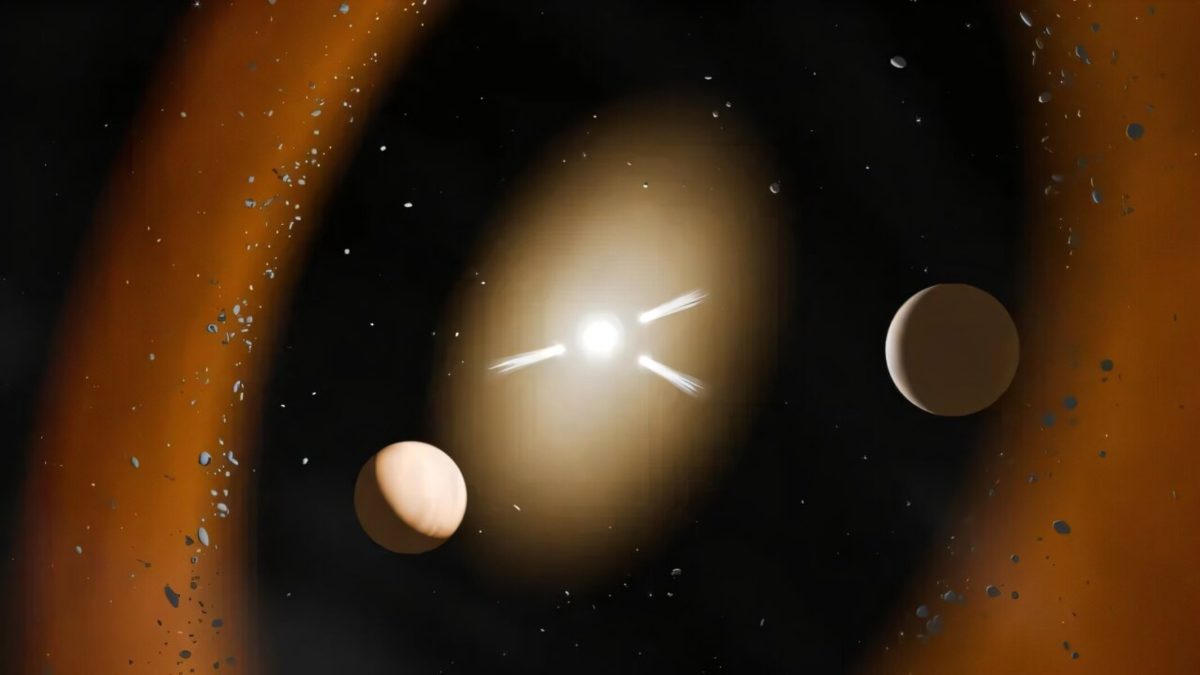
Calculations indicate that objects located in the distant outer regions may be subject to the gravitational influence of gas giants, which propel them toward the star. Comets originate in the cold outer regions, where water can exist as ice. If they are directed inward, water and other volatile substances are transported with them into the planet-forming region.
A comparable situation is currently under consideration for our own solar system. “This resembles a possible process in the early solar system, where comets may have helped deliver water to the young Earth,” observes Alexandra Stockwell Murphy, an astronomer affiliated with the same university.
Search for exocomets in Ukraine
Research concerning exocomets is also underway in Ukraine. Daria Dobrycheva and Maksym Vasylenko, affiliated with the Main Astronomical Observatory of the National Academy of Sciences of Ukraine, in collaboration with the Department of Substellar and Planetary Systems Physics, have applied machine learning to this field of study; however, they have utilized a different category of data.
Their methodology relies on analyzing light curves, given that the comet’s tail results in an asymmetric decline in the star’s luminosity, in contrast to the symmetrical transit characteristic of planets. The research team verified the existence of an exocomet within the Beta Pictoris system, and team leader Yakiv Pavlenko finalized the revisions prior to publication.
The origin of water on Earth
The origin of water on Earth remains a mystery. Among the possible sources are water-rich asteroids and comets, and PDS 70 offers an opportunity to observe a similar process while the planetary system is still in its early stages of development.
Researchers aim to gain further insights into the system through a new instrument presently under development in Chile. “When the Extremely Large Telescope commences operations, we will be able to ascertain the existence of additional planets within the system and obtain a more precise understanding of the mechanisms by which water and other fundamental components of planets are conveyed,” concludes astronomy researcher Jens Huymaekers.
