

Blue Origin has finally revealed the cause of the massive explosion that turned its New Glenn rocket into a giant fireball above the launch pad at Cape Canaveral in May. The catastrophic “anomaly,” as the company cautiously described it, occurred during prelaunch static-fire testing. It not only sent shares of space companies tumbling but also threatened NASA’s ambitious Artemis schedule for returning astronauts to the Moon.

However, Blue Origin CEO Dave Limp shared encouraging news. Engineers have identified the failure precisely. Fortunately, it requires a relatively quick fix. The only complication is that the problem is connected to the reusable BE-4 rocket engines. This means the repercussions of the accident could also affect future launches of United Launch Alliance’s Vulcan Centaur rocket. ULA is a joint venture between Lockheed Martin and Boeing.
What Went Wrong?
Wanted to give an update on the hotfire anomaly investigation. Progress continues. The anomaly originated at the main oxygen valve on one of the BE-4 engines, which was later confirmed by hardware recovery and inspections. Extensive component-level and engine hotfire tests have…
— Dave Limp (@davill) August 5, 2026
“The anomaly occurred in the main oxygen valve of one of the BE-4 engines, which was later confirmed during inspection of the surviving hardware,” Limp said. According to him, specialists conducted extensive static-fire testing of engines and components to understand the failure mechanism and develop appropriate safety measures.
A solution has already been identified. The company is making minor modifications to the valve design that can be installed quickly and easily on existing units.
Rebuilding the Launch Pad
The New Glenn explosion caused serious damage to Launch Complex LC-36A. The site had undergone a major reconstruction for nearly a decade after Blue Origin leased it in 2015. The restored complex had been operational for only about 18 months, having opened for New Glenn’s inaugural launch in January 2025.

After the accident, the company’s main efforts focused on bringing LC-36A back into operation as quickly as possible. The launch tower was preserved, while the enormous 900,000-kilogram launch table was dismantled for inspection. In parallel with repairing the damage and upgrading the infrastructure, the technical team is completing its investigation. Blue Origin has set an ambitious goal of preparing New Glenn to fly again by the end of this year.
A Chain Reaction
BE-4 engines are the “heart” of the first stage of the partially reusable New Glenn rocket. However, two of these engines are also installed on every Vulcan rocket. ULA representatives said they are working with Blue Origin as part of the investigation but have not yet commented on how the incident may affect their launch schedule.
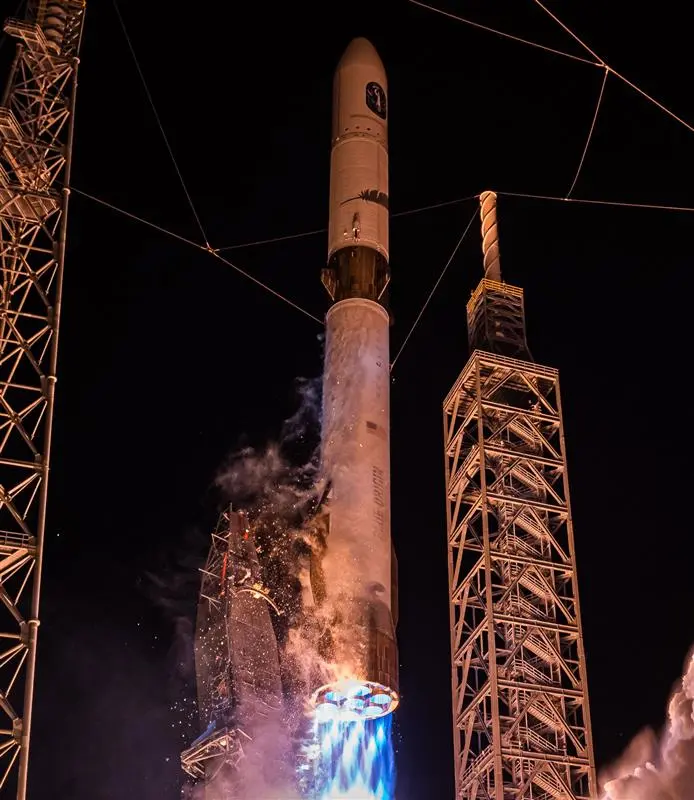
It should be noted that Vulcan has also faced problems of its own. In February, during a mission to place a U.S. Space Force satellite into geosynchronous orbit, the rocket lost one of the nozzles from a solid rocket booster. Although the mission was completed successfully, Vulcan has not flown since. Northrop Grumman, which supplies the GEM 63XL motors for these boosters, said it was implementing “corrective actions” and plans to introduce an updated version of the motor by the end of the year. Despite the difficulties, the space industry as a whole appears to remain optimistic and is preparing to resume large-scale launch operations.
We previously reported on how Blue Origin demonstrated the technology for vertically landing the New Glenn rocket.
According to Gizmodo
