

You do not necessarily need your own observing time on a large telescope to discover something new in astronomy. Sometimes it is enough to carefully review images that are already available in a public archive. That is how a researcher from Costa Rica noticed an unusually elongated streak of light that no one had described before. According to preliminary estimates, the light from this galaxy has been traveling toward us since almost the very beginning of the Universe.
A Trace in a Galaxy Cluster
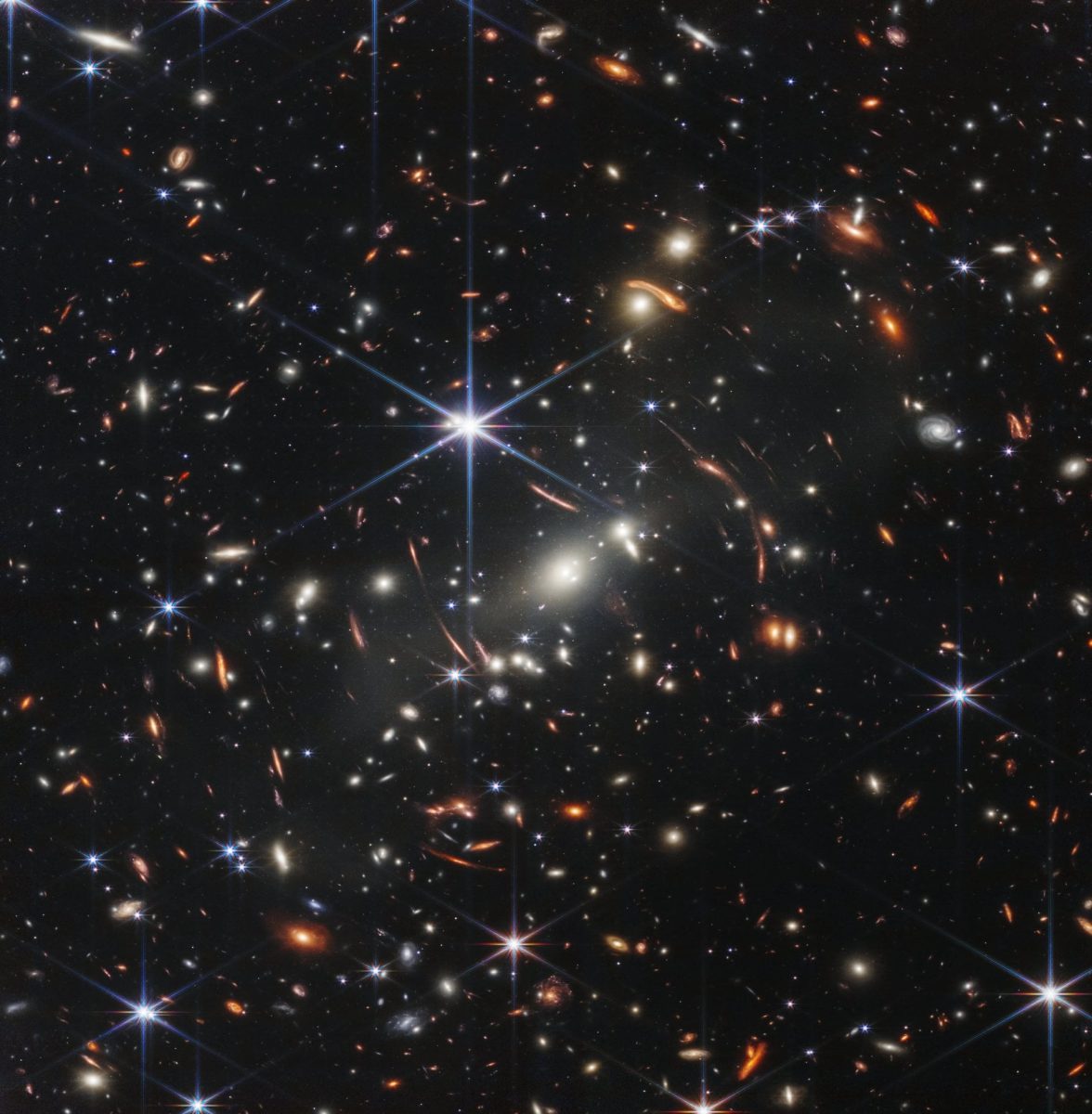
The object was designated A1 and appears in the images as a thin, curved streak near the edge of the cluster MACS J0308.9+2645, one of the most massive clusters identified using data from the Planck space observatory. This is how distant galaxies can appear when their light is distorted by gravitational lensing.
The enormous mass of the cluster warps the space around it, causing light passing nearby to deviate from a straight path. An object located behind the cluster therefore appears stretched while also becoming brighter than it would otherwise be. In the case of A1, the magnification reaches approximately seven times, according to a preprint submitted to the journal Publications of the Astronomical Society of Japan.
Two Candidates Out of Sixteen Hundred
Astrophysicist Homer Dávila Gutiérrez examined 54 fields imaged with NIRCam and ran nearly 1,600 elongated sources through his own selection process. Most were rejected immediately because ordinary galaxies seen edge-on can also meet the initial criteria.
Only two objects reached the final stage, and both were located in the same cluster. The second, fainter object remains uncertain for now, Universe Today reports. Neither object appears in the previous catalog of lensed images of this cluster or in three major astronomical databases.
The Power of a Public Archive
The images in which A1 was found had originally been taken for an entirely different purpose. A scientific team was observing a known distant galaxy in this region, while the rest of the camera’s field of view was simply recorded along with it.
After the data became publicly available, they were accessed by an independent researcher who had no connection with the original observing program. The researcher runs the Spanish-language astronomy resource skycr.org and, after making the discovery, contacted the authors of the observing program, who confirmed that the object had not previously been described.
The James Webb archive is growing faster than astronomers can analyze it. The discovery shows that previously released datasets still contain undescribed objects.
What Comes Next
For now, A1 remains a candidate. The curvature of the streak and its orientation point toward gravitational lensing, but a definitive answer will only come from spectroscopic observations, which can be used to determine the distance directly.
It usually takes years for such a candidate to be confirmed, because observations of this kind require a separate application for telescope time, and demand for observing hours is always many times greater than the available time. The study has not yet undergone formal peer review.
