

The white dwarf SDSS J0608−0059 is part of a wide binary star system and ranks among the most massive white dwarfs known. Researchers have found that its properties are better explained by the presence of a rare oxygen-neon core and have examined what this could mean for its future evolution.
A Rare White Dwarf
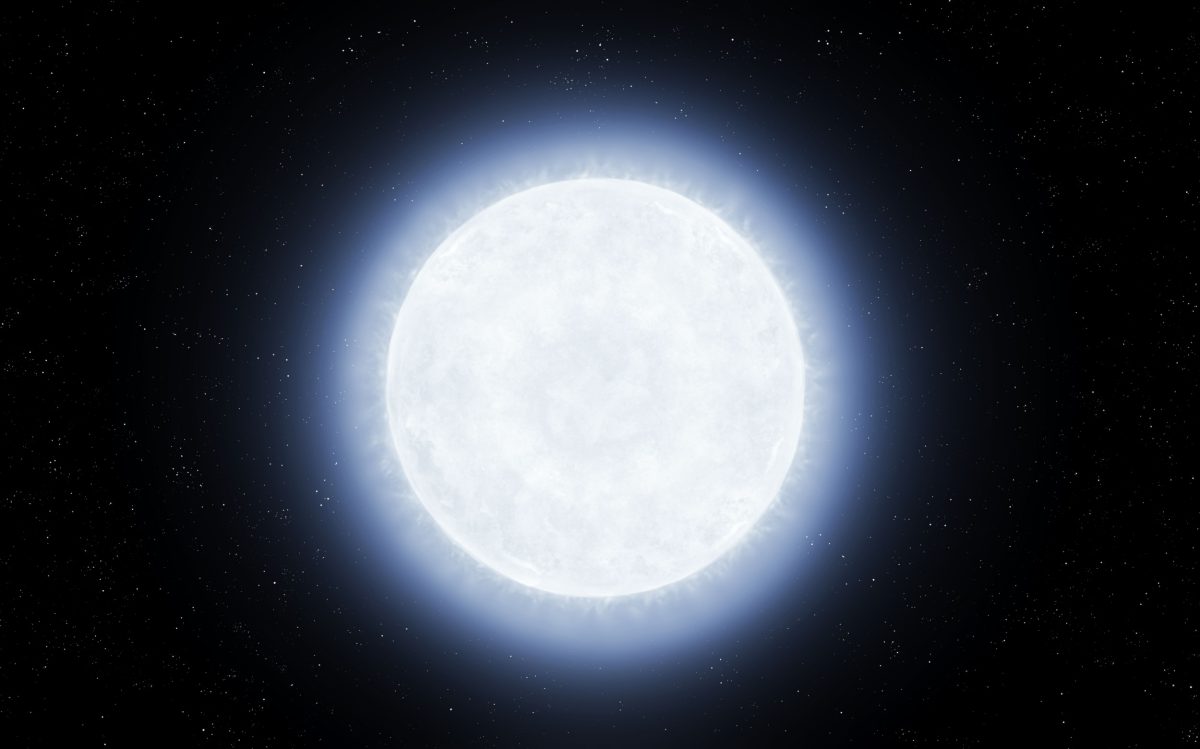
As phys.org reports, The Astrophysical Journal has published a paper devoted to the chemical composition of the white dwarf SDSS J060851.44-005950.3, also known as SDSS J0608−0059. The authors concluded that its internal structure probably differs from that of a typical white dwarf: instead of the common carbon-oxygen core, it most likely has an oxygen-neon one.
It is worth explaining that white dwarfs are compact remnants of stars that shed their outer layers at the end of their lives. Most form from stars whose initial masses were approximately 0.8 to 8 times the mass of the Sun. A white dwarf is usually smaller than Earth, while still having a mass comparable to that of the Sun. A typical white dwarf has a mass of about 0.6 solar masses, and its core consists mainly of carbon and oxygen.
More massive white dwarfs with oxygen-neon cores are much rarer. They are thought to form from progenitor stars with masses of roughly 8–10 solar masses. In such stars, the core reaches higher temperatures and densities, allowing carbon burning to begin after a carbon-oxygen core has formed. This process produces oxygen and neon.
How Massive Is the White Dwarf?
SDSS J0608−0059 has a main-sequence companion star located about 2,684 astronomical units away. Such a wide binary system proved extremely useful to researchers. To determine the mass and radius of the white dwarf, they used gravitational redshift—the shift of spectral lines caused by the strong gravitational field of a compact object. The more massive and compact a white dwarf is, the more strongly its gravity changes the wavelength of the light.
By combining gravitational redshift measurements with photometric data and modeling, the researchers determined that SDSS J0608−0059 has a mass of approximately 1.226 solar masses and a radius of about half that of Earth. In other words, it is roughly twice as small as Earth in size, yet contains more than one solar mass of material.
The measured parameters were then compared with theoretical models of white dwarfs with different core compositions. The result was more consistent with an oxygen-neon core model than with a carbon-oxygen one. However, this is not yet definitive proof. The authors note that future observations may help confirm or refute this conclusion.
The researchers also examined an alternative possibility in which the white dwarf’s unusually high mass could have resulted from the merger of two smaller white dwarfs. However, its ordinary Galactic velocity, the absence of a strong magnetic field, and its presence in a wide binary system are more consistent with a standard stellar-evolution scenario than with a recent merger.
