

Methanol in which all hydrogen atoms have been replaced by heavy hydrogen—deuterium—has been detected near a protostar in the constellation Perseus. This organic compound is far more abundant there than current chemical models allow. The models appear to be missing a process that forms organic substances even before stars and planets emerge.
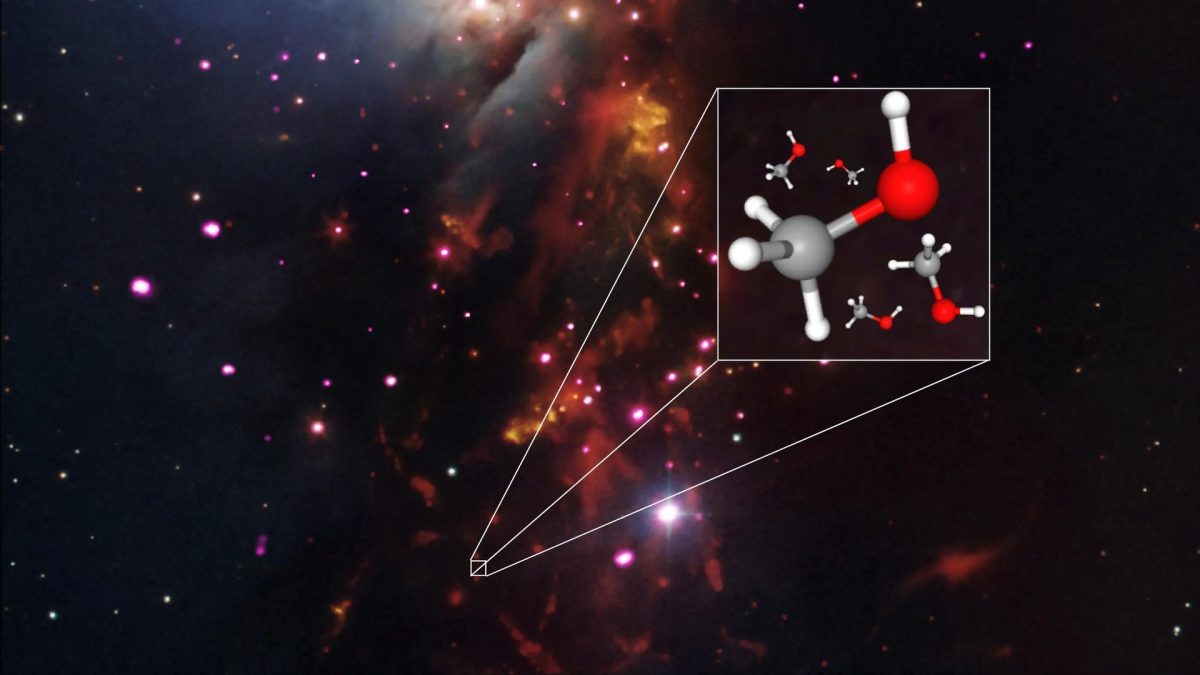
Four Heavy Atoms
Methanol, also known as wood alcohol, contains four hydrogen atoms. In its fully deuterated form, all four are replaced by deuterium, an isotope of hydrogen with an additional neutron in its nucleus. Such methanol has long been synthesized in laboratories on Earth, but no molecule containing four deuterium atoms had previously been detected in interstellar space.
Deuterium is rare: in the Galaxy, there are more than 60,000 ordinary hydrogen atoms for every deuterium atom. Near the protostar IRAS4A2, however, one in every 2,500 methanol molecules is fully deuterated.
The protostar IRAS4A2 belongs to a binary system in the NGC 1333 molecular cloud, approximately 950 light-years from Earth. It was observed with the Atacama Large Millimeter/submillimeter Array (ALMA) alongside ten other low-mass protostars. The results were published in the peer-reviewed journal Astronomy & Astrophysics.
How Methanol Forms
Methanol forms in cold clouds of gas and dust at temperatures of around 10 kelvins. Carbon monoxide molecules freeze onto dust grains, and hydrogen atoms attach to them one at a time.
At such low temperatures, reactions transfer deuterium from molecular hydrogen to other molecules, while the reverse reactions lack sufficient energy. The proportion of deuterium in a molecule therefore indicates the conditions under which it formed. Study co-author Silvia Spezzano of the Max Planck Institute for Extraterrestrial Physics, quoted by Universe Today, explains that this makes it possible to trace the journey of complex molecules from interstellar clouds to planets.
When a protostar begins to shine, it heats its surroundings to approximately 200 kelvins. The ice evaporates, and radio telescopes detect the radiation emitted by the molecules.
A Discrepancy with the Models
In almost every protostar where partially deuterated methanol has been found, molecules containing two or three deuterium atoms have proved more abundant than expected from the number containing just one. If deuterium were incorporated into methanol randomly, the proportions would be different.
Chemical models predict that methanol containing two or three deuterium atoms should be tens or hundreds of times less abundant than observations show. For fully deuterated methanol, the discrepancy is even greater, reaching approximately a hundred thousandfold in one model. According to the authors, led by Arnaud Belloche of the Max Planck Institute for Radio Astronomy, the models appear to be missing a key process. Exactly what that process is remains unknown.
The Contribution of Kharkiv Researchers
But how can a molecule be identified from nearly a thousand light-years away? Researchers must know in advance the frequencies at which it emits radiation. In 2023, an international team led by Vadim Ilyushin of the Institute of Radio Astronomy of the National Academy of Sciences of Ukraine measured the spectrum of fully deuterated methanol. The frequencies within ALMA’s observing range were measured in the institute’s laboratory in Kharkiv. Ilyushin also led work on the data for two other deuterated forms of methanol used in the study.
Unidentified lines remain in the spectrum of IRAS4A2 that may come from forms of methanol containing two and three deuterium atoms. Once laboratory data become available for them, the authors expect to identify both molecules easily.
